South African mining collapse from number one in the world to among the worst


South Africa’s reputation as a mining jurisdiction has collapsed from being the most attractive in the world to being among the top ten worst places for mining companies to operate.
The mining sector has been hamstrung by constantly changing legislation and regulations and the constant threat of nationalisation.
This has resulted in investment in opening new mines, expanding existing ones, and exploration plummeting, leaving South Africa with 6,152 abandoned mines that have become hotspots for crime.
Operating a mine in South Africa presents massive challenges, including volatile labour relations, disputes with surrounding communities, and organised crime.
The industry is also hamstrung by regulatory uncertainty, unreasonable delays in processing applications and infrastructure bottlenecks.
The Fraser Institute, based in Canada, conducts an annual survey on the attractiveness of different countries as mining jurisdictions. These days, South Africa ranks among the ten least attractive mining destinations.
The financial ecosystem that supported junior miners in years gone by has also largely disappeared.
Local investors have limited appetite for supporting early-stage mining companies, and global investors have little appetite for investments in South Africa.
Little exploration is done despite geologists estimating that a rich natural bounty remains.
Mining analyst Peter Major at Modern Corporate Solutions recently explained to 702 why the country’s mining industry has collapsed in the past few decades.
“The simplest explanation is that you had an established mining law and protocol system on how to develop and run mines and who owned them,” Major said.
“That had been built up over 150 years and was working pretty well. It made us the number one mining country on the planet.”
Once the backbone of the local economy, South Africa’s mining output has steadily declined since the 1990s by around 0.4% annually, with gold, in particular, falling off a cliff and declining by 85%.

South Africa’s position as the world’s number one mining jurisdiction changed swiftly when the ANC came to power and began calling for the nationalisation of mines.
These calls were also coupled with increasingly severe Black Economic Empowerment (BEE) requirements.
“When the new administration took over, it decided to try to totally revamp mining law in South Africa and copy what other African nations did,” Major said.
“It said, ‘We will nationalise these mines and take them back. They are no longer private property but are the state’s property.’”
“You can imagine. You put billions into projects for 100 years and are now threatened with state ownership. New investment just stopped. Exploration and expansion just stopped. Why put money in something the state owns?”
“They were also changing legislation non-stop. You first had to have a BEE partner that owned 25%, and that quickly increased to 30%. And then, they said 70% of the money you spend had to go to BEE suppliers.”
“As if nationalising property was not enough, they put on all these horrendous conditions that drove capital away,” Major said.
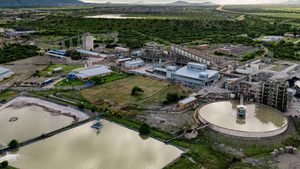
As a result, South Africa now has 6,152 abandoned mines for which the state is theoretically responsible, but it does not have the resources or skills to manage them.
“The ANC did not realise the consequences of their actions. They are now abandoned mines that could have been generating billions of dollars for the local economy if things were just left the way they were.”

Peter Major’s sentiment closely echoes that of Old Mutual Wealth investment strategist Izak Odendaal, who used BHP’s failed bid for Anglo American as emblematic of mining’s decline in South Africa.
BHP’s bid for Anglo pointedly excludes Anglo’s South African iron ore and platinum operations. Some analysts say this is because BHP was primarily focused on Anglo’s copper assets in Chile and Peru.
However, it is hard to escape the fact that South Africa is viewed as an unattractive mining country.
The challenges are massive, including volatile labour relations, disputes with surrounding communities, organised crime, regulatory uncertainty, unreasonable delays in processing applications and infrastructure bottlenecks.
In recent years, the decline has been smoothed over by a commodity boom following supply shocks during the Covid-19 pandemic.
This raised prices, masking the declining output by increasing the value of the commodities sold.
However, the boom is over, and a near-perfect storm of load-shedding, logistical inefficiencies, declining prices, and poor labour relations have hit the mining industry and accelerated its decline.
This has led many to discuss the need to restructure their unprofitable operations in South Africa.
Some miners have already begun restructuring their operations, potentially impacting between 4,000 and 7,000 jobs in South Africa.
PGM miners and others have also cut their production to reduce costs and because they cannot export their commodities due to deteriorating rail infrastructure and port backlogs.
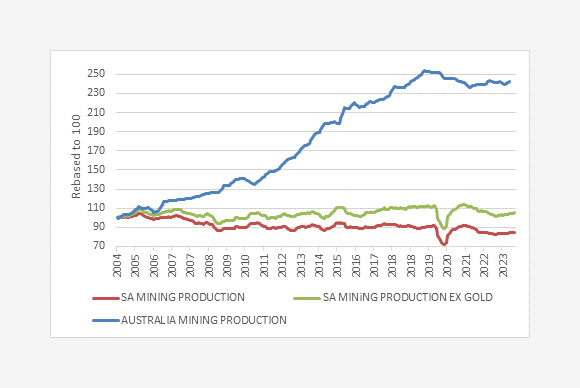
The evidence is in the form of mining production – the volume of stuff pulled out of the ground – that has declined over the past 20 years.
Excluding gold, which is largely mined out, makes the picture somewhat better, but not much.
In contrast, Australia, not facing the same physical and institutional bottlenecks as on this side of the Indian Ocean, has managed to steadily double output over this period.
This contrast is shown in the graph below.



Comments