South African taxpayer shocker


The government has significantly increased expenditure and debt over the last decade, which puts tremendous pressure on already overburdened South African taxpayers.
To understand the increased pressure on South African taxpayers, it is important to turn back the clock thirty years.
In 1994, South Africa had a national unemployment rate of 20%, and the state paid grants to around 2.5 million people.
Fast-forward to 2024, South Africa’s unemployment rate has increased to 34%, and the government pays grants to 28 million people.
However, this is only a small part of South Africa’s problems. The state has significantly increased spending and has a bloated and ineffective workforce.
The government also gave its employees above inflation increases for many years and consistently increased budgets for most departments.
In addition, widespread corruption and mismanagement exist at all governmental levels, creating an unsustainable situation.
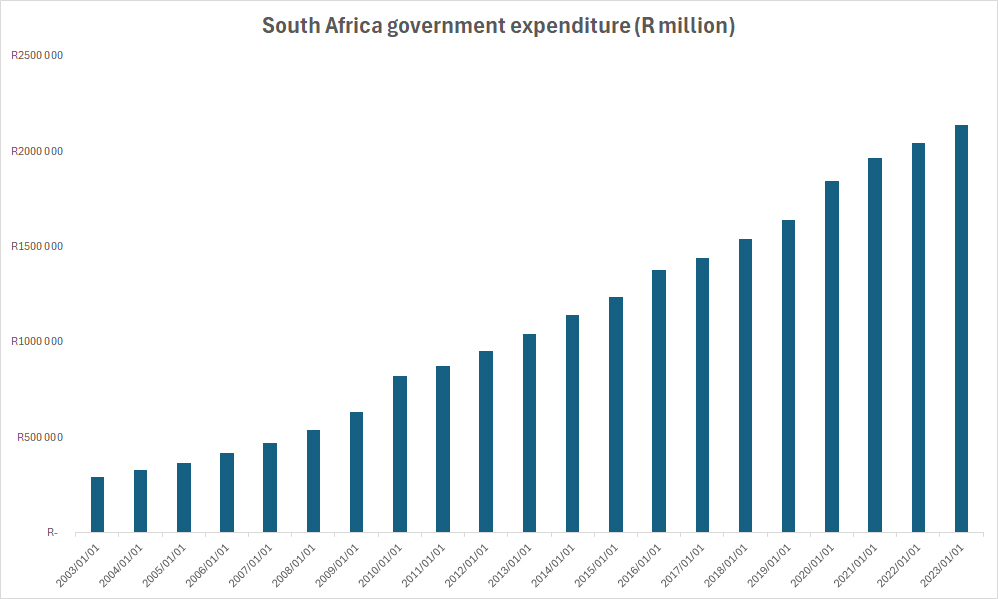
Government expenditure increased from R292 billion in 2003 to R2.1 trillion in 2023, a 634% rise that resulted in higher taxes.
South Africa’s gross tax revenue increased from R279 billion in 2003 to R1.7 billion twenty years later.
Despite the significant increase in taxes, it was not enough to keep pace with the government’s big increase in spending.
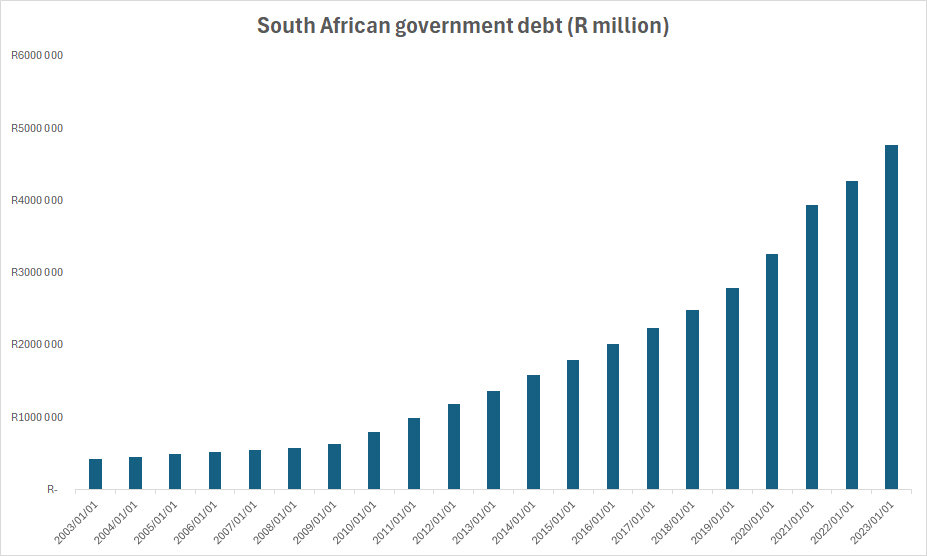
This means that the deficit had to be funded by debt. Gross government debt increased from R427 billion in 2003 to R4.8 trillion in 2023.
The higher debt means higher interest payments. In 2017, South Africa’s sovereign credit rating was downgraded to junk status, which increased interest rates.
Simply put, the government has to pay more in debt servicing costs, which puts additional pressure on its finances.
South Africa is paying more than R1 billion daily in debt-servicing costs in the 2024/25 financial year.
Finance Minister Enoch Godongwana said they would spend R382.2 billion on debt-servicing costs this year, making it the third-largest expenditure item in the budget.
Debt-servicing costs are the fastest-growing expenditure item in the country’s budget, and the National Treasury expects it to increase by 7.3% each year until 2027.
The charts below show South Africa’s rapidly increasing government expenditure and debt.
The impact on taxpayers
Government expenditure and state debt are often misunderstood. Former United Kingdom Prime Minister Margaret Thatcher explained it best.
In her speech at the Conservative Party conference forty years ago, she said people should not forget a fundamental truth about state spending.
The state has no other source of money than money that people earn themselves. If it spends more, it can do so only by borrowing people’s savings or taxing them more.
“It is no good thinking that someone else will pay – that someone else is you. There is no such thing as public money. There is only taxpayers’ money.”
This is exactly what happened in South Africa. The government’s increased spending meant it had to tax South African workers and businesses more.
Personal income tax, value-added tax (VAT), dividend withholding tax, and numerous other taxes increased.
The government also increased new taxes, including a plastic bag levy, carbon taxes, and a tax on sugar-sweetened beverages.
More and more money was taken from South African taxpayers to fund the government’s spending spree.
Renowned American economist and statistician Milton Friedman said the true tax people should be looking for is how much the government is spending.
He explained that all government budgets are balanced, independent of how much the government spends, because taxpayers pay for them.
“If you are not paying for it in the form of explicit taxes, you are paying for it in the form of inflation or borrowing,” he said.
With this in mind, Daily Investor analysed a combination of government spending and state debt in relation to the number of taxpayers.
There is an argument that all South Africans are taxpayers because of VAT and related taxes. However, this is not a good description of the problem.
When people receive all their money from the state, like grant recipients, and give some back in VAT, they are not net contributors to state coffers.
The National Treasury’s data showed that the number of individual taxpayers increased from 11 million in 2013 to 15 million in 2023.
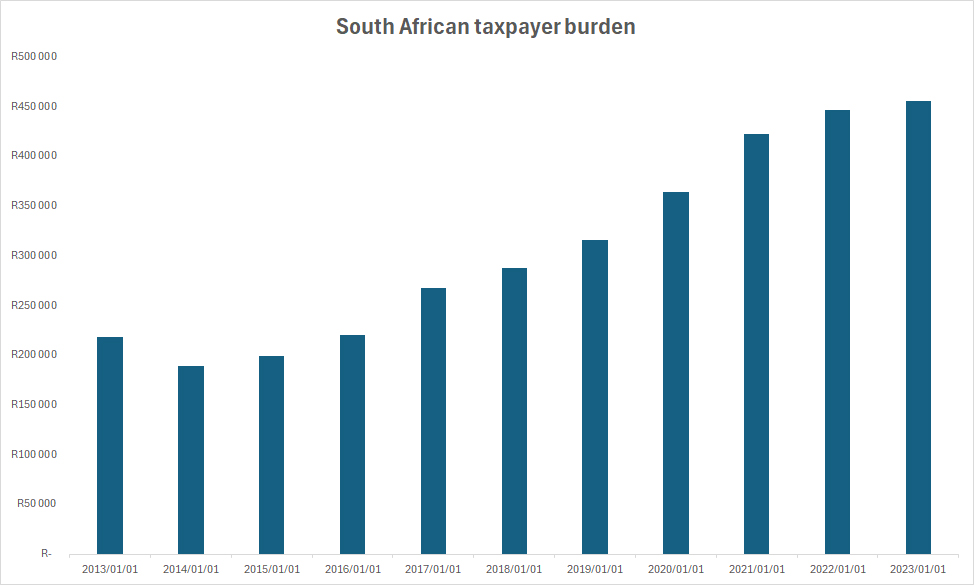
The burden per taxpayer, which includes government expenditure and debt, increased from R218,000 in 2013 to R456,000 a decade later.
The chart below shows the growth in the tax burden on individual taxpayers in South Africa over the last ten years.




Comments