Shoprite Checkers declares war on Clicks and Dis-Chem in R116.8 billion market



Shoprite is making strong inroads into the health and beauty market through its pharmacy business, Medirite, which operates out of the retailer’s existing stores.
Traditionally dominated by Dis-Chem and Clicks, South Africa’s R116.8 billion health and beauty market has attracted the attention of grocery retailers.
As they hunt for growth in a stagnant economy, retailers including Shoprite and Spar have turned to health and wellness to grow their top and bottom lines without additional real estate.
This boosts the trading density of their stores and profit, as health and wellness products are not subject to the same razor-thin margins as groceries.
The expansion by traditional retailers into health and wellness was met with scepticism, given the effective duopoly of Dis-Chem and Clicks.
However, data from Trade Intelligence shows that the stranglehold these companies have is no longer as strong as it once was.
“Perhaps the clearest shift is that there is no single health and beauty shopping destination. Shoppers move between specialist retailers, supermarkets, and e-commerce platforms,” Trade Intelligence insights lead Andrea Slabber said.
“True retailer exclusivity is rare. Healthcare shoppers use an average of 2.4 different store types, while personal care schoppers use an average of 2.2.”
Their shopping is split across various specialist chains, such as Dis-Chem and Clicks, supermarkets, and e-commerce channels.
This provides an opening for players like Shoprite to leverage their dominant position in grocery retail to win a growing share of the health and beauty market.
Shoprite is also looking to bring its scale to bear on the market, using its existing real estate to grow its Medirite brand and its Transpharm logistics business.
Currently, there are 140 Medirites located inside an existing Shoprite supermarket that offer basic products and services.
These are coupled with stand-alone Medirite Plus pharmacies that offer full-service healthcare and expanded retail offerings in a similar format to a Dis-Chem or Clicks.
Shoprite’s results for the first half of the 2026 financial year revealed that Medirite Plus sales surged by 73.5% year-on-year.
While this is strong growth, the real weapon may lie in Shoprite’s Sixty60 offering, which can give it a serious edge over traditional pharmacies through home delivery.
This threat is certainly keeping Dis-Chem CEO Rui Morais awake at night, as he told Daily Investor that Shoprite can capture significant market share if it leverages Sixty60 to deliver pharmaceutical goods.
“I see Clicks as a natural competitor, but I worry more about Shoprite, because they are able to use their Sixty60 asset to amplify their ability to scale,” he said.
Easier said than done
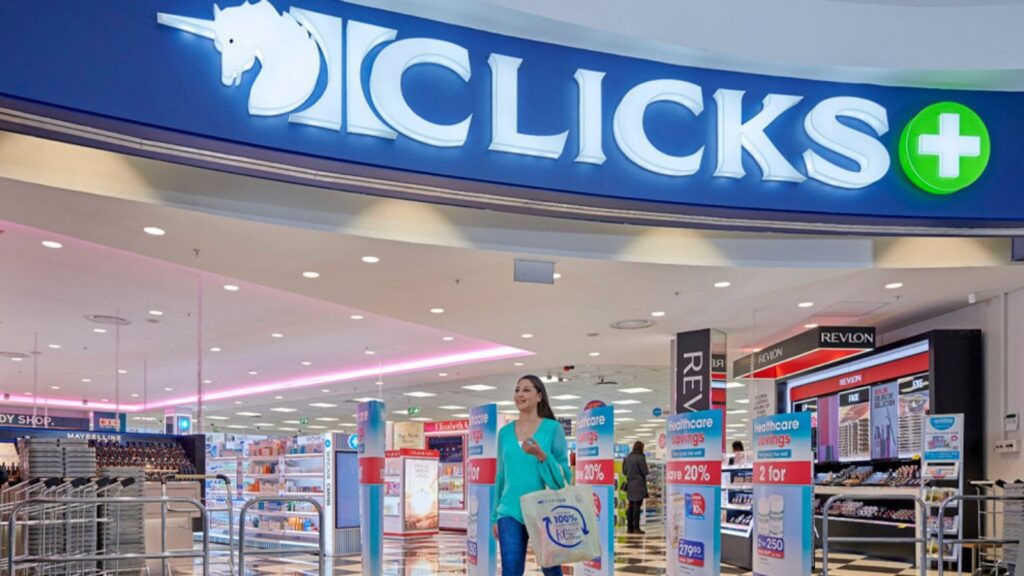
While Shoprite has distinct advantages, South Africa’s biggest retailer will not have it all its own way, as there are significant hurdles for it to overcome.
The primary hurdle is the strong association Dis-Chem and Clicks have with pharmaceutical goods, resulting in them being the go-to for range, new products, and advice.
Trade Intelligence’s data points to the traditional pharmacies being seen as highly credible brands for high-value offerings, such as medicine, new products, innovation, and category depth.
This trust also leads many South Africans to use Dis-Chem and Clicks as their go-to for anything relating to medication and healthcare.
In contrast, supermarket pharmacies are closely associated with convenience, affordable pricing, and broader household needs.
As such, Shoprite is likely to struggle to break into the pharmacy ‘proper’ game, with it dominating generic medication, beauty products, and basic healthcare offerings.
However, this will still be enough for the retailer to move the needle on its top and bottom line, with it not having to beat Dis-Chem and Clicks head-on to make pharmacies a profitable part of its business.
Personal care, the area where Shoprite’s advantages can be brought to bear most effectively, is the largest category of pharmacy sales.
This category accounts for over half of the total health and beauty market and is growing rapidly, eating up shelf space once reserved for healthcare.
South Africa’s economic stagnation also makes this category more valuable as shoppers seek small, affordable luxuries as opposed to high-value purchases.
Thus, the personal care game is becoming increasingly about volume – a game that Shoprite tends to win in South African retail.
Trade Intelligence’s analysis also shows that Shoprite’s digital offering through Sixty60 is likely to be a winner.
The convenience offered by the Sixty60 service is likely to make Medirite the dominant player in personal care unless traditional pharmacies can find a way to compete.
Furthermore, Shoprite’s credibility in this space makes its offering more effective as it can be used to inform in-store purchases.
“While physical retail still dominates, shoppers increasingly use online resources before making purchases, meaning that online sales understate the role digital plays in the path to purchase,” Slabber said.
Login or register for unlimited free access.