Good news about interest rate cuts in South Africa


South Africa is expected to see one of its shortest tightening cycles since 2000, with the Reserve Bank’s projections implying an interest rate cut in November.
However, these projections are only a policy guide, with decisions taken on a meeting-by-meeting basis.
Codera Analytics data scientist Jurgens Fourie outlined South Africa’s current interest rate environment in November 2026.
Fourie’s comment is based on the Reserve Bank’s Monetary Policy Committee (MPC) projections in September.
Based on these projections, Fourie said South Africa is set for one of its shortest tightening cycles since the adoption of inflation targeting 26 years ago.
In February 2000, South Africa’s monetary policy approach shifted to inflation targeting, with the MPC adopting a target range of 3% to 6% in 2002.
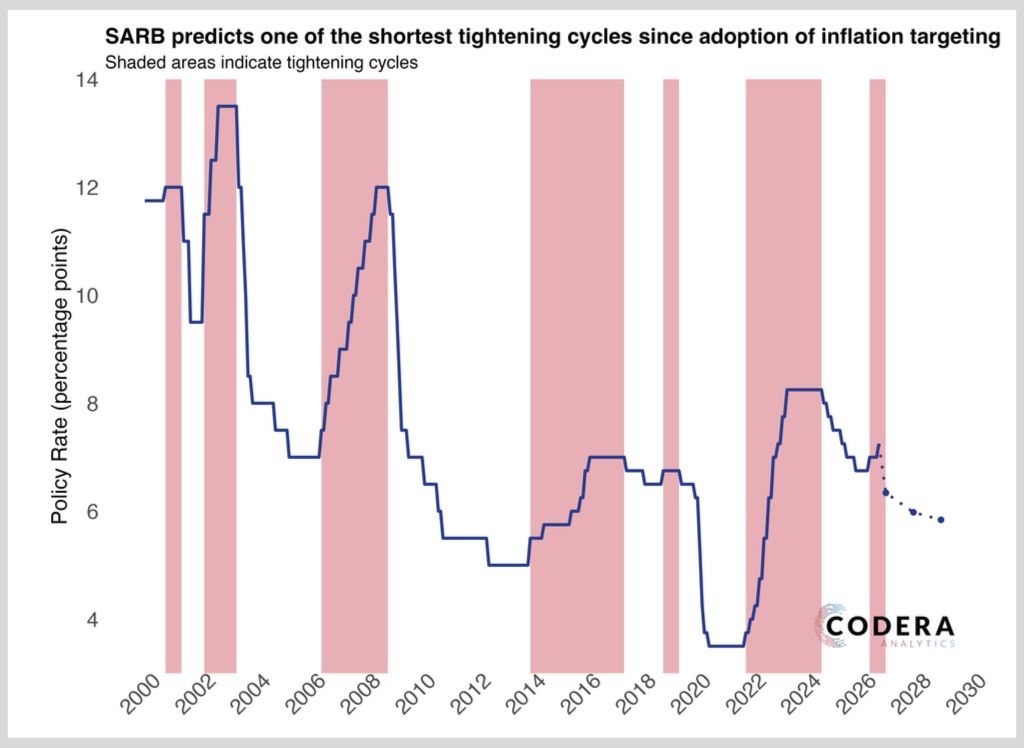
Fourie found that, based on the Reserve Bank’s projections, South Africa is set for one of its shortest tightening cycles since 2000.
Following a cutting cycle that ran from September 2024 to November 2025, the MPC started hiking rates again in May 2026.
From May 2026 to its latest meeting in September 2026, the committee has raised interest rates by 50 basis points across two hikes.
These hikes came in response to inflationary pressures stemming from the US-Iran war, which broke out in late February 2026.
These hikes brought the Reserve Bank’s policy rate, or repo rate, to 7.25%, up from 6.75% at the start of 2026.
Fourie explained that, based on the Reserve Bank’s September MPC projections, the hiking cycle started in May 2026 is now complete.
The MPC’s projections imply a cut in November, which would make the current hiking cycle one of the shortest in South Africa’s history.
“Despite hiking in September and raising the forecast for inflation, the SARB’s projections still imply a cut in November,” Fourie said.
A 25-basis-point cut in November would bring the repo rate back down to 7%, returning to the level seen prior to the September hike.
South Africa’s interest rate tightening cycles since 2000 are shown in the graph below, courtesy of Codera Analytics.
Interest rates in South Africa
In the September MPC statement, Reserve Bank Governor Lesetja Kganyago emphasised that projections remain a broad policy guide, with decisions taken on a meeting-by-meeting basis.
Therefore, a November cut is not guaranteed, and some economists even suspect another 25-basis-point hike.
Kganyago said MPC decisions will be made based on the outlook, data outcomes, and the balance of risks to the forecast.
One scenario the MPC outlined in September considered how interest rates would change in an environment with higher inflation expectations and wage increases.
Kganyago said this scenario showed a tighter policy stance, with between one and two hikes above the baseline peak, and rates staying higher for longer.
At the September meeting, the Governor also said that the MPC expects inflation to remain elevated into 2027, only returning to the 3% target towards the end of next year.
CAM Asset Management chief economist Maarten Ackerman said South Africa’s deteriorating inflation outlook will place the MPC under renewed pressure at its next meeting on 19 November.
Ackerman said conditions have deteriorated since the last meeting, when the committee unanimously voted to raise interest rates.
“With the latest inflation print at 4.5%, inflation is moving towards 5%. There is a strong case for another rate hike,” he says.
Ackerman explained that the nature of the shock complicates the decision, as there is only so much monetary policy can do to counter a supply-driven inflation shock.
“Trying to suppress demand in an economy as weak as South Africa’s risks doing more harm than good,” he said.
Ackerman said the Reserve Bank may take some comfort from the US Federal Reserve’s decision to hold rates at its recent meeting despite relatively sticky inflation.
Investec chief economist Annabel Bishop said on 10 November that expectations of a United States interest rate hike are waning.
This spells good news for domestic monetary policy, as the Reserve Bank may not need to worry about the narrowing of the interest rate differential between South Africa and the US.
“Although this is not certain for this year, next year is expected to see further moderations in the oil price, and US inflation and so inflation expectations,” Bishop said.
She explained that the sharp drop in the oil price so far has subdued international petroleum product prices.
Falling oil prices will, in turn, help lower South Africa’s fuel prices and reduce the chance of another interest rate hike this year.
Old Mutual Wealth Investment Strategist Izak Odendaal has also said that there is little reason for the Reserve Bank to hike rates again this year.
While inflation is above the Reserve Bank’s target, at 4.5% in September, Odendaal said this is likely temporary.
“By April next year, high fuel prices will be in the base for year-on-year comparisons, and inflation should decline towards a three-handle quickly,” he said.
Login or register for unlimited free access.






Conversation
1 commentsHope for the best to come.