Former Capitec CEO Gerrie Fourie reveals the most difficult time he faced at the bank


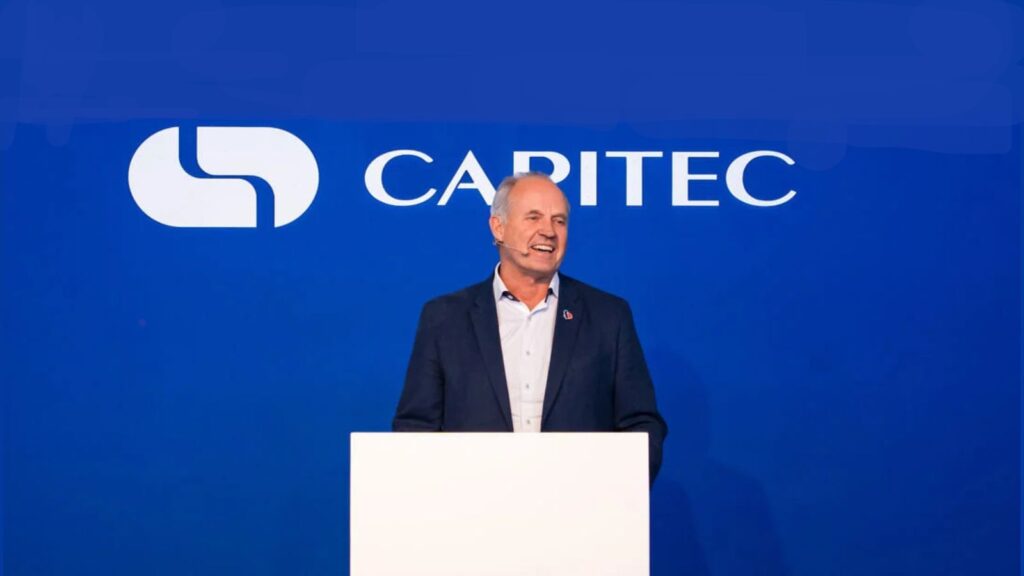
Former Capitec CEO Gerrie Fourie said the hardest time during his tenure as chief executive was the 2018 Viceroy Research short-seller attack.
Fourie told Peregrine Capital that when the attack occurred, there was no script for him to follow and no “right” way to handle it, leaving the CEO and his team to tackle the issue head-on.
However, while this was the most difficult situation Fourie had to tackle in his 11-and-a-half-year tenure, he said it also brought the company closer together.
The situation dates back to January 2018. At the time, Capitec was flying high, trading at near all-time highs.
It was widely considered the most successful retail banking story in South Africa’s history, having achieved a market capitalisation of R108 billion and a client base of 9.9 million.
Capitec’s success and renown at the time are what made Viceroy’s move on 30 January 2018 so shocking to many who had been following the company’s growth.
Viceroy is an investigative financial research group that was founded in 2016 by Fraser John Perring, Aiden Lau, and Gabriel Bernarde.
The company has developed a reputation for publishing critical reports and often taking short positions in the firms it analyses.
While registered in Delaware, United States, Viceroy had built up a reputation in South Africa when it published a report on Steinhoff the day after its stock went into freefall.
Viceroy mapped out how Steinhoff had hidden its bad assets and moved liabilities off its balance sheet.
This report came out when many investors were trying to understand what had gone wrong at the former investment darling, with Viceroy providing many of the answers they were looking for.
Many credited the firm with blowing the whistle on one of the biggest fraud cases in South African history.
Therefore, when Viceroy published a report on Capitec two months later, on 30 January 2018, it garnered immense attention.
Viceroy’s Capitec allegations and the fallout
Viceroy’s report, titled ‘Capitec – A wolf in sheep’s clothing’, was scathing, containing multiple allegations about the bank’s solvency and financial health.
The report characterised Capitec as a “loan shark”, saying it is a reckless microlender operating a “massively overstated” loan book.
Viceroy compared Capitec to African Bank, which had collapsed four years earlier.
“Viceroy’s extensive due diligence and compiled evidence suggest that Capitec must take significant impairments to its loans, which will likely result in a net-liability position,” Viceroy said.
“We think that it’s only a matter of time before Capitec’s financials and business unravel, with macro headwinds creating an exponential risk of default and bankruptcy.”
Viceroy said this made Capitec “uninvestable” and called on the South African Reserve Bank and Finance Minister to immediately place the bank into curatorship.
The effect of this and other allegations was almost immediate: Capitec’s shares plunged as much as 30% intraday, wiping R25 billion from its market capitalisation.
Within hours of the crash, the Reserve Bank was forced to step in and release a public statement confirming that Capitec was liquid, solvent, and fully capitalised.
At Capitec, Fourie explained that he and his executive team had to hold an emergency briefing that same afternoon to systematically debunk Viceroy’s claims.
Capitec held a briefing that was attended by 700 analysts, investors, asset managers, and media representatives.
“When it took place, there was no script. There’s no way to handle it. We had to deal with it, and we dealt with it by leading from the front and being direct and attacking them,” Fourie said.
“The hardest part was actually not the process. It’s the fact that you’ve built a business and they’re actually attacking your integrity, what you stand for.”
“That was hard, because you had to get over that. But that also brought the whole company together, and the whole company stood behind what Capitec stands for.”
Capitec’s efforts paid off. Its stock recovered most of its losses over the days that followed, and the executive teams successfully averted a bank run.
In September 2021, South Africa’s Financial Sector Conduct Authority (FSCA) hit Viceroy with a R50 million administrative penalty.
The FSCA said Viceroy had breached the Financial Markets Act by publishing false, misleading, or deceptive statements about Capitec while profiting from short positions.
Viceroy challenged the fine, arguing that the FSCA lacked jurisdiction over foreign actions, leading to a multi-year court battle.
In mid-2025, this battle culminated in the High Court, which ruled in the FSCA’s favour and upheld the R50 million penalty.
Having recovered from the attack, Capitec continued its rapid expansion and is now the largest retail bank in South Africa by customer numbers, with 26.6 million active clients in its base.