South Africa makes laws for a Rolls-Royce when it is a Toyota Corolla



South Africa has legislation that imposes extremely strict requirements on investment in key economic sectors.
This impedes economic development in the country by creating non-financial barriers to investment, particularly regarding environmental requirements.
South Africa’s mining sector has been particularly hard hit by this type of legislation that Finance Minister Enoch Godongwana refers to as “Rolls-Royce legislation”.
This moniker refers to the luxurious nature of the legislation, typically reserved for highly developed economies.
These economies do not desperately need investment as South Africa does, so they can pursue luxury legislation that sets high barriers to entry.
Godongwana told BizNews that South Africa has Rolls-Royce legislation in the form of its onerous environmental regulatory framework that prevents investment.
The Finance Minister’s comments follow his Medium-Term Budget Policy Statement (MTBPS), which was filled with positive news regarding the country’s debt trajectory.
However, it did include a downward revision to the country’s economic growth rate for the current year to 1.2%.
This indicates that the country’s economy will continue to grow at a slower rate than its population, resulting in the average South African getting poorer.
The National Treasury’s initial expectation in February was for economic growth to reach 1.6% in 2026 before increasing towards 2% in 2027.
The conflict in Iran and subsequent oil price shock have dashed those hopes and returned South Africa towards its post-2010 average of 1.1% annual growth.
This is effectively stagnation, with South Africa’s emerging market peers growing at 4.5% on average over the same period.
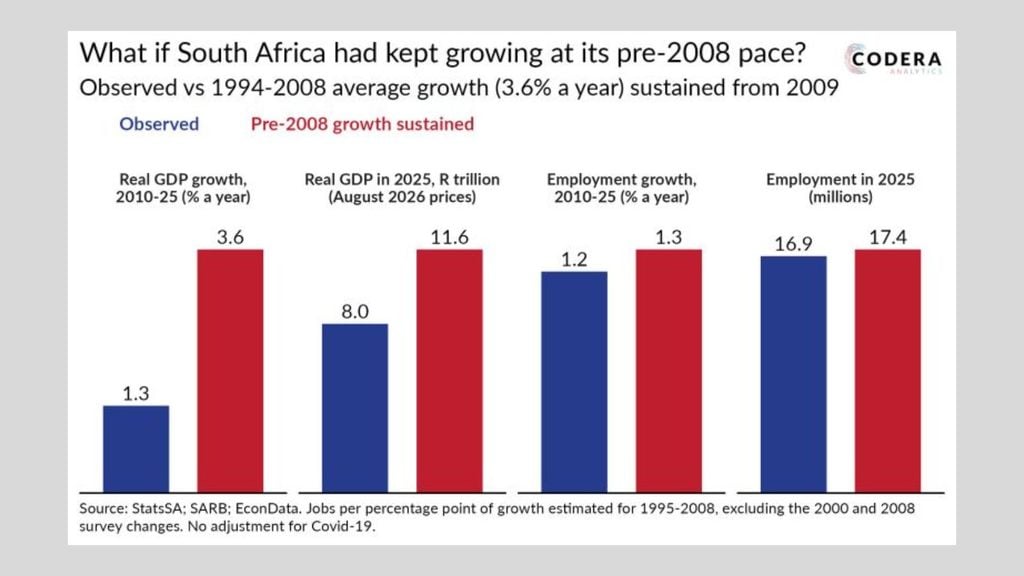
A recent analysis from Codera Analytics showed that South Africa’s economy would be R3.6 trillion larger had it maintained its pre-2008 growth rate until the present day.
This would have translated into 500,000 new jobs being created and additional tax revenue that would eliminate the state’s budget deficit.
Rolls-Royce laws for a Toyota
Godongwana argued that the onerous regulatory framework created by South Africa’s Rolls-Royce legislation inhibits economic growth.
In particular, Godongwana has his sights on the country’s environmental regulatory framework and its strict requirements for investment.
“We have put forward legislation which, in my view, is Rolls-Royce legislation that has requirements which far exceed even developed nations,” Godongwana said.
“They find gas in Namibia and in South Africa, but they can’t proceed here because of environmental challenges.”
Offshore gas discoveries in South Africa could be transformative for the local economy, generating billions in foreign exchange earnings and creating thousands of high-paying jobs.
However, investment to develop these discoveries has been halted by court cases from environmental action groups.
The Rolls-Royce legislation has not only prevented offshore gas exploration and development but also negatively impacted South Africa’s mining sector.
“Whether it is mining, whether it is exploration for oil and gas offshore and onshore, it is quite difficult to get approval,” Godongwana said.
“To compare us to Canada and Australia, which have a similar mineral endowment to South Africa, is like chalk and cheese.”
“The most recent data shows that those two countries each had $40 billion invested into exploration, and we had a mere $2 billion.”
Godongwana said the entire regulatory framework that governs specific sectors needs to be closely looked at and reformed.
“As we have done with structural reforms in electricity, logistics, and so on, we have got to start asking what else comes into the equation as part of these reforms,” he said.
“We have to ask what other mining jurisdictions are doing to be able to succeed. We have to take those successful cases and learn from them.”
Godongwana said South Africa’s Rolls-Royce legislation is not designed for an economy that is desperate for investment and growth, comparing it to needing legislation that suits a cheaper car model, like a Toyota Corolla.