Reserve Bank wants to unmask South Africa’s hidden R1 trillion economy



The Reserve Bank is launching a pilot for its QR+ initiative, which could enable it to gather data on the economic activity of informal businesses in South Africa.
This could provide South Africa with valuable insight into its informal economy, which is estimated to be worth R1 trillion.
Up until recently, businesses operating in this economy have largely gone unnoticed within the formal economy.
While many South Africans may have been aware that businesses like spaza shops, backroom rentals, and roadside sellers existed, very few realised just how large the informal economy had become.
Based on the research of informal economy expert and Kasinomics author GG Alcock, the informal economy is far larger than many people think.
He has estimated the size of the informal economy to be between R1 trillion and R1.13 trillion in annual turnover.
Alcock has explained that the informal economy is similar to its formal counterpart in that it comprises businesses across different sectors.
For example, he said the Spaza retail sector alone is worth between R190 billion and R200 billion.
The growth of the informal economy, which has been estimated to be faster than that of the formal economy, has begun to draw the attention of major South African companies.
Corporate giants such as Capitec, Shoprite, and Tiger Brands have made moves to expand into the informal sector.
Despite this new attention, one major problem with informal businesses persists: they are difficult to track.
Since most transactions in the informal economy are conducted in cash, government agencies such as the Reserve Bank and Statistics South Africa have difficulty tracking them.
This, in turn, makes it impossible to know how many businesses operate in the informal economy, what size they are, and what their needs may be.
This is one of the problems the Reserve Bank’s new QR+ programme aims to solve.
The Reserve Bank’s QR+ initiative
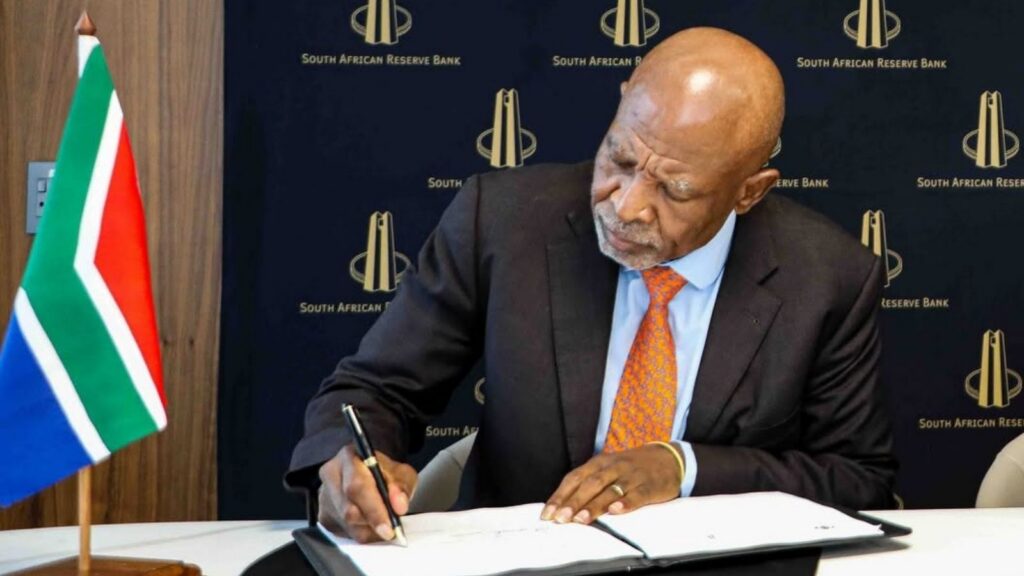
On Tuesday, 20 October, Reserve Bank Governor Lesetja Kganyago outlined the bank’s QR+ programme.
He explained that financial inclusion is one of the central bank’s priority areas, and one way to promote it is by making digital payments simple and affordable.
“We want people and businesses to be able to establish their identity without repeated friction,” Kganyago said.
“And we would like them to be able to use their own economic records to gain access to a wider range of financial services.”
He explained that informal businesses like street vendors may have a bank account, but they will not start accepting digital payments if doing so requires expensive equipment, such as a point-of-sale device.
This slows the adoption of digital payments in South Africa and prevents small and informal businesses from accessing credit easily.
“Many informal businesses lack conventional collateral, audited statements or formal credit records,” he said.
“Yet their payment flows may show regular sales, recurring customers, turnover patterns and the ability to manage cash flow.”
The answer to these problems, Kganyago said, is QR+, a single digital ID for payments.
The Reserve Bank’s vision is for QR+ to serve as a single interoperable code that merchants can display, allowing customers to pay using the service of their choice.
“It is meant to be simple and cheap. Encouragingly, we have a pilot that is about to begin, and we look forward to learning from it,” Kganyago said.
Since QR+ will take the form of a single digital ID, it should also lower the barrier to proving their identities for users.
“It enables reusable and verifiable digital credentials that work across the payment ecosystem and that are stored in a wallet controlled by the individual,” Kganyago explained.
“With the customer’s consent and appropriate safeguards, this verified information could be reused to reduce onboarding friction and support more consistent verification.”
Kganyago said this also creates the opportunity to help people and businesses use their transaction histories as evidence of economic activity.
This should, in turn, allow businesses to establish a digital footprint and access credit and financial services more easily.
However, the governor noted that this does not mean every transaction automatically becomes a credit score.
“Customers must retain meaningful control over how their information is used. Data must be accurate, relevant and open to correction,” he said.
“This is not about erasing privacy. It is about helping people who have earned a good reputation but cannot benefit from it because that information is invisible.”