The South African retailer that has opened 43 new stores every year for the past seven years


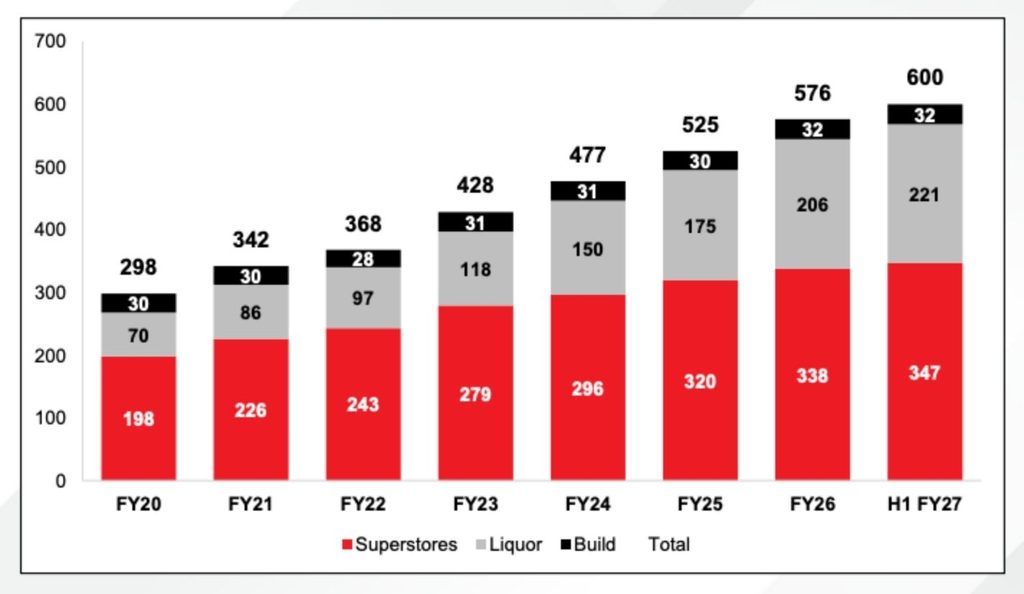
Boxer has invested billions in expanding its physical footprint over the past few years, going from 298 stores in 2020 to 608 today.
CEO Marek Masojada told Daily Investor that this is not growth for growth’s sake, as the retailer believes an expanding store base is key to growing in a low-growth environment like South Africa.
This growth comes at a cost, with Boxer having spent billions to open new stores over the past seven years.
In Boxer’s results for the six months through August 2026, it announced that it had opened 24 new stores – 9 superstores and 15 liquor stores.
These additions brought its footprint to 600 stores, putting Boxer well on the way to reach its target of opening 60 new stores in the 2027 financial year.
The retailer’s results also revealed that, since the interim period ended in August 2026, it has opened 8 more stores, bringing its additions in FY2027 to 32.
To achieve its goal of 60 new stores, Boxer has guided for capital expenditure of R1.1 billion, a large portion of which will go towards the store openings.
Rolling out stores at this pace has made Boxer the fastest-growing discount retailer in South Africa, but has also led to a considerable rise in expenses.
In the first half of its 2027 financial year, Boxer’s trading expenses grew 10.2% to R4.2 billion, outpacing turnover growth of 6.3% and trading profit growth of 8.1%.
The retailer attributed this rise in expenses largely to higher energy costs, with diesel and electricity prices having risen over the six-month period.
In fact, Boxer spent R174 million on diesel in the first half of FY27, up 32.4% compared to the first half of 2026.
Boxer described this trading environment as “challenging”, saying it is characterised by a constrained consumer and continued selling price deflation.
The retailer recorded a -2.4% selling price inflation in the first half of the 2027 financial year, as Boxer absorbed higher costs to keep prices low.
Growth for the sake of growth
Amid these cost pressures, Boxer remains steadfast in its goal to open 28 more stores in the 2027 financial year.
On the surface, this may seem counterintuitive. Boxer is facing billions in rising costs, many of which are outside of its control and, in the case of diesel prices, unlikely to decrease anytime soon.
Boxer has also always prided itself on maintaining low inflation in selling prices, offering value to consumers who are increasingly under pressure.
Yet it wants to roll out 60 stores in the 2027 financial year, and, according to Masojada, investing in store rollouts is one of the best ways for Boxer to protect its margins in this tough environment.
However, he added one critical caveat: the new stores that Boxer opens must be “good stores”.
For Masojada, this means stores in good locations, serving a defined community, with business models that will work and be profitable.
“Our challenge is that, because rentals go up at 5% to 6% every year, as do wages, as does electricity, etc., those dynamics have to be managed,” he said.
“But on the other side of the equation is that, if you open good stores, you’re amortising your whole central cost across another store.”
By opening a new, profitable store with room for growth, Boxer can reduce its head office centralised infrastructure as a percentage of turnover.
“Economies of scale are very, very powerful,” Masojada said. “We don’t have to employ more people at the head office, we don’t have to open more distribution centres, etc.”
“It actually makes the economics of the distribution centre work better if there’s more volume going through it.”
However, to achieve the scale needed, Masojada said Boxer does extensive research into every store it plans to open. This includes detailed feasibility, demographic, and competitor analyses.
“We won’t open the store unless that store will have a sustainable future of profitability, and we will close stores that don’t make money because something’s changed in the environment,” he said.
Despite Boxer’s 60-store goal for the 2027 financial year, Masojada said he would be happy to open only 50 stores, as long as they give the same turnover as 60.
“The new stores are almost more important in this low-growth environment,” he explained.
“Because generally you get those economies out of your existing estate and your new store estate, and obviously we’re missing one of those legs at the moment.”
Analyst opinion
Otto1890 senior equity analyst Alec Abraham told Daily Investor that he would typically be concerned about a company’s expenses outpacing turnover.
However, this is not the case for Boxer. “In the current context, I think it is a ‘necessary evil’ for Boxer,” he said.
“The ramp-up in expenses to execute its strategy just ‘appears’ very high, but only because the deflationary pricing dynamics are limiting sales growth.”
“I expect basket price inflation will return (boosting sales growth) and the investment to execute the strategy will dissipate as the group reaches scale.”
While Abraham does not believe Boxer’s strategy of rolling out tens of stores each year will work in the long-term, it is a solid approach for the short- to medium-term.
He described this as a “land-grab” strategy, whereby Boxer snaps up locations in the less-contained “white space” of soft-discount retailing in peri-urban areas.
Abraham said this strategy is plausible and promising, and has served Boxer well so far, as it seeks to operate in areas where giants such as Shoprite are not aggressively competing.





Comments