South Africa sat back and watched R3.6 trillion disappear


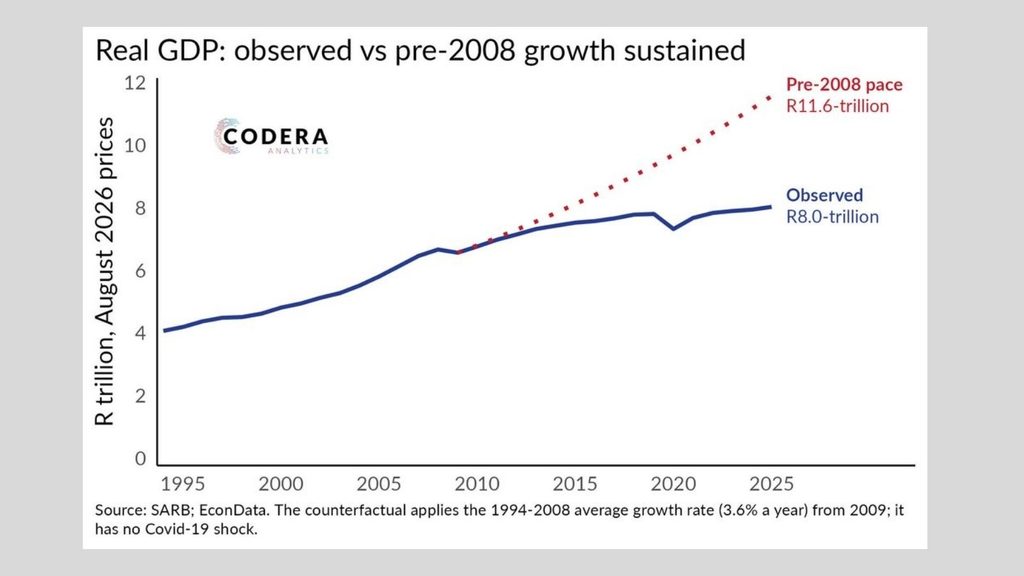
South Africa’s GDP would have been R11.6 trillion in 2025 had it continued growing at the pre-2008 average rate of 3.6% per year.
Instead, the country’s GDP stands at R8 trillion, even though the economy grew only 1.3% per annum from 2010 to 2025.
This was revealed in an analysis by Codera Analytics, which compared South Africa’s observed GDP with that of an economy growing at the pre-2008 pace.
Such a difference is not trivial, with a R3.6 trillion larger economy fundamentally changing the reality of South African citizens.
Growing at 3.6% per year would mean that the average South African was not getting poorer every year from 2010 to 2025.
This translates into higher living standards and significantly greater consumer spending, while also boosting individual wealth.
For the government, it would also have significant positive consequences that extend beyond a more content and satisfied population.
Crucially, a larger economy generates far more tax revenue for the state, boosting its financial health and providing funds for ambitious projects.
In South Africa’s case, an economy that is R3.6 trillion larger would generate enough tax revenue to eliminate the government’s budget deficit of R540 billion.
The government would probably not even be in the situation to have such a large deficit, as the debt burden would be much smaller as a share of GDP.
This would lower debt-servicing costs that eat up 22% of tax revenue. This money is effectively spent on nothing.
Instead of using the balance sheet to invest in infrastructure and grow the economy, South Africa’s government is heading towards a fiscal reckoning.
South Africa’s growing debt-to-GDP ratio is hampering debt repayment and preventing investment, creating a downward spiral.
The country was projected to stabilise its debt-to-GDP ratio in the current financial year, following efforts by the National Treasury to limit state spending.
However, the supply shocks from the war in Iran have shattered that projection, with South Africa’s debt burden likely to continue growing.
South Africa playing catchup
The data from Codera point to a period when South Africa’s economy grew at a much faster rate, thanks to efficient state spending, infrastructure investment, and a lighter regulatory burden on the private sector.
This shows that it is possible. However, South Africa’s slow growth has persisted for over a decade, leaving it far behind its peers.
The country is fundamentally playing catch-up and will have to outperform just to reach the pre-2008 average.
Investec Wealth & Investment’s Osagyefo Mazwai outlined what it would take for South Africa just to return to the average global GDP per capita.
Mazwai estimated that to reach the global average GDP per capita, South Africa would have to grow its economy by between 3% and 5% in real terms for the next decade.
In nominal terms, the economy would have to grow at 8% to 8.5%. This is above the global average growth rate of 4.4% and the average growth rate for middle-income countries of 5.9% since 1991.
This would take a miracle, with numerous factors having to align in South Africa’s favour, and not all of them are in its control.
For example, the war in Iran blew apart the National Treasury’s forecast for this year and disrupted the outlook for the coming three years.
It forecast economic growth of 1.6% in 2026, accelerating to 2% by 2028. The reality is that the economy will grow at 1% in 2026 and struggle to hit 2% by the end of the decade.
Mazwai explained that the key to turning this situation around is improving business confidence, which has remained in the doldrums for the past decade.
His analysis shows a close relationship between rising business confidence and improving economic outcomes, particularly growth.
“The key is that business confidence should be the main focus of the current government when solving for economic and employment growth, in turn solving for the poverty, unemployment and inequality problem in South Africa,” Mazwai said.
“Our fundamental proposition is that South Africa needs to get back to business, and by that, we mean get back to the basics of business confidence.”
This is largely in the hands of the government, which is certain for the future, being critical for investment and growth.
“There are internal factors that drive business confidence that are within the control of the state. Policy formation processes must have business confidence at the centre,” he said.

Comments