Western Cape residents are better off but feel worse about their finances



Western Cape residents recorded the lowest Financial Confidence Index score among South Africa’s nine provinces, at only 49 out of 100.
The Western Cape also recorded the lowest scores for financial self-determination and resilience. Yet, its financial well-being score was the second-highest among the provinces.
This paradox was revealed in Sanlam’s 2026 Financial Confidence Index (FC) Report, which has been released annually for the past four years.
In short, the FCI tracks how South Africans feel about managing their money. The 2026 report was compiled based on responses from 1,502 survey respondents.
These respondents consisted of South Africans aged 20 to 70 earning at least R1,000 per month from any source. The survey covered all nine provinces, with a focus on metro and urban areas.
This wide reach gives Sanlam interesting insights into South Africa’s financial position based on age, location, and gender, allowing the company to compile an FCI score across these metrics.
An FCI score combines financial goals (self-determination), resilience, and well-being into one score from 0 to 100, where 100 means completely confident.
The 2026 report revealed that the overall FCI score across respondents increased to 54, up from 53 in 2025.
Financial self-determination remained flat at 61, while financial resilience fell by one point to 57. Financial well-being rose by three basis points to 35, its highest level in four years.
Sanlam head of brand Tshepo Mogotsi said the well-being score stood out for him due to the context South Africans found themselves in during 2026.
“It happened during a very challenging year for South Africans, with petrol price increases, inflation and all the other pressures people are dealing with,” he said in the report.
“Our circumstances have not necessarily improved, but people seem to be finding ways to keep going and manage with what they have. I find that encouraging.”
Provincial rankings

Sanlam’s 2026 FCI Report also revealed interesting findings when it came to the provincial rankings.
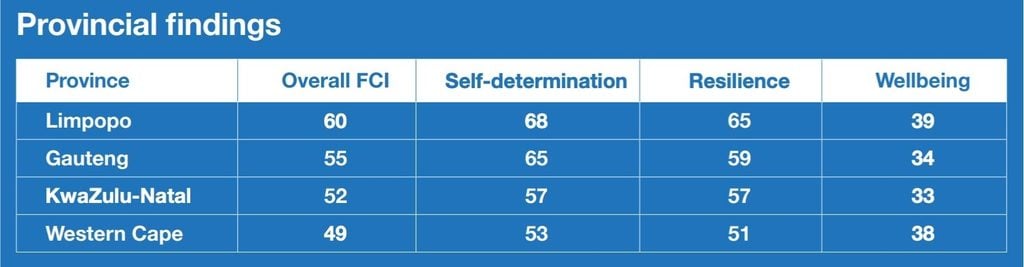
It found that Limpopo and Mpumalanga recorded the highest overall FCI at 60, far higher than Gauteng’s 55 and the Western Cape’s 49.
This finding is interesting because, based on South Africa’s economic data, Gauteng and the Western Cape are far ahead of the other provinces in terms of GDP per capita.
In 2024, South Africa’s GDP per capita ranged from R52,145 to R99,423 per person, and this differed widely between provinces.
The lowest GDP per capita was recorded in the Eastern Cape, at R52,145 per person, followed by Limpopo at R52,867, and KwaZulu-Natal at R63,708.
Mpumalanga had the fourth lowest GDP per capita, at R68,731 per person, followed by the Northern Cape and the Free State.
The two highest GDP per capita provinces were the Western Cape, at R88,805 per person, and Gauteng, at R99,423. Both of these were higher than South Africa’s average of R74,839.
Therefore, Sanlam’s finding that Limpopo and Mpumalanga had the highest FCI score of any province is surprising.
Among the provinces with at least 100 respondents – Limpopo, Mpumalanga, Gauteng, the Western Cape, and KwaZulu-Natal – the Western Cape had the lowest FCI score.
However, the Western Cape’s well-being score was higher than Gauteng’s and KwaZulu-Natal’s, at 38 points compared to 34 and 33, respectively.
Limpopo had the highest overall FCI (60), self-determination (68), resilience (65), and well-being (39) scores of all the provinces.
Sanlam’s report also found that budgeting ranged from 65% in Limpopo to 40% in the Western Cape, while emergency savings ranged from 53% in Limpopo and Gauteng to 32% in the Western Cape.
“It seems South Africans are becoming more resilient, even though many are still facing significant financial pressure,” Sanlam’s head of channel and segment marketing, Lee Hancox, said.
She said the report’s findings suggest that people are adapting emotionally and mentally to their financial realities, despite higher living costs, unemployment, and uncertainty.
“What is encouraging is that more people feel in control of their day-to-day finances and believe they are managing their money in a way that makes them feel secure,” she said.
“My key takeaway is that confidence is holding, but people must now shift their focus from coping to building long-term financial security.”






Comments