State-owned bank with R10 billion in assets in serious financial trouble


Despite a significant operational turnaround, Postbank’s capital adequacy ratio (CAR) fell to 1.62% in the 2025/26 fiscal year.
This is well below international banking standards, which mandate a minimum CAR of 8%, and puts Postbank and its customers in a highly precarious position.
This significant drop in its CAR comes as Postbank’s total assets reached R10.03 billion in the 2026 financial year, driven by growth in investments and cash reserves.
These metrics were revealed in Postbank’s Annual Report for the 2025/26 fiscal year, which showed a marked improvement in its operational performance.
Postbank achieved 79% of its Annual Performance Plan targets for the year, a notable improvement from 44% in 2024/25 and just 12% in 2023/24.
In the 2025/26 fiscal year, the Postbank also achieved a major operational milestone by successfully reacquiring its financial services provider (FSP) licence.
Postbank lost this licence when it separated from the South African Post Office Group in 2019, when it was legally incorporated as a separate entity.
Up until recently, Postbank had operated under a formal deposit–taking exemption from the South African Reserve Bank and through partnerships with commercial banks.
However, with the FSP licence now re-acquired, Postbank can broaden its product catalogue and reduce its reliance on traditional revenue channels.
“This achievement is more than a regulatory milestone – it is a strategic enabler that broadens the bank’s operating capabilities and provides opportunities to diversify its revenue streams,” Postbank chairperson Khayalethu Ngema said.
Ngema said the FSP licence will strengthen Postbank’s ability to enhance its product offering and reduce its reliance on traditional income sources.
This comes at a good time for Postbank, which desperately needs additional revenue streams.
While the bank reported a significant increase in net interest income to R715.5 million in 2025/26, it also recorded a 56.7% drop in net fee and commission revenue to R60.4 million.
This reflects lower transaction volumes and system limits, with Postbank reporting an overall net loss after tax of R5.2 million.
It should be noted that this loss reflects a R44 million SARS-related interest charge. Without this charge, the bank said it would have reported a profit before tax of R42 million.
Capital adequacy concerns
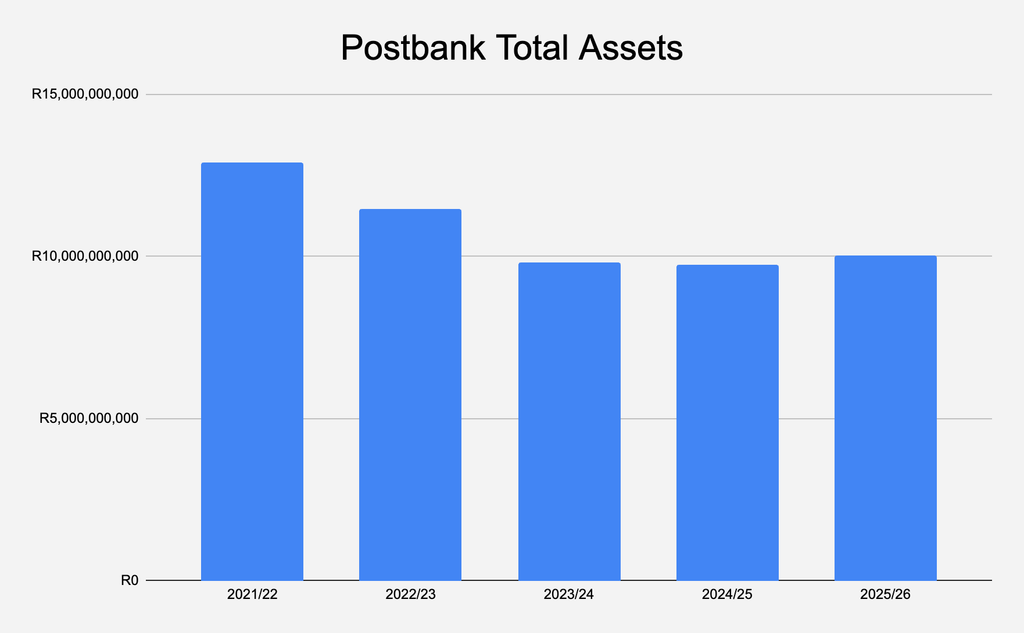
Alongside its loss figures, Postbank reported that its total assets grew to R10.03 billion in 2025/26, representing a 3.08% increase from 2024/25.
This increase reflects growth in investments and cash reserves, making Postbank responsible for a far larger proportion of South African assets.
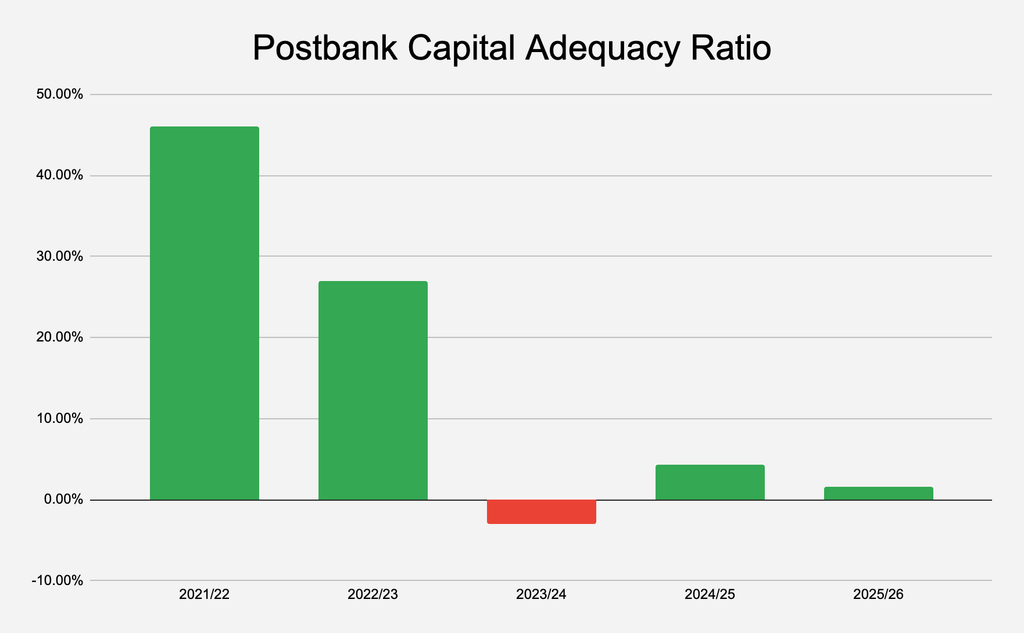
The results further revealed that Postbank’s CAR dropped to 1.62% in 2025/26, down from 4.25% in 2024/25.
CAR is a measure that compares a bank’s available capital to its risk-weighted assets to assess its ability to absorb unexpected losses.
There are international banking standards for CAR contained in Basel III, a global, voluntary regulatory framework designed to strengthen bank capital requirements following the Global Financial Crisis.
South Africa strictly follows and enforces the Basel III framework as a full member of the Basel Committee on Banking Supervision.
Adherence to these international standards is one of the main reasons why South Africa has developed such a healthy and world-class financial services sector.
The Basel III framework sets a minimum international CAR of 8% of a bank’s risk-weighted assets.
This minimum increases to 10.5% when a mandatory capital conservation buffer is included.
For both benchmarks, Postbank’s CAR falls dangerously short, even before the decline experienced in 2025/26.
For reference, Standard Bank maintains a CAR of between 13.8% and 16.8%, Capitec reported 33% in its 2026 financial year, and Absa’s stood at 12.7% in its 2025 financial year.
With a CAR of 1.62%, Postbank is at severe risk of collapse should an unexpected loss occur.
Postbank’s management is aware of this danger, acknowledging in its 2025/26 report that its regulatory CAR “remained below the level expected of fully licensed commercial banks”.
To address this problem, Postbank is applying to the National Treasury for a R2.5 billion injection, with R2 billion earmarked to strengthen the bank’s regulatory capital position.
 Loading ...



Comments