Petrol and diesel price shock coming for South Africa’s economy


The South African economy looks set to absorb another substantial fuel price shock next week unless the government offers more temporary relief.
However, there has been no indication that such relief is being considered, meaning motorists and the broader economy will feel the full effect of upcoming fuel price hikes.
The Bureau for Economic Research’s (BER) chief economist, Lisette Ijssel de Schepper, said the global energy market has changed since the start of the war in Iran.
She explained that it is no longer a story of an oil shock getting worse, as the energy supply is adapting.
This, she said, creates the possibility of meaningful relief if de-escalation gains traction. However, this does not mean that the pressure has disappeared.
“Part of it has migrated into global bond markets, where persistent inflation, resilient growth, and enormous financing needs are pushing borrowing costs higher,” Ijssel de Schepper said.
In other words, due to the oil price shock stemming from the war in the Middle East, inflation has risen and has now prompted central banks worldwide to hike rates.
For South Africa, this means that even if oil prices decline meaningfully, it would not automatically ease financial conditions.
South Africans and the economy will still need to contend with higher inflation and interest rates, both of which will take time to come down.
“The SARB has already raised the policy rate to 7.25%, and our baseline is that it now remains on hold,” Ijssel de Schepper said.
“But the next phase of the outlook may be shaped as much by what happens in global bond markets as by what happens at the petrol pump.”
She emphasised that what happens to fuel and diesel prices will still matter “quite a lot”.
Currently, the Central Energy Fund predicts an underrecovery of R3.29 for petrol and R3.19 for diesel.
This is due to a perfect storm of higher global oil prices and a weaker rand in September, with motorists set to see a very steep increase on Wednesday, 7 October.
Ijssel de Schepper said the hit of these increases will be felt unless the government announces some form of temporary fuel-levy relief.
However, she said there has been no indication from official sources that such relief is being considered.
“The South African economy looks set to absorb another substantial fuel-price shock next week,” she said.
Inflation and interest rate pressures
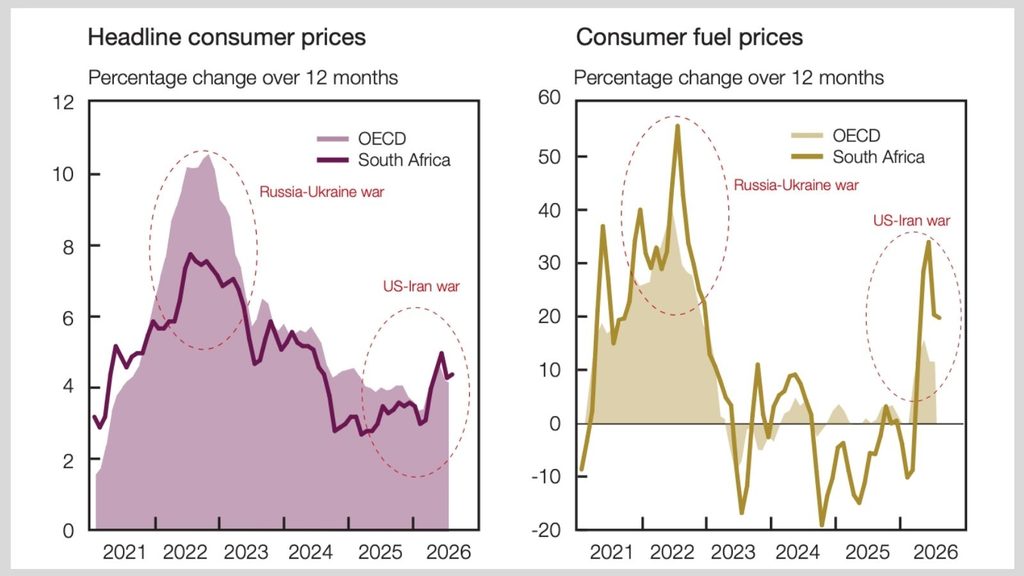
The Reserve Bank’s Quarterly Bulletin, released in September 2026, highlighted fuel prices as a primary catalyst for inflationary pressures and broader economic strain in South Africa.
Petrol price inflation reached 31.7% in June 2026, easing to 18.4% in August, while diesel price inflation peaked at 53.8% in May and moderated to 29.6% in August.
The Reserve Bank said these fuel price movements were the principal factor pushing headline CPI up from 3% in February to 5% in June.
Higher fuel costs also pushed administered price inflation from 1.7% in February to 15.5% in June.
The central bank said these record-high fuel prices had secondary impacts on the price of transport, mining, and commerce.
For example, public road transport inflation surged from -0.1% in January 2026 to 11.6% in June as transport operators adjusted their fares to cover higher fuel bills.
Positively, some of this impact was offset by a strong rand exchange rate for much of the year.
While the rand has come under pressure from the war in the Middle East, particularly over the past month, it has remained remarkably resilient.
This helped cushion the domestic economy from the full impact of global crude oil price spikes.
Ijssel de Schepper said rising household real disposable income also provided some support, helping consumption hold up despite the broader economic slowdown in the second quarter of 2026.
However, she said the external energy shock continues to drain purchasing power from the economy at the same time that global financing costs are rising.
 Loading ...



Comments