Top businessman calls for targeted United States sanctions on South African government officials


Former Sibanye Stillwater CEO Neal Froneman has urged the United States to apply targeted sanctions against specific government officials and individuals.
These officials, Froneman argued, continue to promote policies that are unsupported by the majority of South Africans and that damage the local economy.
Such policies include South Africa’s support for Iran and Russia, as well as expropriation without compensation.
Froneman shared this suggestion in an interview on BizNews, where he discussed plans to bring Formula 1 back to South Africa.
The mining stalwart said that South Africa’s foreign policy has made it extremely difficult to do international deals, particularly with businesses from the United States.
Froneman is best known for his tenure leading Sibanye Stillwater and as a serial dealmaker.
A mechanical engineer by training, Froneman gained experience across South Africa’s mining industry by working at Gold Fields, Harmony Gold, and the famous Johannesburg Consolidated Investments.
This is where he learnt operations and management skills that made him the obvious fit for Sibanye Stillwater, which was then a small spin-off from Gold Fields.
Founded as Sibanye Gold in 2013, the company operated Gold Fields’ former Kloof, Driefontein, and Beatrix mines in South Africa.
Froneman led the company from its inception and rapidly began making deals that would transform it into a giant.
Sibanye generated significant cash flow from its gold operations, which Froneman used to buy platinum mines in the North-West Province and Limpopo.
This diversified Sibanye’s earnings and crucially reduced its reliance on deep gold mines, making it more attractive to investors.
Froneman also led Sibanye’s overseas expansion, including the acquisition of the US-based Stillwater Mining Company. This turned Sibanye Gold into Sibanye Stillwater.
When Froneman retired in October 2025, Sibanye had transformed from a gold miner into a diversified giant with interests including lithium and nickel assets.
Now the stalwart is looking to bring Formula 1 back to South Africa and turn around Copper 360’s fortunes as its chairman.
Targeted sanctions
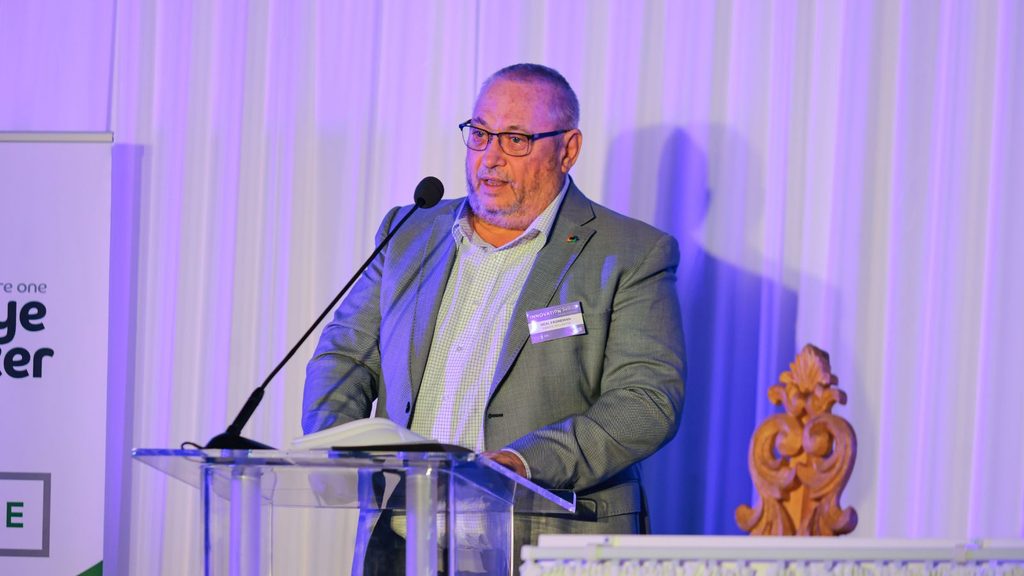
Before becoming Copper360 chairman, Froneman travelled to Washington, D.C. to discuss South Africa with American authorities.
Froneman was meeting with US officials to discuss the possibility of Formula 1 returning to South Africa, with the sport’s media rights held by the American giant Liberty Media.
American authorities had given South Africa’s previous bids a lot of trouble because of the country’s ties to Iran and Russia.
Froneman was working to avoid such trouble with his consortium’s bid to bring Formula 1 to a purpose-built track in Swartland.
“With my work in Washington and with the United States, we have made it very clear that the private sector and the majority of South Africans are not the problem,” Froneman said.
“Therefore, don’t punish business in South Africa. Rather, target those individuals who continue to drive policies that are not supported by the majority.”
This would be the least economically damaging outcome for the South African economy, with blanket sanctions likely to wreak havoc.
The policies Froneman was referring to include expropriation without compensation, but primarily centre on the continued support for Iran and Russia.
“With this support and South Africa’s foreign policy, you have started seeing these targeted sanctions, if I can call them that, coming through now,” he said.
On 15 September, United States Secretary of State Marco Rubio announced a new visa restriction policy against South Africans involved in race-based discrimination.
These restrictions will extend to individuals who enact or enable policies that promote race-based discrimination in South Africa.
They may also apply to those who incite violence and enable expropriation without compensation.
US Ambassador to South Africa Leo Brent Bozell III said these restrictions are only the start, as America has run out of patience.
He said the United States wants lasting relations with South Africa, but Pretoria has not shown that it wants the same.
“As a result, the consequences, as I’ve attempted time and again to express, are necessarily going to be severe,” he warned.
 Loading ...




Comments