Woolworths Food braces for Checkers Sixty60 battle


Woolworths plans to reorient its business around its crown jewel, the Food business, which the retailer sees as its strongest source of competitive advantage and the primary engine of value creation.
This comes as South Africa’s other major retailers, including Shoprite’s Checkers and Spar, are increasingly moving into Woolworths’ territory by targeting higher-income consumers with luxury offerings.
Woolworths released its results for the 52 weeks ended 28 June 2026 on Wednesday, 2 September, wherein it announced a reorientation of its business.
“We are reorienting the group around our market-leading premium food ecosystem, our strongest source of competitive advantage, and the primary engine of value creation,” the retailer said.
“Selected adjacent growth categories, such as Beauty and Home, play a particularly important role in extending the Food relationship into a broader lifestyle proposition as we seek to optimise the future FBH mix.”
Woolworths’ Food business has been its crown jewel since inception, being its largest, most consistent, and most profitable segment.
Therefore, the retailer’s decision to hone in on this strength makes sense, particularly given that this segment is where Woolworths’ new CEO, Sam Ngumeni, has his roots in the business.
Before taking the helm in June 2026, Ngumeni served as the CEO of Woolworths’ Food division, and the segment performed exceptionally well under his stewardship.
This strong performance continued in the 2026 financial year, with above-market growth and a strong uplift from the retailer’s online offering, Woolies Dash.
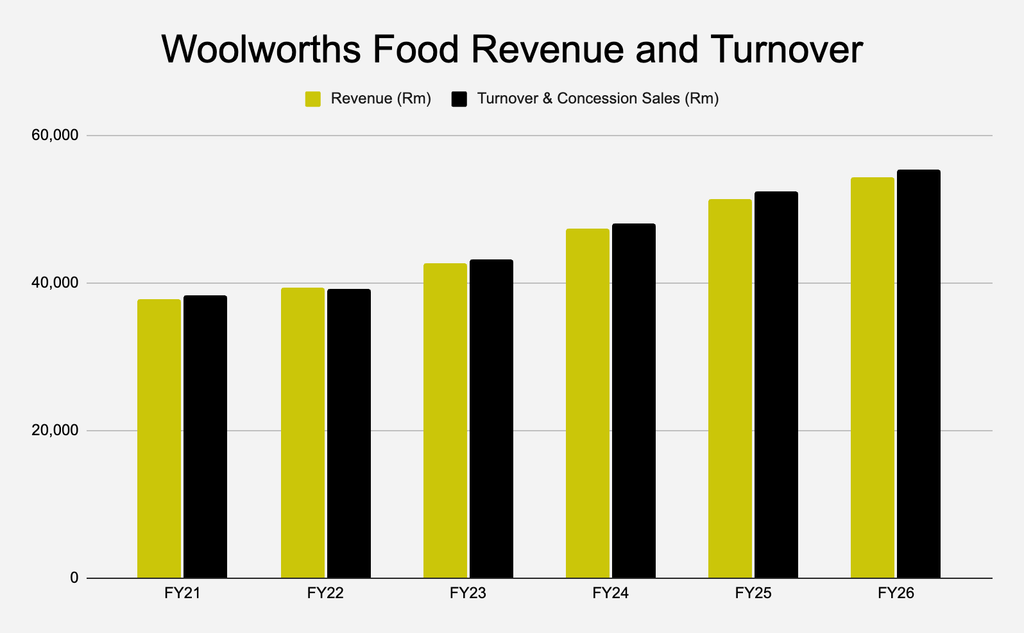
The Food business delivered above-market turnover and concession sales growth of 5.7%, or 3.7% on a comparable-store basis.
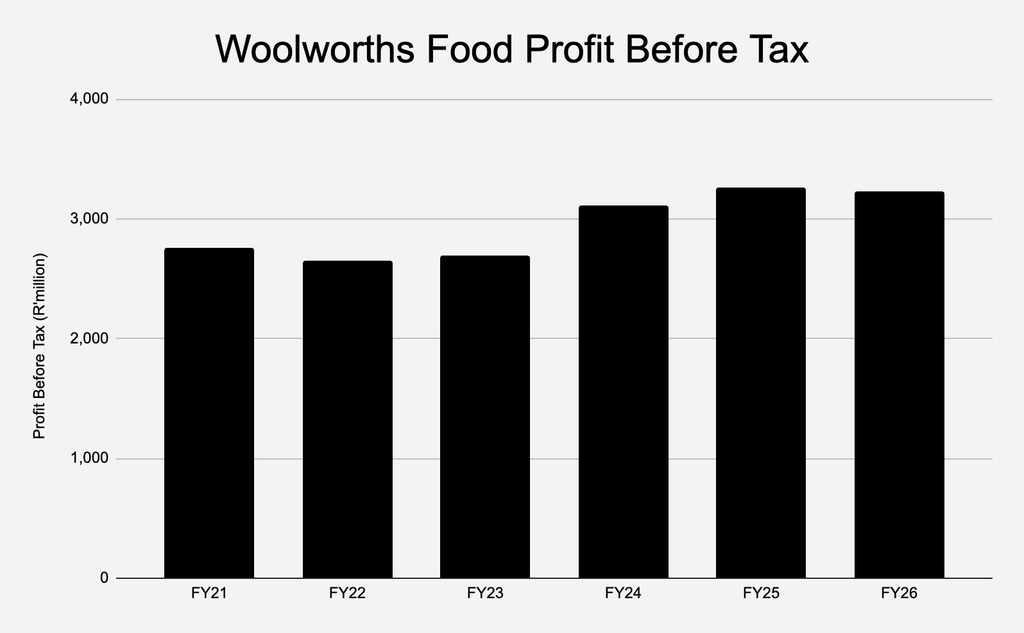
The segment’s turnover rose by 5.45% to R54.02 billion, while revenue grew by 5.55% to R54.33 billion. However, its before-tax profit dipped 1.13% to R3.23 billion.
The profit dip was due to higher distribution costs, a result of rising fuel prices, and greater investment in growth initiatives like Woolies Dash.
The segment’s adjusted EBITDA rose by 6.1% to R5.04 billion, ahead of topline growth.
Spar and Checkers
Woolworths’ decision to reorient its business comes as the retailer faces increasing competitive pressure.
South Africa’s major grocery retailers, including Shoprite, Spar, and to a lesser extent Pick n Pay, are seeking a larger share of the premium retail market that Woolworths has traditionally dominated.
This is, in part, driven by the uptake of on-demand delivery services, which have given retailers greater access to customers across the income spectrum.
However, moves into Woolworths’ territory have also become more deliberate, with Checkers and Spar having opened dedicated luxury or gourmet stores.
Spar opened its first Gourmet store in Zimbali Oasis, north of Durban, KwaZulu-Natal, in November 2025, with the retailer initially saying more rollouts would follow in the next few years.
While this store has a premium feel and appears to be generating good foot traffic from the nearby Zimbali estate, its rollout has stalled.
Spar is facing financial and operational struggles that it is looking to work through via a turnaround strategy, likely placing its hopes to take on the higher-end market on pause.
A bigger threat to Woolworths Food is Shoprite, with its highly successful Sixty60 offering and FreshX stores.
FreshX stores are Shoprite and Checkers’ upmarket supermarket concept designed to offer an elevated shopping experience.
It is the retailer’s attempt to crack into the premium retail sector by targeting wealthier South Africans with high-end products and speciality stations such as artisan bakeries, sushi bars, wine cellars, and craft coffee counters.
Shoprite’s trump card is its Sixty60 service, the on-demand delivery platform that has enabled the retailer to gain market share from competitors over the past five years.
The Sixty60 threat
Previously, Checkers, Pick n Pay, and Spar have been unable to match Woolworths’ brick-and-mortar offering in the premium retail market.
It is difficult to replicate Woolworths’ market-leading control over product development, its cold supply chain, and proprietary farm-to-shelf specifications.
However, the rising uptake of on-demand delivery services and Sixty60’s clear market dominance have allowed Shoprite to attract consumers across the income spectrum.
In Shoprite’s 2026 financial year, Sixty60 increased its sales to R25.5 billion, up from R18.9 billion over the previous period.
This means that Sixty60 alone generated just under half of Woolworths Foods’ entire business turnover in 2026.
When looking at the two retailers’ revenue growth figures, with Sixty60 at 34.5% and Woolworths Food at 5.55%, it is clear that the e-commerce service is rapidly catching up.
Woolworths’ answer to Sixty60, Woolies Dash, is also growing far slower than its competitor.
Revenue through the Woolies on-demand service grew by 19.6%, with the online channel now contributing 7.3% to South African Food sales.
In contrast, Sixty60 now represents 11.1% of Shoprite’s Supermarket RSA sales, which is a much larger base than Woolworths Food.
In 2022, Shoprite revealed that Sixty60 captured an estimated 75% share of South Africa’s online grocery delivery market.
More recent estimates place Sixty60’s market share at 80% of the local on-demand grocery delivery market.
Therefore, Woolworths’ decision to reorient its business around the Food division comes at a time when it needs to hone in on its strengths to fight off heightened competition from South Africa’s largest retailer.






Comments