Cape Town house prices rose much faster than Johannesburg and Durban



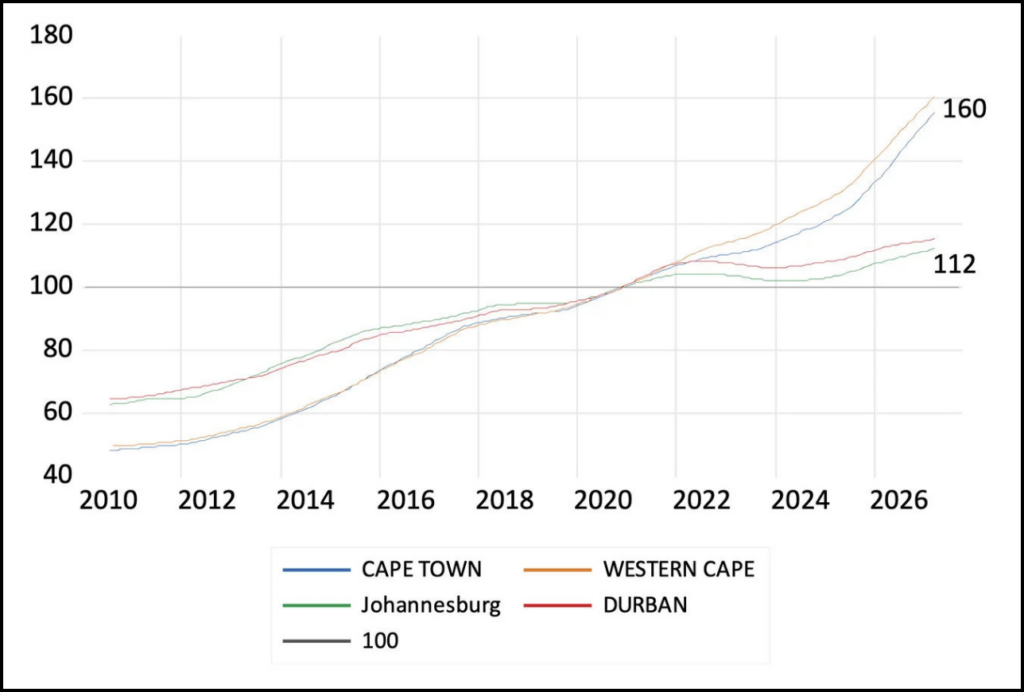
Cape Town’s average home prices have risen by 60% since 2020, outpacing those in Johannesburg and Durban.
This was revealed by Investec Wealth & Investment International’s Brian Kantor, who said Cape Town’s rising property values show how demand, investment, and municipal competence can reinforce one another.
Kantor cited Clifton as an example of how changes in property ownership can drive up values. The City of Cape Town allowed Clifton residents to convert their land leases into freehold ownership at an attractive rate.
“Rents and the value of renovated homes then began an upward spiral that continues to this day,” he explained.
Many original residents sold their properties and moved to less expensive areas, while developers and buyers moved in to meet demand for higher-value homes.
These properties also generated more revenue for the city through rates, creating a link between rising property values and municipal income.
Kantor explained that a similar trend is now evident across Cape Town and its surrounding areas.
“A Clifton-type story is now unfolding in other parts of Cape Town and its environs, where rents and property values have been rising and are expected to continue to increase,” Kantor said.
High-rise developments are being built to meet housing demand, while construction activity creates jobs and income across the economy.
The price gap between Cape Town and South Africa’s other major cities has also widened. The average price of a home in Cape Town has increased by 60% since 2020.
By comparison, average house prices in Johannesburg and Durban increased by 12% over the same period.
While the gains have benefited Cape Town homeowners, Kantor noted that the trend also creates problems.
“These include traffic congestion for established residents and visitors, and increased strain on the delivery of water and electricity, refuse collection, and road maintenance and management,” he said.
Rising property values also mean that those who do not own their own home face higher rental costs.
“You can rent at much lower rates per square metre in Johannesburg and Durban,” Kantor said.
More housing is needed
According to Kantor, the solution to rising property costs is to increase housing supply.
“The answer to the growing scarcity of any good or service, including accommodation, is to increase supply,” he said.
Kantor noted that there is still undeveloped land close to central Cape Town that could be used for housing.
The city could help unlock this land by investing in the infrastructure needed to connect it to water, electricity, and other essential services. This could, in turn, also benefit the city financially through additional property taxes.
“The additional income collected each year from rates charged on the additional housing stock would help recover the city’s costs,” Kantor said.
This shows that infrastructure spending could provide both economic and financial benefits for the city.
“Investing in infrastructure can provide good long-term returns, both in kind and in cash, for a growing city,” he said.
Kantor explained that the growth in Cape Town property values has already translated into higher municipal revenue.
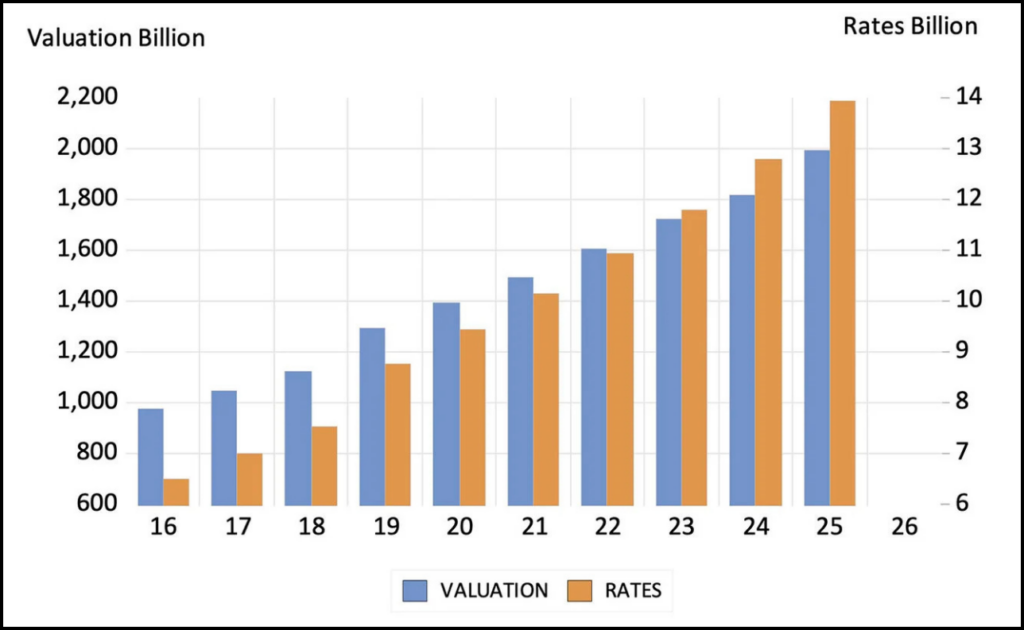
The value of taxable real estate in Cape Town increased from R1 trillion in 2016 to nearly R2.2 trillion in 2025.
Property rates have increased alongside this growth, rising from R6.5 billion in the 2015/16 financial year to R13.92 billion in 2025/26.
The City of Cape Town expects to collect R15.8 billion in property rates during the 2026/27 financial year, a 13.7% increase.
Kantor described this relationship between property values, municipal revenue and investment as a “virtuous circle”.
“A successful city, with a growing stock of taxable real estate, can make choices that reinforce the potential to raise incomes, with a budget that provides for improved amenities that, in turn, add to property values,” he said.
The additional revenue can be used to maintain existing infrastructure and expand capacity as the city grows.
“The tax revenue helps maintain the municipal capital stock and fund additional capacity to meet growing demand, thereby supporting and reinforcing property values, which in turn further improve revenue flows,” he said.
Given the city’s strong balance sheet and low debt, Kantor said Cape Town should be more aggressive with its infrastructure spending.
Additional infrastructure could help the city accommodate more residents, increase housing supply and support property values.
“It could raise debt to expand its infrastructure in ways that would reinforce property values and revenues. More boldness is called for,” he said.






Comments