Nedbank has a warning for South Africa


Nedbank chief economist Nicky Weimar warned that South Africa’s economy is at risk of stalling as consumer spending comes under pressure.
Increased household spending over the past year has given South Africa’s economy a “sugar high”, temporarily boosting growth.
However, this cannot sustain growth forever, as inflation and interest rates rise due to the war in Iran, and fixed investment remains lacklustre.
Weimar explained that fixed investment is crucial for long-term economic growth as it boosts individual productivity and activity.
Fixed investment refers to capital allocated towards infrastructure, equipment, and machinery, among other things.
Weimar told the 2026 Nedgroup Investments Treasurers Conference that South Africa is facing a dangerous combination of weak investment, inflationary pressure, and export challenges.
These are a major threat to economic growth and are why South Africa’s economy appears to be losing momentum in 2026.
“South Africa’s 1.1% GDP growth in 2025, after years of stagnation, was driven almost exclusively by consumer spending,” Weimar said.
“Spending grew by 3.6% and contributed 2.3 percentage points to GDP growth, while fixed investment shrank by 2.2% and negatively contributed to GDP growth.”
“This is not a sustainable growth recipe. Consumer-led growth without business investment indicates an economy runnin gon fumes.”
Weimar said the tables have already turned, with six consecutive quarters of growing real income and consumer spending coming to an end in the middle of 2026.
In other words, the forces driving South Africa’s economic growth are now dissipating, putting the country on the brink of another year of 1% growth.
Consumer relief from lower inflation is temporary, as fuel prices push costs higher across the economy and take more money out of consumers’ pockets.
“We expect inflation to stay elevated, ending the year above 4%, with monetary policy remaining tight for as long as energy shocks persist,” Weimar said.
As a result, Weimar has adjusted her forecasts for the coming years, with consumer spending growth being only 1.8% in 2027 and GDP growth reaching 1.4%.
Fixed investment disaster
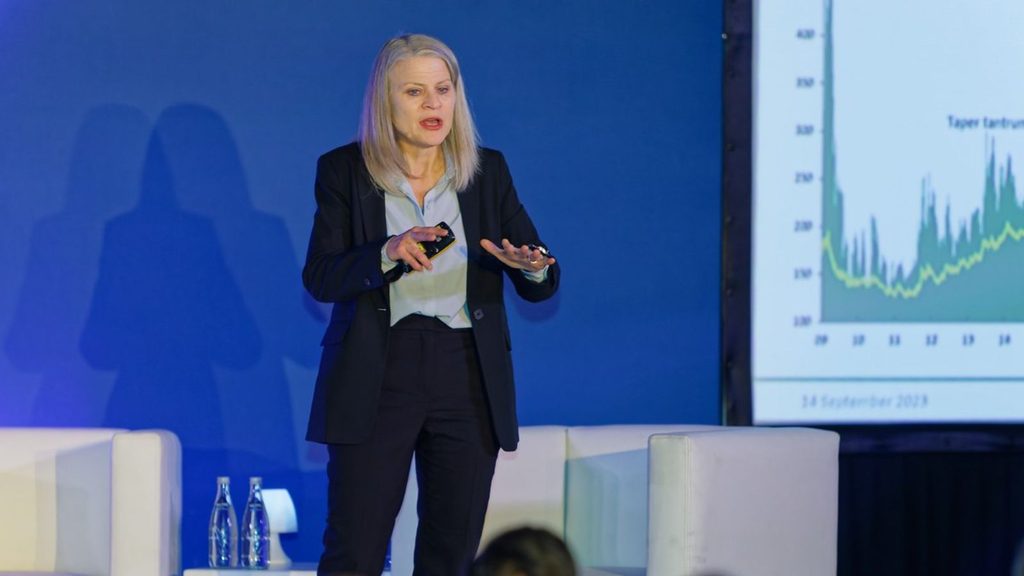
Most concerning for Weimar is the continued decline in fixed investment despite various government pledges and programmes.
Recently, the state announced an ambitious target of R1 trillion in infrastructure spending over three years with a focus on logistics and energy.
Weimar said that despite this ambition, capital formation remains very low, averaging 14.1% of GDP since 2020.
The average for much faster-growing emerging economies is 25% to 35%. This translates into average economic growth of 4.5% across emerging markets.
“While the rate of decline is slowing, it remains far below levels required to lift GDP growth materially,” Weimar said.
“Public sector outlays are volatile, and private sector investment has relapsed, leaving infrastructure spending at “extremely low levels.”
“Without sustained private-sector participation, public spending will struggle to generate the multiplier effects needed to transform the economy.”
The government also simply does not have the balance sheet required to invest on such a scale, given the historic mismanagement of state finances.
Government debt has surged from 26% of GDP in 2008/09 to over 76%, forcing significant changes at the National Treasury.
The Treasury’s fiscal consolidation policy to tackle South Africa’s rising debt leaves little room for the government to invest heavily without private participation.
Crucially, one of the main benefits of private capital is that it is held to extremely high standards by shareholders, regulators, and management.
A private company cannot afford to lose significant sums of money to wasteful and irregular expenditure, nor can it afford to invest in a project that does not generate adequate returns.
Weimar said the only way to unlock significantly higher fixed investment is to accelerate the implementation of structural reforms.
These reforms in the energy, logistics, and water sectors will increase private-sector involvement in the economy and provide greater space for investment.
This needs to be coupled with urgent investment in South Africa’s infrastructure, which is vital to improving citizens’ lives and easing the ease of doing business.





Comments