Tables have turned on South Africa


The war in Iran has flipped South Africa’s economic script, with forecasts of much faster growth being replaced by another year of flat 1% GDP growth.
Boutique wealth manager Melville Douglas is the latest financial institution to significantly shift its outlook for South Africa from the start of the year.
Melville Douglas is Standard Bank’s boutique investment house that manages the wealth of high-net-worth individuals and families.
Its chief investment officer, Bernard Drotschie, gave the firm’s updated outlook for 2026 and 2027 at its annual investment conference.
Drotschie explained that at the beginning of 2026, Melville Douglas was bullish on South African assets, along with most asset managers.
This was driven by the yield offered by South African assets and, for the first time in over a decade, an emerging story of faster economic growth.
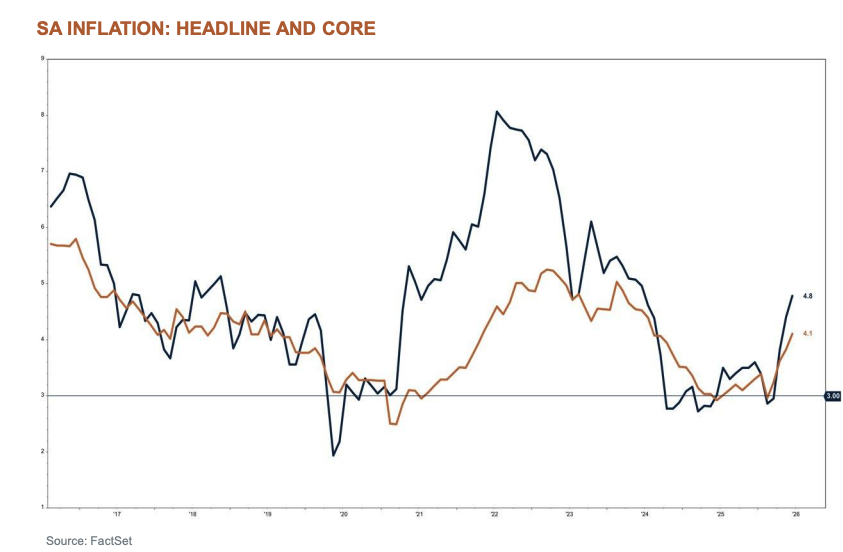
A shift to a lower inflation target of 3% and steady implementation of reforms led many to revise their 2026 growth outlooks higher, with some projecting GDP growth of over 2%.
Lower inflation and interest rates were expected to translate into increased consumer spending and investments, with key reforms increasing private participation in the economy.
At the start of 2026, Melville Douglas forecast South Africa’s economy to grow at 1.4%. While low, this was remarkably higher than the previous decade’s average of 0.8%.
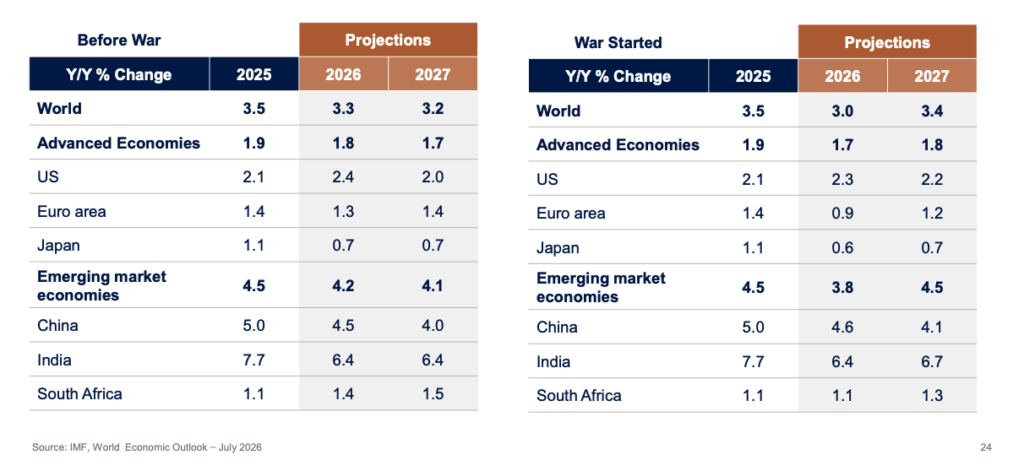
However, after considering the impact of the war in Iran, the firm now projects South Africa’s economy to grow by only 1.1% in 2026.
This is the same rate of growth seen in 2025 and will only marginally improve to 1.3% in 2027. This is far below the growth rate needed to tackle surging unemployment.
Drotschie pointed out that the country is an outlier among emerging markets, with most expected to be more resilient than South Africa.
Economic growth in China and India is expected to hold at pre-war levels and even improve. These countries are also falling from a much higher base.
Emerging markets are expected to grow 3.8% on average in 2026, which is down from the long-term rate of 4.5%.
These differences may appear small, but the difference between 1.1% and 3.8% is your economy doubling every 65 years or every 19 years.
Interest rate clouds
Drotschie explained that the main reason for the downturn in economic growth is rising interest rates that may remain higher for longer.
Rising interest rates subdue economic activity by making borrowing more expensive and encouraging individuals to save, thereby reducing disposable income.
South Africa’s economy is heavily reliant on trade and consumer spending for growth, which are among the hardest hit by elevated rates.
However, the country does have a saving grace in the form of a conservative Reserve Bank, which has not aggressively cut interest rates.
This means that the country’s rates remain restrictive, reducing the need to hike interest rates to combat elevated inflation.
This gives the Reserve Bank time to assess the impact of the war in Iran and not act hastily, which is vital to avoid unnecessarily tightening monetary policy.
Drotschie said the bank is likely to hike rates once more in September before restarting its cutting cycle in 2027.
This won’t be enough to reignite South Africa’s economic growth prospects, with the government’s reform agenda progressing very slowly.
Lower interest rates will boost consumer spending and lift GDP. However, rates are, by nature, cyclical and will not boost growth over the long run.
The main long-term driver of economic growth is fixed investment in infrastructure, equipment, and machinery, as such investment boosts productivity.
South Africa’s fixed investment rate is 13% of GDP. In contrast, the average emerging market invests 25% of its GDP in this way.
South Africa has achieved notable reform success in some areas, such as electricity, visas, and telecoms. This unlocks fixed investment and crowds in private participation.
However, the logistics and water sectors are increasingly the biggest drag on the local economy. These sectors are where the least progress has been made.
Drotschie said South Africa’s water sector is in a full-blown crisis, while logistics reform has been painstakingly slow.
One advantage of South Africa’s low growth is that even minimal improvement can significantly boost activity. Progress is slow, but it is heading in the right direction.
 Loading ...



Comments