Allan Gray backs Shoprite, Mr Price, and Dis-Chem


Allan Gray views Shoprite, Mr Price, and Dis-Chem as high-quality businesses trading at meaningful discounts to their history.
Given challenges in the local macroeconomic backdrop, the asset manager said it approached the opportunity in these stocks with caution and selectivity.
This was revealed in the overview of the asset manager’s Equity Fund for the first half of 2026, wherein Allan Gray portfolio manager Tim Acker discussed opportunities on the JSE.
He identified the fund’s continued rotation into SA Inc shares as a key theme for the first half of 2026.
SA Inc stocks refer to companies listed on the JSE that derive the vast majority of their income from the local economy.
Classic examples of these stocks are retailers, as most of their stores, and therefore their customers and income, are located in South Africa.
These stocks are often overlooked or considered risky, as any changes to South Africa’s macroeconomic environment – which can be challenging at the best of times – will directly influence their performance.
For example, changes to interest rates or inflation will directly impact consumers’ disposable income, thereby also putting pressure on a retailer’s income.
This is why many domestically focused companies have lagged the broader market and still trade at depressed valuations.
However, Acker pointed out that the FTSE/JSE All Share Index reached record highs earlier this year, revealing opportunities in SA Inc stocks.
“We took profits in areas of strength, such as precious metals and multinationals like British American Tobacco, and redeployed capital into select domestic businesses where valuations are more compelling,” Acker explained.
Acker specifically identified retailers such as Shoprite, Mr Price and Dis-Chem, saying Allan Gray views these stocks as high-quality businesses trading at meaningful discounts to their history.
Below is an overview of how Shoprite, Mr Price, and Dis-Chem have performed over the past five years, and their stock performances in the year to date.

Shoprite
South Africa’s biggest retailer continues to lead the grocery retail market, remaining far ahead of the competition.
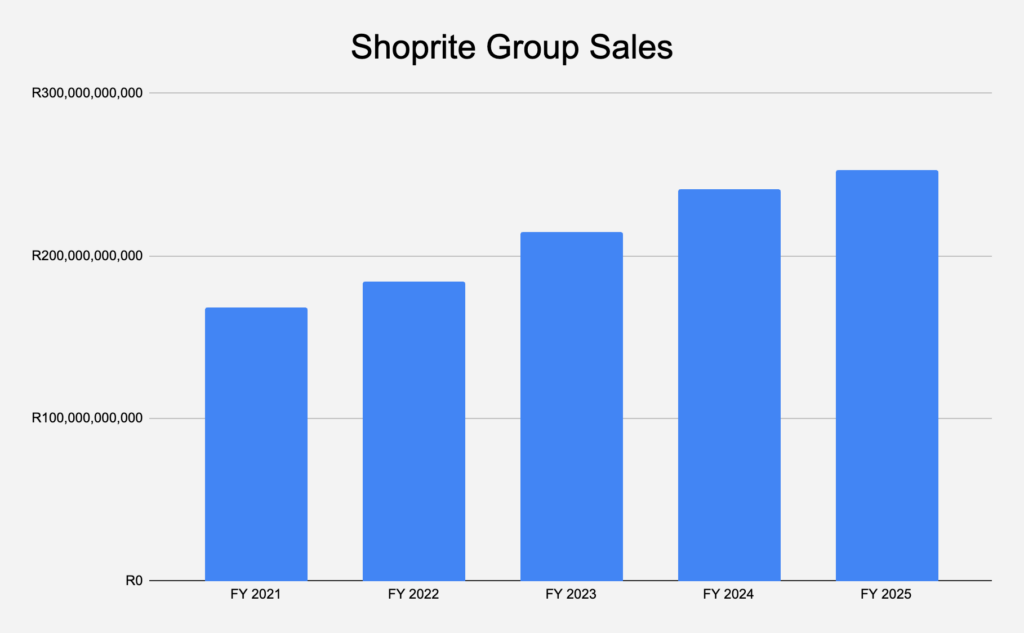
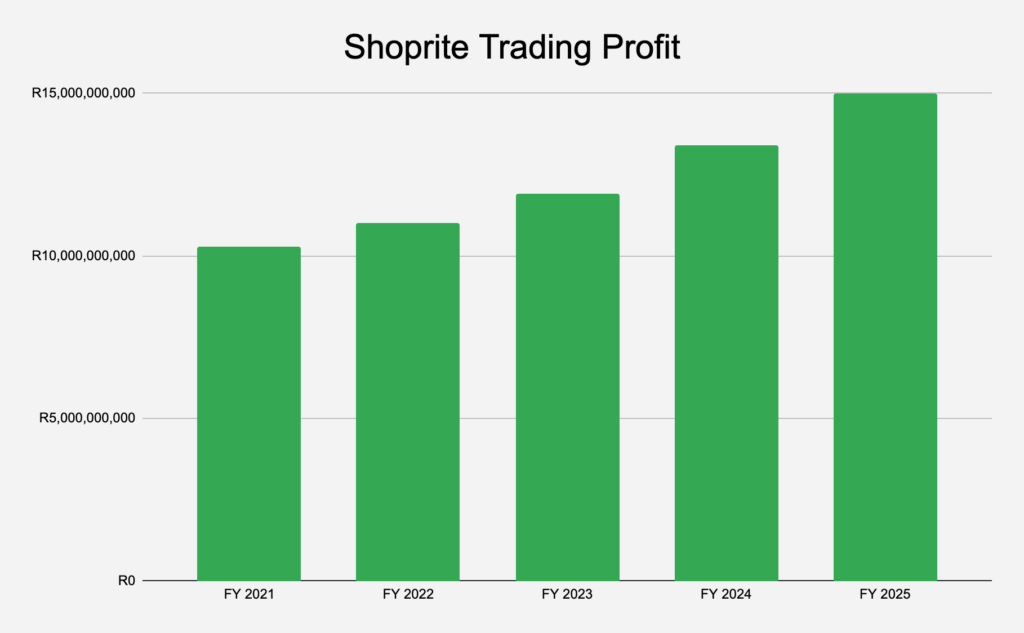
Over the past five years, the retailer has consistently grown its sales, profit, and market share despite South Africa’s lacklustre consumer environment.
Much of this growth has been driven by its highly successful Sixty60 on-demand delivery service, which launched in 2019 and blazed the trail for other retailers’ 60-minute delivery offerings.
Crucially, Shoprite completed the acquisition of Pingo, the logistics backbone behind Sixty60, in 2024.
This move has been celebrated as a smart way to ensure that the retailer has full control over every step of the delivery process, ensuring the continued success of Sixty60.
The retailer now boasts a 19.4% return on invested capital (ROIC), and its latest full-year results for the 2025 financial year showed that it made R252.7 billion in sales.
Its growth has also been powered by the Xtra Savings Loyalty Programme, which has grown rapidly and now has 33.7 million members.
While the group has come under some pressure from the 2021 floods and unrest, high load-shedding levels in 2023, and commodity deflation in 2025, it has weathered these storms well.
Through cost containment and improved logistics, the retailer ensured that its sales continued to grow, albeit more slowly than in previous years, and that its ROIC returned to its peak in 2025.
Investors have noted Shoprite’s strong performance, and the stock is up 12% in the year to date.
Mr Price
Mr Price is an apparel retailer that operates mainly in South Africa but also has operations in the rest of Africa and, more recently, in Europe.
Apparel retail can be a very difficult business, especially in South Africa’s depressed consumer environment, where people have limited disposable income and are highly price sensitive.
Local apparel retailers have come under particular pressure in recent years with the rise in popularity of low-cost global e-commerce businesses such as Shein.
While Mr Price has come under pressure, it has managed to keep its head above water and sufficiently diversified its income to ensure a more stable performance.
The retailer’s telecoms business, in particular, has seen strong growth over the past five years, now contributing R1.5 billion to group sales.
Mr Price has also been on an acquisition spree, buying local fashion and homeware brands to diversify its offerings and expand its footprint across the country.
It recently also completed the acquisition of German retailer NKD, which marked its expansion into Europe.
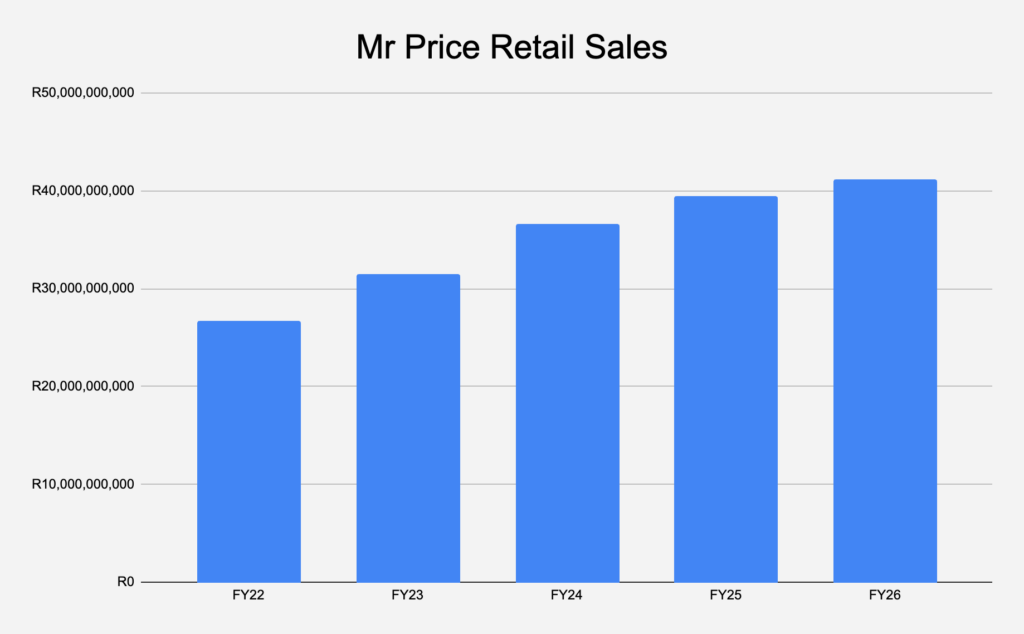
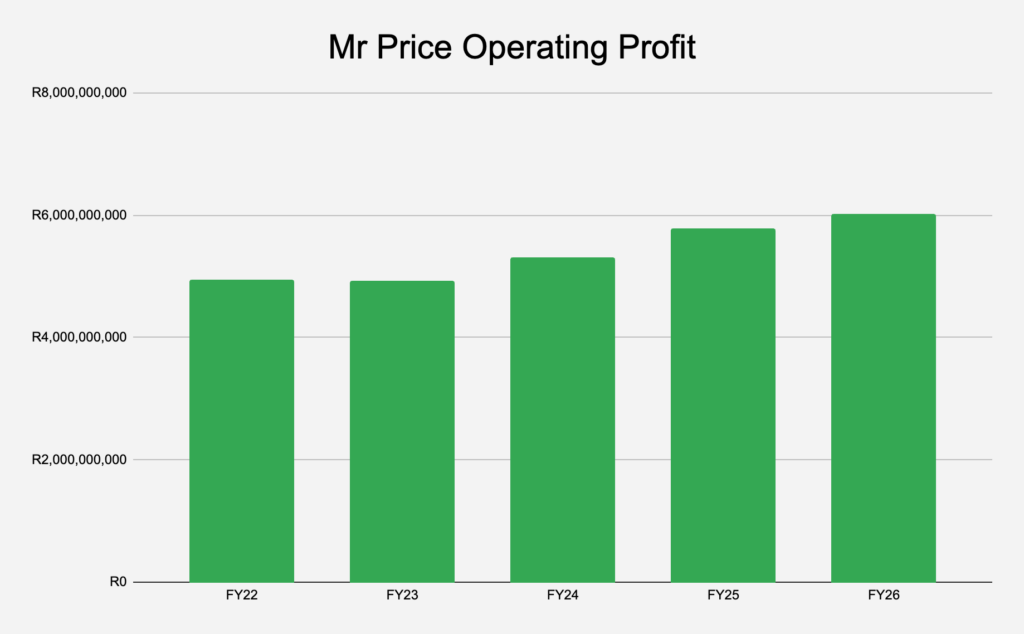
At a group level, Mr Price’s sales have grown consistently over the past five years, and it reached a record operating profit in its 2026 financial year, exceeding R6 billion for the first time.
The retailer now operates across a footprint of 3,182 stores, having added 196 new stores in the 2026 financial year. This excludes its footprint in Europe following the NKD acquisition.
Despite its strong performance, Mr Price’s share price has taken a beating this year to date, with the stock down 5%.
Dis-Chem
Dis-Chem operates in a very different competitive environment than Shoprite and Mr Price, as South Africa’s retail pharmacy market is dominated by only two players – Dis-Chem and Clicks.
To make its business stand out, Dis-Chem has spent the past few years expanding its wholesale operations and positioning itself as a key player in the broader healthcare market.
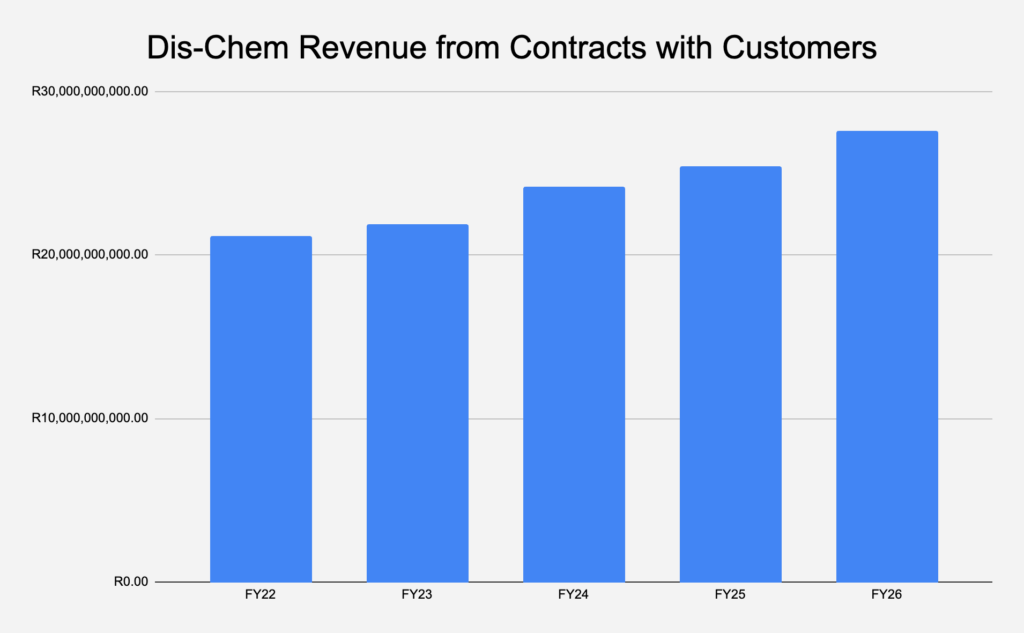
While there is still some uncertainty as to how the retailer’s investments and ambitious expansion plans will pan out, Dis-Chem has managed to consistently expand its top line.
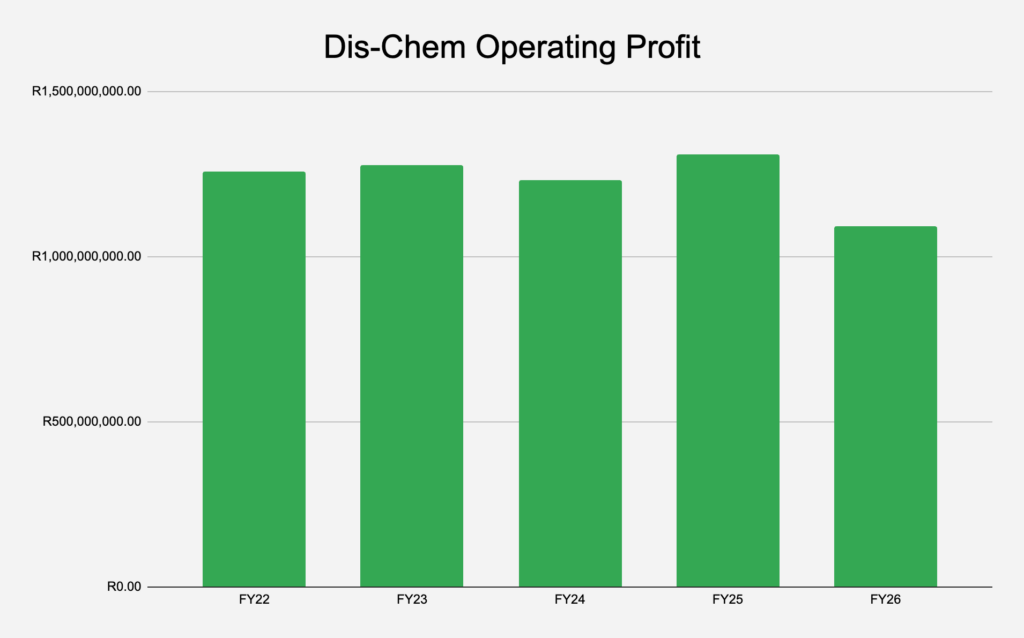
There has been some bottom-line volatility, particularly as the retailer’s operating costs have risen and it has made some high capital investments.
However, Dis-Chem’s trading profit in its latest financial year, 2026, remained above R1 billion.
The retailer has also reported seeing benefits from its revamped loyalty programme, Better Rewards, which is expected to be a strong growth lever in the coming years.
Dis-Chem CEO Rui Morais has also made it clear that the retailer plans to move more into the healthcare sector in the years to come.
Dis-Chem is looking to create a business model centred on an integrated healthcare ecosystem, combining retail pharmacy services, wholesale distribution, and specialised primary care clinics.
The retailer has also been investing in its financial services offering through targeted equity acquisitions and joint ventures in health and life insurance.
Through this, Dis-Chem is creating a closed-loop system where patient healthcare data, in-store clinic visits, and preventative care are tied to insurance rewards and products.
This represents a dramatic shift from a traditional retail pharmacy model to a highly diversified, data-enabled healthcare group.
However, investors may need more time to see how these investments and shifts pay off, as Dis-Chem’s share price is down 17% in the year to date.
 Loading ...




Comments