DA finance chief’s company accused of illegally taking billions out of South Africa



Kastelo, a fintech company founded by DA Federal Finance Chairperson Mark Burke, has been accused of breaching South Africa’s exchange control regulations.
Kastelo has denied these claims, saying it acted in its clients’ best interests and did not contravene Exchange Control Regulations.
A recent case heard in the Johannesburg High Court revealed that Kastelo filed an application to set aside the Reserve Bank’s order freezing its bank account. Kastelo is led by Burke’s brother, Nicholas, who serves as its CEO.
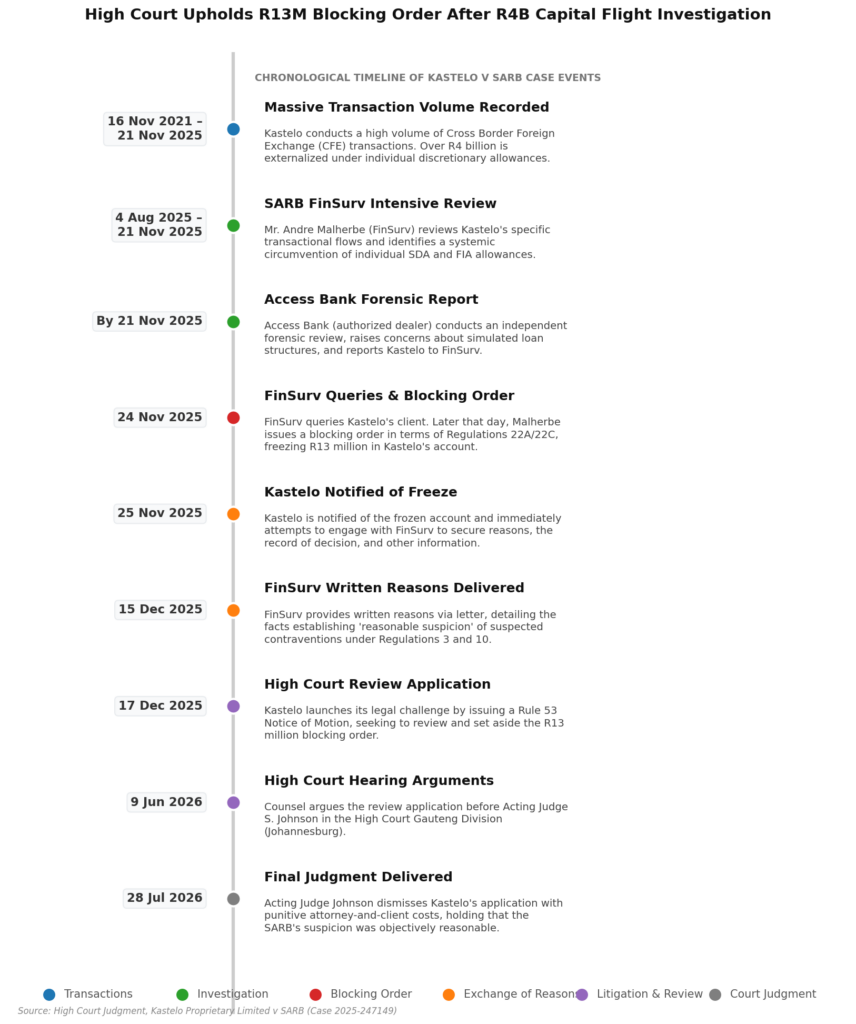
The main issue in the case took place between 2021 and 2025, when Kastelo conducted a huge volume of Cross-Border Foreign Exchange (CFE) transactions.
The Reserve Bank, through its Financial Surveillance (FinSurv) Department, routinely records these types of transactions in a database.
From August to November 2025, a dedicated official in the FinSurv Department, Andre Malherbe, conducted an intensive review of Kastelo’s specific transactional flows.
He found that Kastelo’s business model allegedly facilitated the transfer of R4 billion in foreign currency out of South Africa in the 2025 calendar year alone.
Around the same time, Kastelo’s authorised dealer, Access Bank, had raised concerns about potential exchange control contraventions and launched its own forensic investigation.
As part of this investigation, Access Bank reported Kastelo’s transactions to the Reserve Bank’s FinSurv Department.
On 24 November 2025, Malherbe contacted one of Kastelo’s clients, who rebutted the FinSurv Department’s assumptions. The client also copied in Nicholas Burke and Kastelo’s legal head, Duan Craffert.
Burke and Craffert offered to provide the FinSurv Department with further information.
Later that same day, Malherbe issued a blocking order to Access Bank, which required it to freeze withdrawals from Kastelo’s bank account. The account allegedly contained R13 million at the time.
The day after, Kastelo was notified of this frozen account and immediately attempted to engage with the FinSurv Department to secure reasons, the record of decision, and other information.
The FinSurv Department provided these reasons in a formal letter sent to Kastelo in December 2025, explaining that it had reasonable suspicions that there had been a contravention of Exchange Control Regulations.
Shortly after receiving the letter, Kastelo launched a legal challenge, issuing a High Court Notice of Motion. It sought to review and set aside the blocking order.
The High Court heard the case in June 2026, and the judge delivered his final verdict on 28 July 2026.
The judge dismissed Kastelo’s application with punitive attorney-and-client costs. The court found that the Reserve Bank had established a valid, objectively reasonable suspicion.
Kastelo’s alleged business model
The Reserve Bank alleged that Kastelo systemically breached South Africa’s Exchange Control Regulations through four key mechanisms.
The first mechanism allegedly involved exploiting individual client allowances via simulated transactions.
In South Africa, individuals are allowed to transfer up to R2 million – before 2026, the allowance was R1 million – offshore every calendar year without requiring clearance from SARS. This is called a Single Discretionary Allowance (SDA).
Separately, South African residents can also transfer up to R10 million per calendar year under the Foreign Investment Allowance (FIA) for offshore investments.
Simply put, the Reserve Bank believes Kastelo used its clients’ personal SDAs and FIAs to purchase foreign currency and acquire crypto assets offshore.
The company allegedly convinced clients to do so by promising them “bonuses” of up to R2,000 for their SDA and R10,000 for their FIA.
According to the Reserve Bank, many of Kastelo’s clients had little to no understanding of what was being done in their names, and did not know that foreign bank accounts had been opened for them.
The second mechanism included murky and artificially vetted loan structures, whereby Kastelo would allegedly advance loans to individuals that enabled them to fund their SDA and FIA allowances.
Access Bank’s investigation revealed that many clients who earned R15,000 per month were receiving unsecured loans of R249,000.
The third mechanism involved systematic breaches of Treasury Outsourcing Company (TOC) Rules.
A TOC is a specialised third-party provider that manages a business’s financial operations. Registered TOCs are bound by the Currency and Exchanges Manual for Authorised Dealers.
The Reserve Bank suspects that Kastelo, a registered TOC, directly contravened some of these rules. These rules:
- Prohibit registered TOCs from buying or selling foreign currency for their own account
- Require transactions to be settled directly between an authorised dealer and clients
- Require TOCs to have a specific client instruction/mandate for every individual foreign exchange transaction
The fourth mechanism is the overarching impact of the first three mechanisms, relating to the illegal export of capital.
The Reserve Bank suspects that, because Kastelo did not have specific permission to operate its collective business model, its 2025 foreign-currency export of R4 billion constituted an illegal capital export by Kastelo itself.
In the High Court, Kastelo refuted this, stating that its model was not a permanent export because value was repatriated to South Africa in rands at the end of each cycle.
The Reserve Bank countered that this did not cure the initial unlawful export of foreign currency, which depleted the country’s foreign reserves.
Kastelo’s response
Kastelo told Daily Investor that the company has always conducted its business with integrity and in compliance with applicable law, “and it is important to us that the public record accurately reflects this”.
Regarding Kastelo’s arbitrage service, the company said it enabled clients to benefit from price differences between domestic and international crypto markets.
“Kastelo, as a licensed financial services provider, administered the arbitrage process on clients’ behalf, for their benefit, in line with a discretionary mandate and against a fee,” it said.
“Client investments were used to purchase foreign currency through an Authorised Dealer, in their name.”
“Foreign currency was sent offshore (on behalf of the clients and within their allowances) for the sole purpose of purchasing crypto assets at a lower price abroad, and immediately returning those crypto assets to be sold at a higher price in South Africa.”
The company said this, therefore, returns more rands to the client at the completion of each trade.
With regard to South Africa’s Exchange Control Regulations, Kastelo pointed out that these rules allow residents to externalise funds from South Africa to the value of their annual SDA, or, with approval from SARS, to the value of the allowable FIA.
“Accordingly, if a South African invests abroad within these allowances or with approval, this is not considered a contravention of Exchange Control Regulation, but rather an allowed externalisation of funds,” it said.
“Accordingly, we do not agree with the statement that ‘Kastelo used its clients’ funds to move money offshore, potentially in contravention of foreign exchange control regulations’.”
*Mark Burke recently confirmed that he is not the chairperson of Kastelo and is not involved in its daily operations. While he previously served as chairperson, he left the position in February 2026 and resigned from Kastelo in 2024 to pursue a political career.






Comments