The South African province which is so bad that more people are unemployed than working



The Eastern Cape’s expanded unemployment rate has increased from 47.7% to 54.1% over the last year, which means more people are unemployed than working.
This was revealed in Statistics South Africa’s latest Quarterly Labour Force Survey, which showed that unemployment increased across South Africa in the second quarter of 2026.
The official unemployment rate increased by 0.9 percentage points to 33.6% over the last quarter. Unemployment increased in six of the nine provinces.
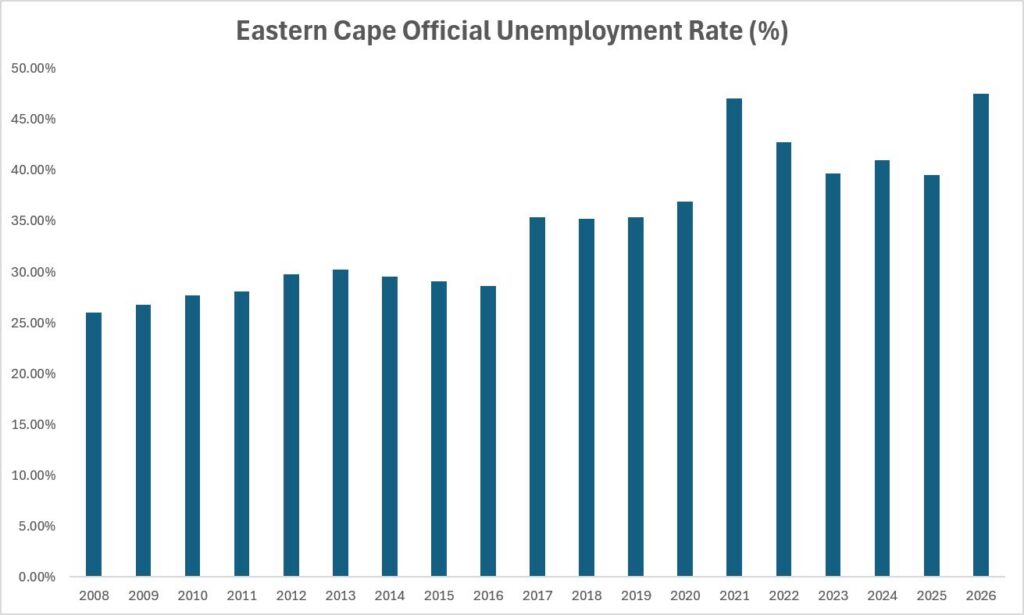
The largest increase in unemployment was recorded in the Eastern Cape, which increased from 39.5% in Q2 2025 to 47.5% in Q2 2026.
However, this only tells part of the story. The combined rate of unemployment and potential labour force gives a full picture.
This measure gives the proportion of the active population that is either unemployed or has a marginal attachment to the job market.
While the official unemployment figure only captures people actively seeking work, the combined unemployment and potential labour force rate is broader.
It includes discouraged job seekers, non-searching available job seekers, and unavailable job seekers.
Simply put, the combined rate of unemployment and potential labour force gives a true reflection of unemployment in a country or province.
In the Eastern Cape, the extended unemployment rate increased from 47.7% to 54.1% over the last year. This means that more people in the province who can and want to work are unemployed than are working.
Out of a population of 4.7 million people between the ages of 15 and 64, only 1.3 million are employed.
Outside of the metros, the situation is even worse. Out of 3.1 million people in this category, only 707,000 are employed.
Concerns raised about the Eastern Cape

Many stakeholders have raised concerns about the rapidly increasing unemployment rate in the Eastern Cape.
One of these stakeholders is Andrew Whitfield, the former Deputy Minister of Trade, Industry and Competition and a member of the Eastern Cape Legislature.
“The province urgently needs to get municipalities working so that they can attract investment and create jobs,” he said.
“Year on year, the unemployment rate jumped eight percentage points, with the province shedding 116,000 jobs in the process.”
The latest figures suggest that large numbers of Eastern Cape residents who were previously outside the active labour force began looking for work.
However, due to the myriad of problems facing the province, the economy could not absorb them.
Outside Buffalo City and Nelson Mandela Bay, official unemployment has now reached 56.5%, while the broader measure stands at 63.2%.
“The Eastern Cape does not have a shortage of people willing to work. It has a shortage of jobs, investment, and functioning local economies,” Whitfield said.
He added that these unemployment figures cannot be separated from the Eastern Cape’s continuing migration crisis.
People move where they believe they can find jobs, opportunity, and functioning communities.
Nearly one million people left the Eastern Cape for other provinces, particularly the Western Cape and Gauteng, over the past decade.
“Turning this around requires more than employment programmes. It requires functioning local economies,” Whitfield said.
“Working towns and cities attract investment. Investment allows businesses to expand. Expanding businesses create jobs.”
“If we want to reverse unemployment and migration, we must start by getting Eastern Cape municipalities working for all.”
That means reliable water and electricity supplies, well-maintained roads and infrastructure, efficient planning systems, and responsible financial management.
It also calls for professional municipal administrations that make it easier, rather than harder, to invest and do business.
“If we are serious about turning the tide on unemployment and migration, getting Eastern Cape municipalities working must become an economic imperative,” he said.
Eastern Cape Official Unemployment Rate





Comments