Tide is turning for South Africa


There are positive signs emerging for South Africa’s economy, with growth turning in the right direction and the state’s financial health improving.
This is despite the significant headwinds posed by the conflict in the Middle East, which has driven oil prices higher and led to elevated inflation.
Old Mutual Investment Group portfolio manager John Orford explained that these short-term fluctuations mask the underlying progress South Africa is making.
Many of these underlying developments are familiar to South Africans, such as Operation Vulindlela, the removal from the greylist, and a new inflation target.
What is different now is that the government has stayed the course regarding critical reforms amid geopolitical headwinds.
There has not been a retreat on the fundamental direction of South Africa’s trajectory. Rather, there has been a doubling down by the government.
For example, President Cyril Ramaphosa reiterated the commitment to creating an open, competitive electricity market despite pushback from Eskom.
All the while, Transnet has steadily offered concessions to the private sector to operate key rail corridors and port terminals.
Crucially, Orford said there is evidence of these reforms working, which has the potential to create a virtuous cycle.
As the private sector plays a greater role in the South African economy and people feel the benefits, there is scope to replicate successes beyond electricity and logistics.
Orford explained that the government does not have the balance sheet to invest in these key sectors at the required rate.
This has forced it to seek private capital, with positive results. Load-shedding has ended, and port efficiency is on the rise.
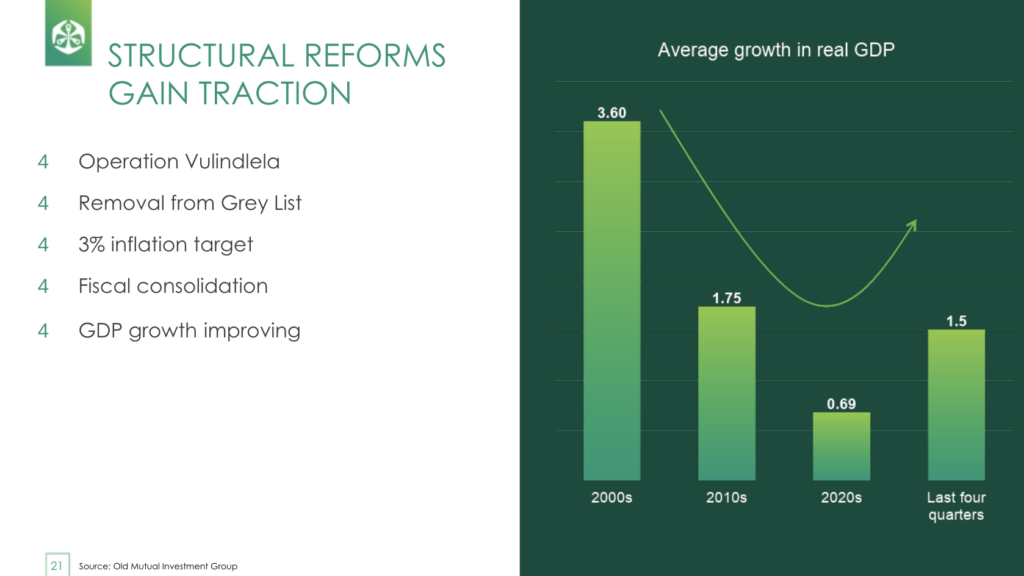
Orford explained that this has fundamentally shifted South Africa’s growth prospects, with the country set to grow at above 1% in 2026 for the first time in the 2020s.
This is more than double the country’s annual growth rate from 2020 to 2025 and approaches the levels seen in the 2010s. It is still far from the golden years of the 2000s.
Hero to zero
One particular point of optimism for Orford is the financial health of South Africa’s government, which has turned the corner.
Since the appointment of Enoch Godongwana as Finance Minister in 2021, the National Treasury has pursued a policy of fiscal consolidation.
This means it aims to keep state spending growth below inflation and to increase tax revenue by enhancing compliance and reducing leniency.
The process is painful, as it means South Africans receive fewer government services while paying more in taxes.
However, outside of a much faster-growing economy, it is the only way the government could stop its financial collapse without significant inflation.
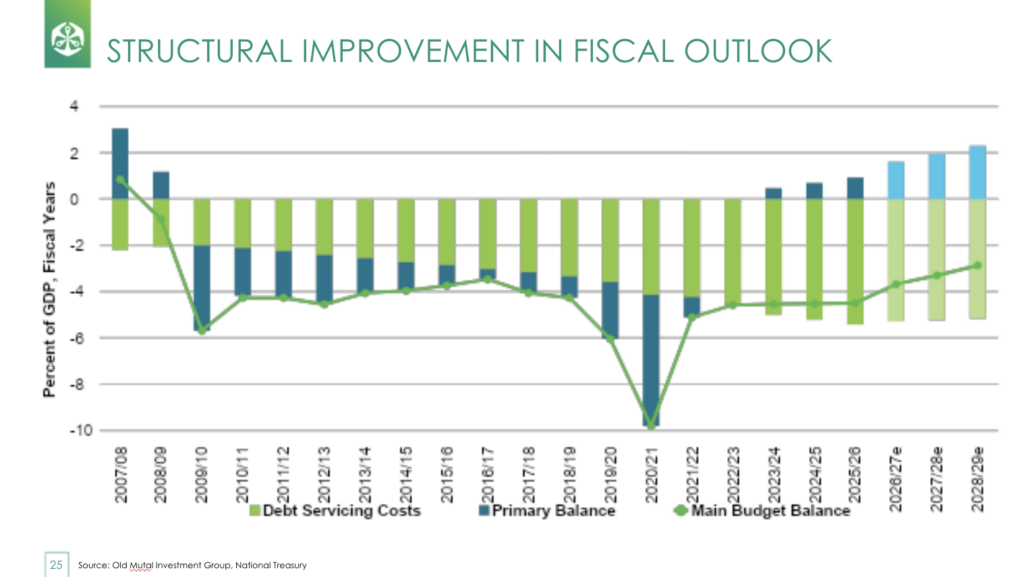
Orford said the process is working as the government is on track to post its fourth consecutive primary budget surplus in the current financial year.
The state is still running a full budget deficit when accounting for debt-servicing costs, which make up 22% of all government spending.
However, a primary budget surplus means the government’s debt burden is growing at a much slower rate and will eventually stop increasing.
This surplus means the government is spending less than it brings in through tax revenue, eliminating the need to raise debt to fund its operations.
Over time, this will slow the growth of the debt pile and enable the government to begin paying down its debt.
This has the potential to create a positive flywheel, where less spending goes towards servicing debt and can be used to invest in infrastructure and deliver services.
It will also result in credit ratings upgrades as South Africa’s finances become more sustainable, increasing foreign investment in local assets.
Orford cautioned that without faster economic growth, this will take a lot of time, and it is unclear whether the National Treasury will have the political cover to pursue consolidation in the future.
Faster economic growth naturally creates additional tax revenue without raising rates or taking more money out of the private sector.
This is the ideal scenario for the National Treasury, as it enables it to free up government spending while minimising debt growth.
A faster-growing economy also improves the country’s debt-to-GDP ratio by raising the GDP component, putting South Africa on a more sustainable fiscal path.





Comments