Critical state-owned company rising from the ashes


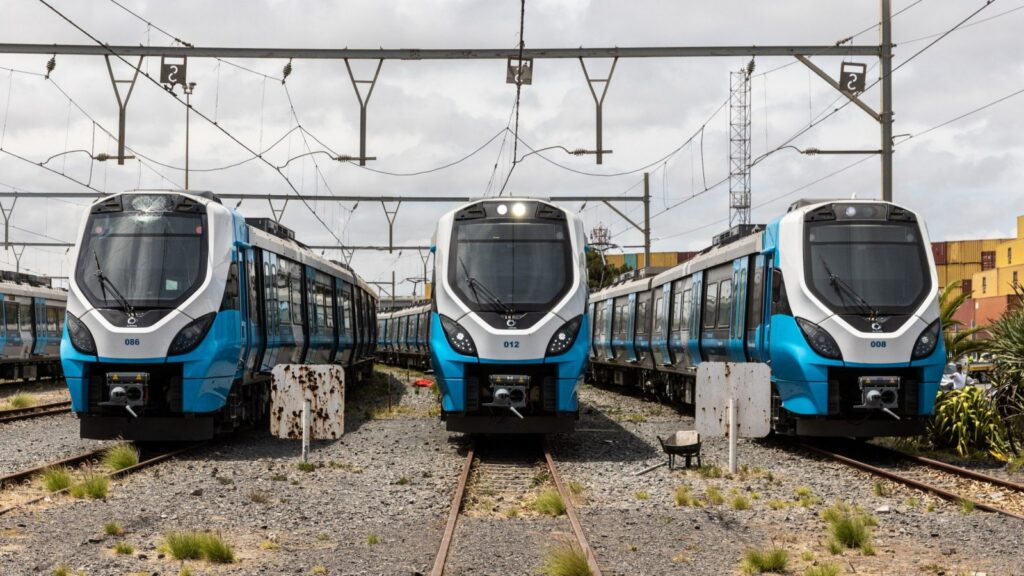
The Passenger Rail Association of South Africa (PRASA) is beginning to make a steady comeback after years of underperformance.
The state-owned passenger rail company recently reported that its monthly passenger numbers had returned to levels last seen six years ago, before the Covid-19 pandemic.
While this is still far below PRASA’s peak monthly passenger levels, it is an improvement over the near-zero numbers it saw during and directly after the pandemic.
PRASA is one of the oldest state-owned enterprises in South Africa, tracing its history back to 1910, when the South African Railways and Harbours Administration was formed.
This was created by the formation of the Union of South Africa to amalgamate the country’s four railway lines and harbour services into a single transport entity.
Later renamed the South African Transport Services (SATS), this entity would be split into separate entities in 1990 to better administer South Africa’s transport system.
As a result, Transnet was created to take over SATS’ rail operations, except for commuter rail, which was transferred to the newly created South African Rail Commuter Corporation (SARCC).
While the SARCC owned all commuter rail assets, such as stations and rolling stock, the services were operated by Metrorail, which was still owned by Transnet.
This agreement caused friction, as neither the SARCC nor Metrorail wanted to take responsibility for the maintenance and investment of the commuter rail system.
Ownership of Metrorail was transferred to the SARCC in 2006, and just two years later, the company was renamed to PRASA.
Between 2011 and 2021, however, PRASA began to experience a significant decline in its ability to provide accessible rail-based transport to South Africa’s urban areas.
According to Stats SA, around 80% of regular PRASA customers stopped using the company’s network between 2013 and 2021 due to unreliable service.
Years of mismanagement and corruption under Jacob Zuma’s presidency contributed to the hollowing out of the state-owned enterprise’s ability to fulfil its mandate.
In December 2016, acting PRASA CEO Collins Letsoalo told the Standing Committee on Public Accounts that PRASA had incurred R13.9 billion in irregular expenditure.
PRASA is making a comeback
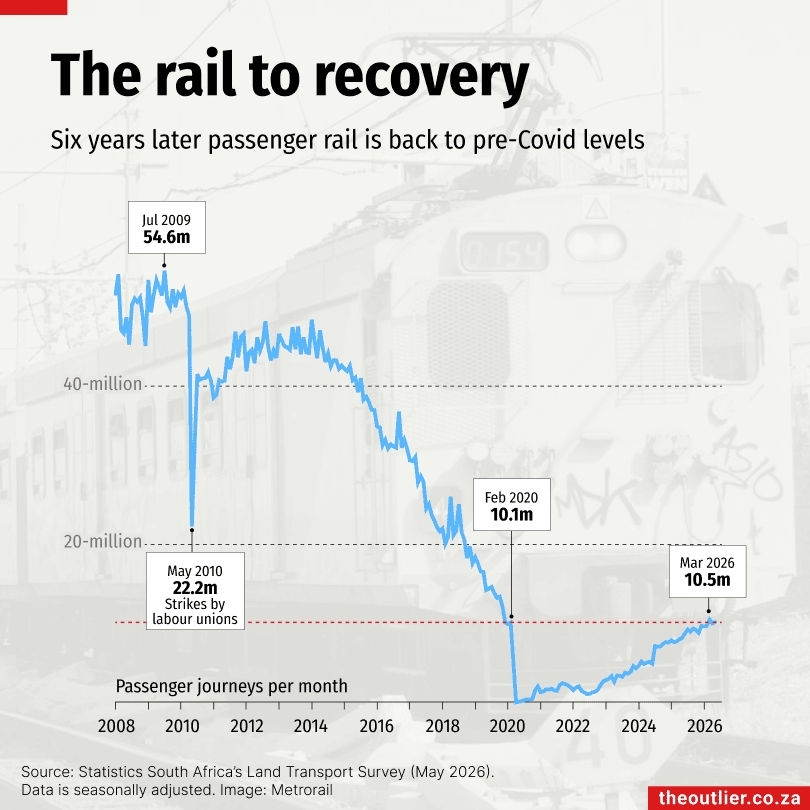
A recent report from The Outlier showed that PRASA’s monthly passenger numbers in March 2026 reached 10.5 million.
This is the highest monthly passenger number that PRASA has recorded since before the Covid-19 pandemic, more than six years ago.
Data from Stats SA’s Land Transport Survey showed that PRASA last recorded more than 10 million passengers in February 2020, when it hit 10.1 million.
The Outlier report identified the restoration of 35 of PRASA’s 40 passenger rail lines as a key driver of the rise in monthly passenger numbers.
The report explained, however, that only about 70% of these lines are reported to operate a full passenger rail service.
According to the company’s 2024/25 annual report, PRASA has also grown its rail fleet from 96 to 134 passenger trains.
While PRASA’s recent monthly passenger numbers reflect a steady recovery, they are still far removed from the company’s peak, which it hit 17 years ago.
In July 2009, PRASA reported monthly passenger numbers of 54.6 million, more than five times its current passenger numbers.
Apart from a significant drop in May 2010 to 22.2 million passengers due to strikes by labour unions, the company’s monthly passenger numbers remained above 40 million until 2015.
This is around the time PRASA’s passenger numbers would begin their steady decline over the next five years, hitting an all-time low point of 10.1 million in February 2020.
PRASA’s 2019/20 annual report attributed this decline to vandalism and theft of rail infrastructure, following the termination of national security contracts at the end of 2019.
After hitting an all-time low point of 10.1 million in February 2020, PRASA’s passenger numbers would drop to near zero with the start of the country’s nationwide lockdown.
Theft and vandalism on the rail network were exacerbated during the lockdown, while the company’s passenger numbers struggled to recover after the lockdown ended.
Now, six years on from the Covid-19 pandemic, PRASA’s gradual recovery is finally bearing fruit, as evidenced by its growing passenger numbers.





Comments