Dawie Roodt shares concerning information about South Africa’s debt


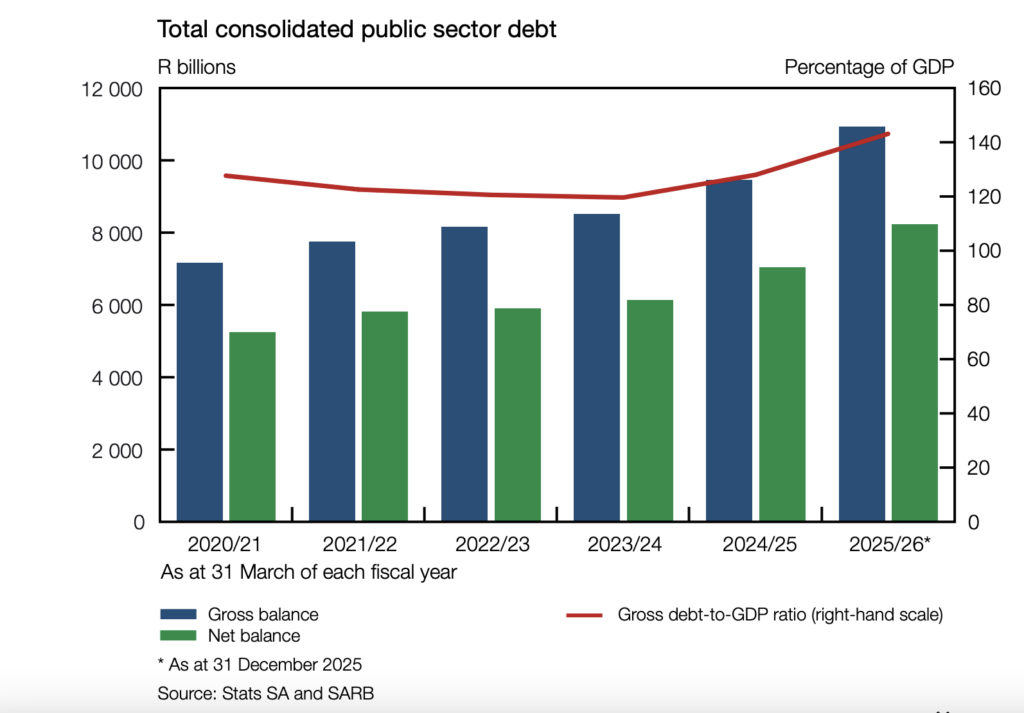
South Africa’s consolidated public sector debt is R10.94 trillion or 143.1% of GDP, making it among the largest debt burdens of any emerging market.
This total is far higher than the government’s debt, which stands at R6.1 trillion, or 78.5% of GDP, after the state borrowed R534.1 billion in the past financial year.
The consolidated debt presents a more accurate picture of South Africa’s overall debt burden, Efficient Group chief economist Dawie Roodt explained.
This is because it reflects the debt owed by the state and financial and non-financial state-owned enterprises (SOEs), such as Eskom and Transnet.
Roodt explained that the state implicitly, and in some cases explicitly, guarantees this debt and is the payer of last resort.
This makes South Africa’s debt burden look far worse than the figure reported by the Finance Minister in his Budget Speech earlier this year.
The Reserve Bank reported total public sector debt at R10.94 trillion in its latest quarterly bulletin, with the figure being revealed at the end of the government’s 2025/26 financial year.
This total rose by R1.48 trillion in the past financial year, representing growth of over 10%. This is far faster than the country’s nominal GDP growth.
The ratio of growth in debt levels to economic growth is closely watched by economists, as it indicates a government’s financial sustainability.
Alongside it, they look at the interest rate a government pays on its debt vs the nominal growth rate of the economy.
If either of these ratios is in favour of the growth of debt, alarm bells start to ring. In South Africa, both are in favour of debt.
This indicates that, without action, South Africa will eventually hit a financial cliff where its economy can no longer sustain the public sector’s debt load.
Thankfully, Roodt said there is good news in the form of fiscal consolidation and improving economic sentiment. However, it is unclear if this will be enough.
The government has run consecutive primary budget surpluses, which will slow the growth in debt and eventually enable it to pay down the debt.
Economic growth remains key in this equation as faster growth will generate more tax revenue, bolstering the government’s finances and improving the debt-to-GDP ratio.
This has proven elusive in South Africa so far, with the country’s economy set to continue growing at below 2% in real terms in 2026 and 2026.
South Africa’s saving grace
One thing working in South Africa’s favour is that the government has avoided borrowing heavily in foreign currencies, helping it avoid a debt crisis.
Emerging markets are often forced to borrow in foreign currencies because their financial markets are not sufficiently developed.
Borrowing in foreign currencies can also result in lower interest rates, as it avoids currency risk for investors, but it carries significant risk for the borrower.
Many emerging markets have collapsed due to sudden changes in foreign exchange rates that leave them unable to service their debt, forcing them to default or seek assistance from the World Bank or the International Monetary Fund.
South Africa has avoided this despite the government borrowing heavily over the past 15 years due to its sophisticated and liquid domestic capital markets.
This enabled the state to borrow from local financial institutions and raise capital from investors on the JSE’s bond markets.
As such, the vast majority of its debt is rand-denominated. This makes it easy to pay back and avoid a cash crunch by issuing more money, if needed.
Roodt said this is a luxury that very few African countries have, with the Reserve Bank having reserves that comfortably cover South Africa’s foreign debt.
Reserve Bank data show that South Africa has R612 billion in foreign-currency debt, with 90% of that in US dollars.
In absolute terms, that is a lot of money, but relative to South Africa’s GDP of R7 trillion and total debt burden of R6.1 trillion, it is small.
More importantly, it is less than the foreign-currency reserves held by the Reserve Bank, which stand at $65 billion (R1 trillion).
“The Reserve Bank has over $65 billion in foreign exchange reserves. That is more than sufficient to pay off our debt in foreign currencies,” Roodt said.
“That is a typical problem of emerging economies, particularly in Africa. If you go out and borrow dollars to import goods, you run out of dollars very quickly.”
Roodt explained that the main reason the government did not have to borrow abroad is that South Africa’s financial markets are well developed.
“We have very sophisticated and liquid capital markets in South Africa. It is very easy to borrow money in rands,” Roodt said.
“That is what the ANC has been doing. They have been borrowing huge amounts of money in rands, with South Africa having trillions of rands worth of debt.”






Comments