South Africa loses top spot in Africa


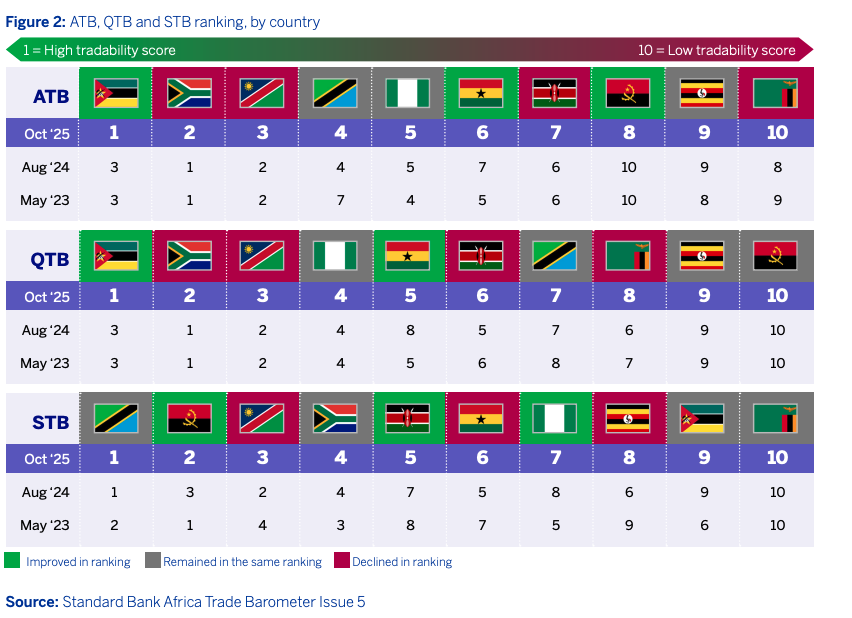
South Africa has lost the top spot in Standard Bank’s Africa Trade Barometer to Mozambique, with the country no longer enjoying a clear edge over its African peers.
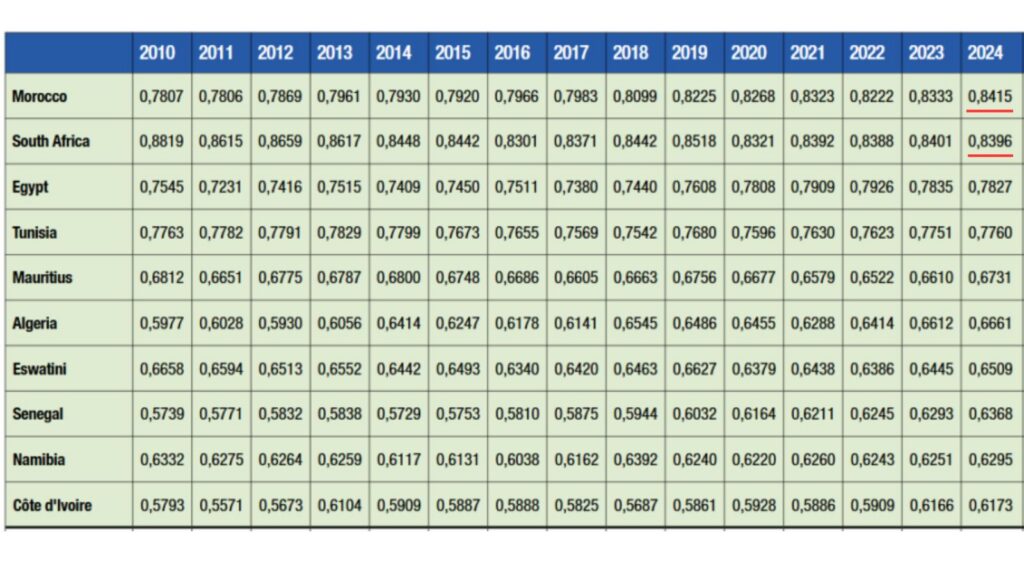
The country is also no longer the most industrialised economy on the continent, losing that title to Morocco in the latest rankings from the African Development Bank.
Standard Bank’s ranking broadly measures the ‘tradability’ of African countries, which measures how easy it is to do business in these jurisdictions.
The bank focuses on ten countries where it has a significant presence and is able to collect independent data on local business confidence, survey its clients, and understand operational challenges.
The ten countries ranked by the bank include South Africa, Angola, Ghana, Kenya, Mozambique, Namibia, Nigeria, Tanzania, Uganda, and Zambia.
For Issue 5, the bank surveyed 2,218 businesses that operate in these countries alongside economic data released by governments.
South Africa has traditionally dominated this ranking and many other economic indices in Africa, thanks to its developed economy, sophisticated financial services sector, and high-quality infrastructure.
However, in recent years, the gap between it and many other African countries has closed, and now those states are much more attractive to investors and businesses.
This is one of the reasons why Standard Bank, and other South African banks, have expanded so aggressively into Africa in recent decades. They want to capture value from faster-growing economies.
One thing African economies lack is access to reliable data, which is why Standard Bank produces its African Trade Barometer.
The latest edition shows that South Africa has slipped from its top spot on the index, with Mozambique replacing it as number one on the tradability index.
Standard Bank explained that the categories underpinning the ranking are macroeconomic environment, stability, government support, infrastructure constraints, openness, financial behaviour, and access to financing.
This is combined into the Standard Bank 3-year Quantitative Trade Barometer, where South Africa dropped to second place as well.
The sentiment of businesses is compiled into the Standard Bank Firm Survey Trade Barometer, where South Africa ranked fourth, behind Tanzania, Angola, and Namibia.
15 years of dominance kissed goodbye
The Standard Bank Africa Trade Barometer dovetails with the African Development Bank’s (AfDB) industrialisation index, where South Africa also lost top spot.
The AfDB’s latest Africa Industrialisation Index report for 2025 revealed that Morocco overtook South Africa to become the most industrialised economy on the continent.
This ended a 15-year streak of dominance by South Africa, with it long being considered the most sophisticated and developed economy on the continent.
The AfDB explained that the change in ranking is as much to do with Morocco’s rise as it is with South Africa’s fall.
It also noted that this did not come as a surprise and happen overnight, with the change being a result of a decades-long decline in South Africa’s development.
Morocco has also consistently implemented the right industrial and economic policies to develop its economy into an export powerhouse.
“While South Africa remains a continental industrial powerhouse, it continues to experience a steady decline in industrial competitiveness,” the AfDB said.
This has occurred during a period when Africa’s consumer market has made it increasingly attractive for manufacturing investment. South Africa has shunned this investment through poor policies.
South Africa should have capitalised on this trend, with an emerging African middle class driving demand for manufactured goods.
The bank noted that the country has been the most developed in Africa since the 1950s, and its opening in 1994 presented the perfect opportunity to meet the demands of this middle class.
However, repeated missteps from the government in Pretoria, collapsed state-run utilities, and onerous regulations make local manufacturing uncompetitive.
“South Africa functions as both a production base and ‘headquarter economy’, providing technology, management, and R&D while also sustaining large-scale manufacturing,” the AfDB said.
“The region has been driven down by the underperformance of South Africa since 2010, whose market value-added per capita has dropped from $1,105 to $800 over the period.”
South Africa continues to lose out on valuable investment to its African peers, with it slipping to fourth in the RMB Invest in Africa rankings.
Behind the Seychelles, Mauritius, and Egypt, South Africa only ranks first in one category – forex stability and liquidity.
Worryingly for the future, it also came in last place on the continent regarding GDP growth forecasts, income inequality and unemployment.
 Loading ...




Comments