South Africa’s rand on shaky ground


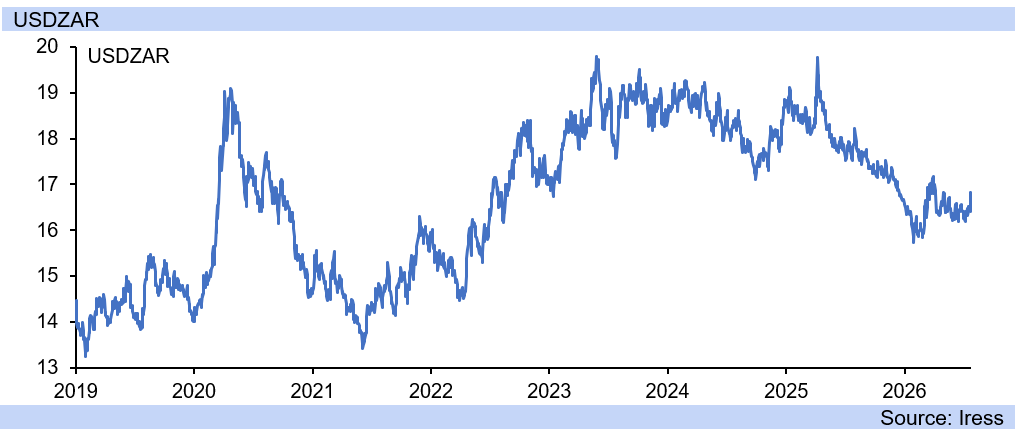
While South Africa’s rand has recovered since hitting R17 to the United States dollar, it is at risk of weakening again if global risk appetite shifts.
Investec chief economist Annabel Bishop explained that the rand remains highly volatile, though its recent movements have been driven by domestic developments.
Most notably, the Monetary Policy Committee’s (MPC) decision to keep interest rates unchanged at its July meeting sent the rand up towards R17/USD.
This marks a departure from the past few weeks, where US dollar movements and changes in global financial market risk appetite have had a bigger influence on the local currency’s movements.
However, as financial markets factor in the change in South Africa’s forecasted interest rate trajectory, the rand will once again be more pliable to global developments.
The MPC announced its decision to keep rates unchanged on 23 July, saying that while there are upside risks to inflation, South Africa’s monetary policy is sufficiently restrictive.
The committee’s decision came as a surprise to many economists and traders, who had expected another interest rate hike of 25 basis points following a similar move in May.
As markets factored out this expected interest rate hike, the rand jumped towards R17 against the US dollar on Thursday, but strengthened to R16.98/USD on Friday, 24 July.
On Monday, 27 July, the rand had strengthened back to R16.70/USD, which Bishop attributed to domestic events, most notably the interest rate decision.
She said this marks a change for the rand, which has largely been driven by global rather than local developments in recent months.
Since February, the rand has been at the mercy of US dollar movements and shifts in global risk appetite amid the war in Iran.
However, over the past week, Bishop said the rand has not been impacted by a fresh wave of geopolitical risk sentiment from the Middle East.
This is because the United States-Iran war has been on hold due to concerns over air defence stockpiles and the increased risk of a widening war in the Middle East.
In addition, Bishop said concerns have centred on an escalating energy crisis and negative impact on the global economy.
There are also concerns over the war’s impact on US allied countries in the Gulf, who have already been attacked and are particularly vulnerable.
Therefore, the rand has remained somewhat immune to global sentiment, with the local currency instead influenced by traders digesting a lower interest-rate trajectory for South Africa.
More rollercoasters coming
While the impact of the interest rate decision marked a departure from this state of affairs, Bishop noted that this does not mean the rand is now immune to global developments.
“While the rand has pulled back from near R17.00/USD, it is volatile, and risks further weakness,” she said.
She said the rand remains particularly vulnerable to switches in global risk sentiment appetite, with the moderate risk-on environment only providing modest support to the rand.
However, the rand may not get more support domestically, as the Reserve Bank’s decision to keep interest rates unchanged showed its commitment to protecting the local economy.
In the July MPC Statement, Reserve Bank Governor Lesetja Kganyago said the committee sees downside risks to South Africa’s economic growth.
“We anticipate slower growth through the second and third quarters of this year,” he said, adding that consumer confidence has fallen sharply, and business confidence has also weakened.
“Households have suffered from higher fuel prices, while uncertainty has weighed on investment. Sectoral data show generally lower activity since the start of the war.”
The MPC’s baseline forecast shows the economy starting to recover in the second half of 2026, as the shock of the Middle East war fades. “But the outlook is uncertain,” Kganyago cautioned.
Bishop said financial markets have drawn comfort from what appears to be a neutral to dovish tone from the Reserve Bank.
She said markets were comforted by the central bank showing more support for the economic growth outlook than expected, which should benefit South Africa’s investment climate.
“South Africa’s benchmark bond yield dropped on the softer inflation and interest rate forecasts in the MPC statement last week,” she said.
This is because risks have subsided somewhat as second-round inflationary pressures have been slow to materialise.
 Loading ...





Comments