Diesel price disaster hitting South Africa


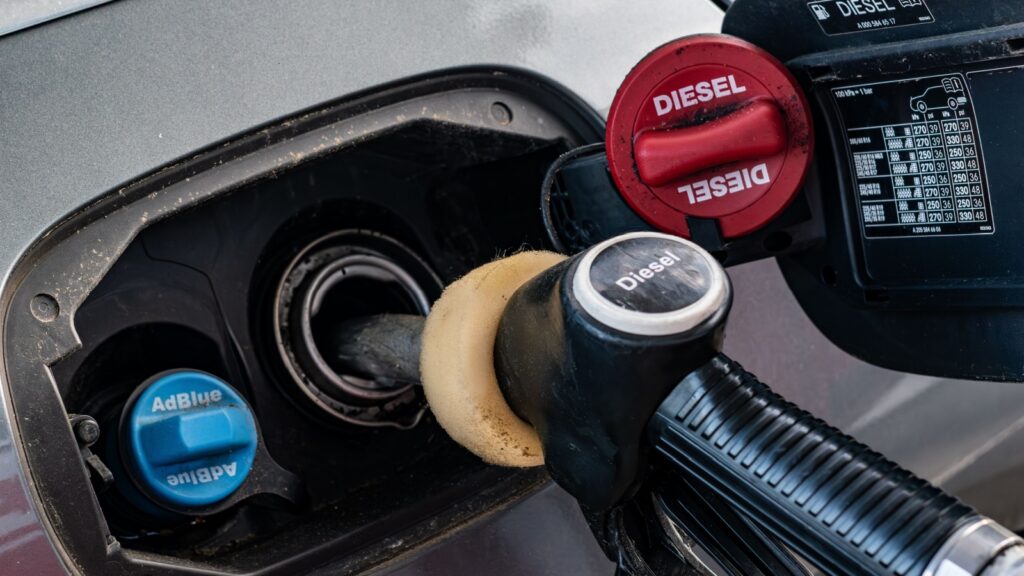
Diesel prices are likely to rise in August as the rising price of oil and slightly weaker rand combine to push fuel prices higher.
Motorists using petrol-powered vehicles are likely to experience some relief as prices of 93 octane and 95 octane fuel are likely to come down slightly.
This difference is because of a global shortage of diesel, which has been building over the past few months and is now being exacerbated by the conflict in the Middle East.
The price of diesel is also being pushed higher by Russia’s ban on exports of the fuel as it prioritises its local market.
Symmetry chief investment strategist Izak Odendaal unpacked the likely implications of renewed conflict in the Middle East on local fuel prices in a recent social media post.
Odendaal explained that the basic fuel price is the part of the price motorists pay at the pump that excludes taxes and other administered elements.
This makes it the swing factor in the price of petrol and diesel, as it changes on a monthly basis, while taxes are typically only altered in the Budget Speech once a year.
The basic fuel price is calculated daily based on the international price of oil and the rand-dollar exchange rate, then it is compared to what it was at the start of the month.
If it is below the price at the beginning of the month, there is an under recovery. If it is above, there is an over recovery. An over recovery means prices will come down.
The daily run rate adds up to an average over or under recovery for the month and translates into a price hike or cut for the next month.
This is done by the Central Energy Fund (CEF), with the final changes being released by the Department of Mineral and Petroleum Resources.
Odendaal pointed out that the latest data from the CEF indicates that the resumption of the conflict in the Middle East has fundamentally changed the outlook for fuel prices.
While the beginning of the month saw a huge projected cut in petrol and diesel prices, the decrease has narrowed and is likely to turn into a hike for diesel prices.
Odendaal expects petrol prices to be cut in August, with daily under recoveries not enough to reverse the month-to-date over recovery.
However, for diesel, the picture is far worse. The average over recovery of 47 cents per litre will be overwhelmed by the daily under recovery of R3.71 per litre.
This can be seen in the table below –
| Fuel Type | Petrol 93 | Petrol 95 | Diesel 0.05% | Diesel 0.005% |
| Daily recovery | 46 cents per litre hike | 60 cents per litre hike | R3.71 per litre hike | R3.63 per litre hike |
| Average recovery | R1.30 per litre cut | R1.26 per litre cut | 47 cents per litre cut | 74 cents per litre cut |
Diesel shortages loom
South Africa faces a double blow to its diesel prices from the return of conflict in the Middle East and a Russian ban on exports.
The conflict in the Middle East has a familiar impact on diesel prices that stems from disrupted supply from major producers in the region.
South Africa is highly reliant on refined products from the region, making it vulnerable to diesel price shocks, in particular.
This has been compounded by the Russian ban on diesel exports from the country, announced on 8 July. The announcement comes after sustained Ukrainian drone attacks on Russian refineries.
“Both developments tighten global diesel supply and lift the cost of crude oil and refined products in South Africa,” the Centre for Risk Analysis (CRA) said in a research note.
Russia’s ban will run until 31 July and includes producers. The country will also begin importing fuel towards the end of the month.
Historically a major diesel supplier, attacks on Russian refineries have limited its ability to produce the fuel for its war machine and domestic consumers.
The CRA said that Russian diesel and gasoil exports fell 39% in June from May and are down 46% year-on-year.
Diesel exports for the first eight days of July stood at 187,000 barrels per day versus 535,000 barrels per day for July 2025.
This will push prices in South Africa higher as it is a net diesel importer, with its major suppliers located in the Mediterranean and the Arabian Gulf. Both are impacted by the war and Russia’s ban.
The CRA explained that the renewed conflict in the Middle East raises the dollar price of international benchmarks, while Russia’s ban removes supply that would have offset the upward pressure on prices.
“If the ceasefire fails to hold and Russia’s ban extends past 31 July, expect a sharp upward correction in the August Basic Fuel Price, with diesel moving more than petrol,” the CRA said.
Transport, logistics, mining and commercial agriculture will feel this first. The rest of the economy will suffer from elevated inflation and potentially higher interest rates.






Comments