Big week for South Africa’s rand


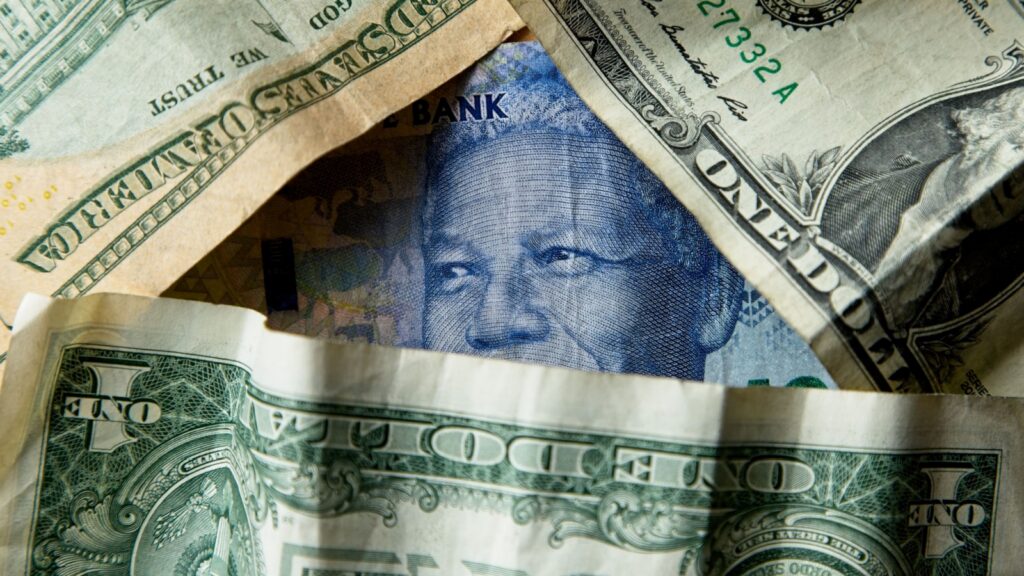
The rand started this week in a good position to strengthen towards its pre-war levels, yet geopolitical movements continue to put pressure on the local currency.
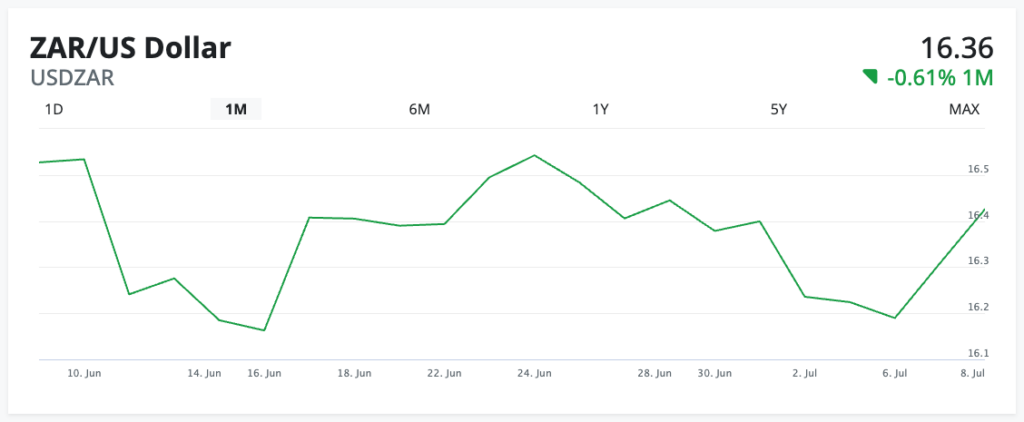
This has seen the rand remain highly volatile, having gone from R16.20 against the United States dollar at the start of the week to R16.40/USD on Wednesday.
On Monday, 6 July, Investec chief economist Annabel Bishop said the US dollar had steadily weakened over the past week.
This was due to the Iran war winding down, meaning investors were making less use of the dollar as a safe-haven asset.
Bishop explained that this allowed for additional rand strength against the US dollar, possibly setting the rand up to strengthen towards the R16.00/USD mark this week.
This would mark the rand’s strongest level since the war started, with South Africa’s currency having been on a good run since January.
However, Bishop also warned that the rand will retain its propensity for volatility this week, as the local currency remains highly reactive to global financial markets, particularly US events.
“Key is direction on US interest rates, with hikes in the US negatively affecting the domestic currency,” she said.
Currently, there are two interest rate hikes expected for the United States in 2026, and a similar number is projected for South Africa.
Bishop noted, however, that concerns around the United States’ economic growth could see fewer rate cuts materialise than expected.
This, she said, should aid the rand, as fewer rate cuts in the United States than in South Africa would widen the interest rate differential between the two countries, making local bonds more attractive.
“Dissipating concerns around US interest rate hikes have, in themselves, driven financial market risk aversion lower,” Bishop explained.
This has caused risk assets like United States equities to rise, making the greenback weaker in turn.
The rand’s performance against the US dollar over the past month can be seen in the graph below, captured at 10:00 on Thursday, 9 July.
The Rattler remains
While US dollar weakness is set to support the rand’s strength in the months to come, this past week has put the local currency’s volatility, which has earned it the nickname ‘the Rattler’ among some traders, on full display.
The rand was trading at R16.20 on Monday, 6 July, strengthening against the dollar yesterday as the Sentix eurozone confidence index jumped to a four-month high.
That same day, South African bond yields fell, with the 10-year at 8.31% and the 20-year at 8.80%, continuing their post-peace-deal decline.
TreasuryONE’s head of market risk, Wichard Cilliers, explained that while the rand strengthened on Monday, its strength remains largely a function of favourable global conditions rather than improving domestic fundamentals.
“While lower oil prices and firmer precious metal prices could provide additional support, the local unit is likely to remain range-bound until a fresh catalyst emerges,” he said.
On Tuesday, 7 July, the rand weakened against the dollar amid escalating US-Iran tensions following a string of Iranian attacks on merchant ships in the Strait of Hormuz.
The United States military responded to these attacks in kind, launching extensive Central Command strikes on Iranian coastal and port targets.
Notably, Anchor Capital pointed out that while the rand weakened against the dollar on Tuesday, the dollar was marginally weaker against the rand on Wednesday morning.
This “counterintuitive move”, the firm explained, may reflect broader dollar softness relative to the initial shock.
However, this did not last too long, with the rand weakening to R16.40/USD on Wednesday.
TreasuryONE currency strategist Andre Cilliers explained that, as a net importer of oil, South Africa faces the dual challenge of rising imported inflation and deteriorating global risk sentiment.
He said both of these factors tend to weigh on the local currency. Therefore, while the rand has been resilient in recent weeks, its near-term direction is likely to remain closely tied to developments in the Middle East and the United States.
On Thursday morning, the rand was again trading firmer against the dollar at R16.35/USD, as the currency continued to show resilience.
Andre said robust, exporter-driven dollar inflows, along with favourable carry-trade flows due to the continued weakness in the Japanese yen, are providing support for the rand.
 Loading ...





Comments