Ambush on South Africa’s rand


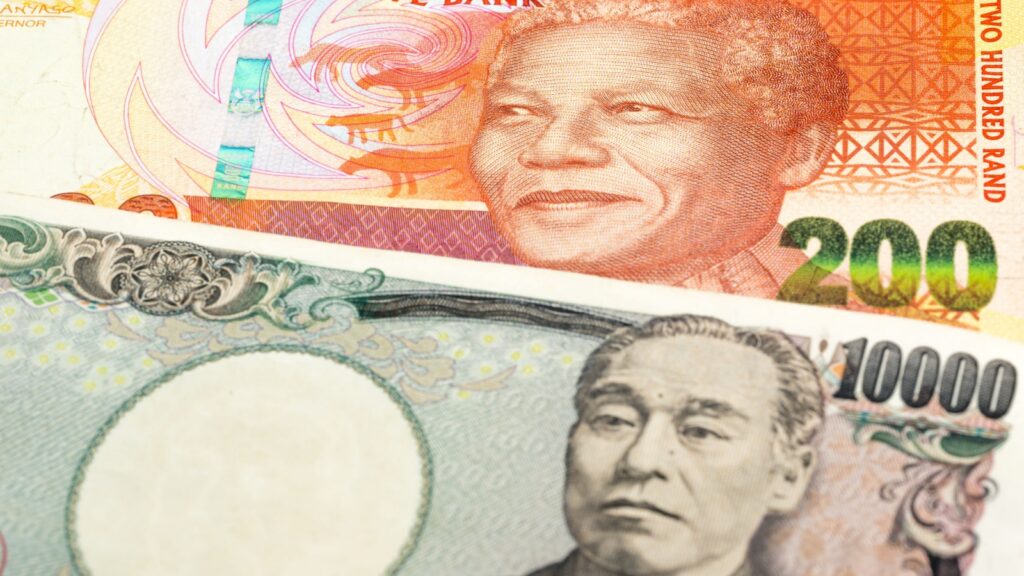
Potential shockwaves resulting from Japan’s new strategy to protect its currency, the yen, could backfire on the rand.
South Africa’s open economy and free-floating currency make the rand highly vulnerable to global panic or tightening of US dollar funding – both of which could happen under Japan’s strategy.
This is a warning from Citadel Global managing director Bianca Botes, who outlined Japan’s approach to protecting its strategy.
Her comments come after the Japanese yen recently hit its weakest level since 1986. The last time the yen was this low, Japan was deep inside the asset bubble that would erase a generation of wealth.
According to Botes, this is what informed Japan’s Ministry of Finance’s (MoF) recent decisions, and explains why the Asian nation has changed its monetary policy playbook.
Japan has a long history of exerting direct control over the yen in an attempt to protect the currency.
This is because carry trades have often been a cause of concern for the yen, with investors borrowing money cheaply in Japan, where interest rates are very low, and investing the money in places like the United States, where interest rates are higher.
Previously, Japan would warn the market ahead of time before buying yen to prop up the currency. This served as a kind of “warning signal” for traders.
Botes pointed out that the old approach was transparent enough that the market had learned to trade around it.
“Officials would issue warnings, traders would gauge proximity to a threshold and position accordingly, the MoF would step in, the yen would recover briefly, and the carry trade would rebuild once the pressure eased,” she said.
For example, between April and May 2026, Japan spent a record ¥11.7 trillion (R1.18 trillion) to buy its own currency to prevent the yen from weakening.
However, this did not work, and the yen kept falling before finally hitting its weakest point in four decades. “The yen bounced and fell straight back through the level they had defended,” Botes said.
This reaction led Japan to realise that its transparency strategy was not working, and to decide that a different approach was needed.
Japan’s new strategy

Botes described Japan’s new strategy simply – silence. “No warnings, no line in the sand, no indication of timing,” she said.
Now, the decision sits with Japan’s top currency official, Atsushi Mimura, who has said nothing publicly since the last intervention.
Botes explained that Japan’s objective now is not to defend a specific level of the yen but rather to wipe out speculative short positions before traders have the chance to unwind.
“Japan’s MoF wants shorting the yen to feel dangerous in a way it currently does not,” she explained.
However, this strategy is easier said than done, with Botes pointing to the International Monetary Fund’s (IMF) classification rule as a major constraint.
Per the IMF’s rule, three days of intervention count as a single operation, and Japan can execute only two more such windows before November without risking its freely floating currency designation.
“Japan is using the ambush to try and make the threat feel unlimited,” Botes said.
In the meantime, she warned that Japan’s strategy presents a notable global risk if its ambush works too well or if interest rates shift.
Should this happen, the pile of bets traders have placed against the rand could collapse all at once, triggering a global financial chain reaction.
Botes explained that a sudden reversal could cause the yen to skyrocket, forcing global investors to rapidly sell off other assets, such as stocks or bonds, to cover their losses.
This also comes at a time when Japanese government bonds are offering decent returns for the first time in a generation.
This has seen Japanese institutions, such as insurers, start bringing their trillions of dollars back home.
“Half of Japan’s 10 major life insurers reduced foreign bond holdings in the most recent reporting period, which is a rational reallocation as the domestic market becomes investable for the first time in a generation,” Botes said.
“The problem, however, is scale. Even a modest acceleration will move global bond markets.”
What this means for the rand

Botes warned that South Africa’s rand sits directly in the firing line of these shifts.
Unlike many other countries, South Africa does not intervene in its currency market in any meaningful way, and the Reserve Bank does not have sufficient reserves to do so sustainably.
Botes explained that South Africa’s open capital account and freely floating currency mean that the country absorbs global risk repricing in real time with no capacity to intervene.
In other words, any global panic or tightening of United States-dollar funding will hit the rand hard and fast.
“When carry trades unwind, and dollar funding tightens, the currencies that move fastest are the ones with no reserve status and a central bank without the firepower to slow the move,” Botes said. “The rand qualifies on both counts.”
For example, a yen-driven unwind would reprice the rand, widen South Africa’s credit spreads, and raise external funding costs.
Notably, this would not be because anything changed domestically, but because the architecture of global capital runs through Tokyo, “whether Johannesburg is tracking it or not”, Botes warned.
Botes previously explained that the rand’s volatility is increasingly becoming more a function of what other countries’ central banks are doing, rather than a pure reflection of what is happening domestically.
“When major economies are quietly capping their own currency weakness, freely floating emerging-market currencies tend to overshoot on the downside during risk-off episodes,” she explained.
“As such, the rand’s volatility is partly a function of what other countries’ central banks are doing, not just what is happening domestically.”






Comments