One of South Africa’s largest employers doubling up


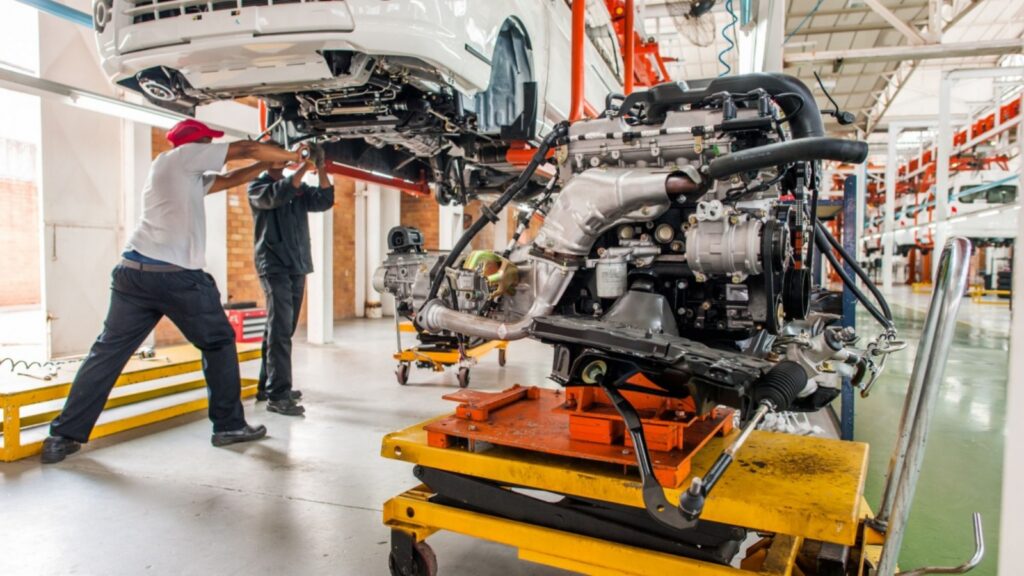
The local content value of South Africa’s automotive industry has reportedly more than doubled in a span of just six years between 2020 and 2025.
This is according to the National Association of Automobile Manufacturers in South Africa (NAAMSA), in response to comments made by Minister of Trade Parks Tau.
Responding to a parliamentary Q&A about the progress of the Automotive Masterplan 2035, Tau said the plan had so far failed to achieve its major targets.
Tau explained that in 2015, three years before the plan was put into action, local content accounted for just 38.7% of South Africa’s assembled vehicles market.
“Since then, there has been a negligible and lacklustre performance in terms of realising the set Masterplan target of 60% by 2035,” Tau said.
“NAAMSA Industry Customs Account Quarter 3 of 2025 reveals that the current local content is at 38.1%. More needs to be done to realise the set local content target by 2035, including localisation broadly.”
Tau said a review of the Masterplan was currently underway, with the intention to address some of the challenges still impeding its success.
In response to Tau’s comments, NAAMSA said that the value of local content in South Africa’s automotive industry had actually risen from R57.2 billion in 2020 up to R126.8 billion in 2025.
This is in spite of the local value share of the industry remaining relatively stable at around 39.7% during this same period, according to NAAMSA.
In an interview with 702, NAAMSA Chief Policy Officer Tshethle Lithoko said this had been driven mostly by the creation of a specific niche to allow South Africa to better compete.
“Over the years, we’ve become a bakkie manufacturing economy,” Lithoko said. “The products that we are producing from our factory floors have a certain value.”
“That value has the right economics for this industry to continue to thrive and be sustained within our economy. Local value addition in South Africa should be seen in that perspective.”
Lithoko explained that because South Africa produces cars of a certain class and market value, this drives up the local content value, even as local value share remained broadly unchanged.
Competing with Asian imports
NAAMSA’s assertion comes at a time when South Africa’s automotive industry is experiencing an influx of cheap car imports from countries such as India and China.
Automotive industry stakeholders across the country have raised concerns that this could severely diminish the country’s local vehicle manufacturing capabilities.
According to Lithoko, locally produced cars accounted for approximately 52% of all car sales in South Africa in 2020, while imports made up the other 48%.
However, this dynamic has shifted in the past six years, with imports now constituting around 60% of all new car sales in South Africa, while locally manufactured cars sit at only 40%.
Lithoko emphasised that this mostly applied to more affordable vehicles within certain price ranges, and not necessarily to the bakkies and SUVs which local producers specialise in.
“We are not competing in the market at the same vehicle classes for the cars that we are importing versus the cars that we are producing,” Lithoko said.
“Where there is an influx of cars in the same classes, you would then find that market leadership is still maintained with locally produced vehicles.”
Lithoko also pointed out that a large percentage of vehicles produced in South Africa are then exported to other countries, with 80% of these exports going to Europe.
One of the main goals of the Automotive Masterplan is for South Africa to account for 1% of global vehicle production by 2035, which Lithoko said is around 900,000.
In 2025, the country produced approximately 610,405 vehicles, or around just two thirds of the target manufacturing output set out by the Masterplan.
For South Africa to increase its competitiveness and reach this goal, Lithoko said policy alignment would be critical for supporting future demand.
“The cars that we produce in South Africa are, on price alone, at least 15% on average at a disadvantage to those that you would otherwise import in the same vehicle classes,” Lithoko said.
“Is there a way that policy can intervene that would make our cars competitive, and make investment in South Africa attractive for those that want to come into our domestic market?”
 Loading ...





Comments