The Winelands town once home to the Khoi people where South Africa’s ultra-wealthy go to retire


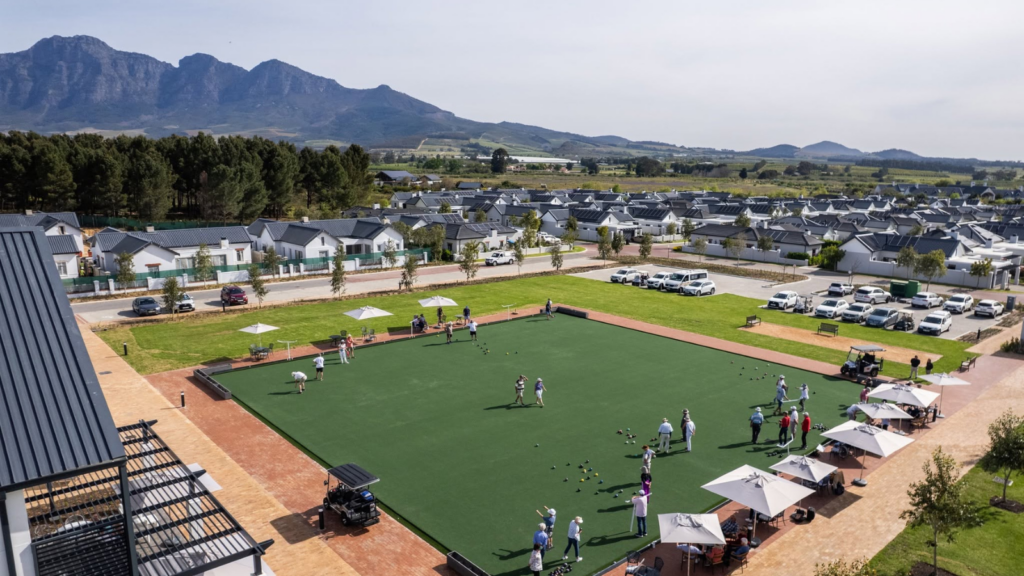
With an average property value of R4.9 million, Drakenstein in the Western Cape is home to South Africa’s most high-end retirement estates.
The Drakenstein area, located in the Cape Winelands region of the Western Cape, has its roots in the early Dutch colonial period. It was originally inhabited by the Khoikhoi before European settlement began in the late 17th century.
In 1687, Governor Simon van der Stel allocated farms in the fertile valley to Dutch settlers and French Huguenot refugees, who brought with them expertise in viticulture and agriculture.
Over time, the settlements of Paarl, Wellington, and surrounding farming communities developed into important agricultural centres, particularly for wine, fruit, and grain production.
Drakenstein also holds significant historical importance. The former Victor Verster Prison, now the Drakenstein Correctional Centre, was where Nelson Mandela spent the final years of his imprisonment before his release in February 1990.
Today, the Drakenstein Municipality encompasses Paarl, Wellington, Saron, Hermon, and nearby rural areas, and remains one of South Africa’s most important agricultural and wine-producing regions.
It is also home to some of South Africa’s most exclusive estates and is popular among wealthy locals, international buyers, and retirees.
While there are several retirement estates in Drakenstein, Val de Vie Evergreen, situated inside the acclaimed Val de Vie Estate, is perhaps the most prestigious.
A recent analysis by Lightstone examined the top 20 towns by average property value in retirement estates and found that Drakenstein topped the list, with an average of R4.9 million.
While Gauteng was the winner in terms of units, the average property value was highest in the Western Cape, with 12 of the top 20 towns there.
Stellenbosch recorded the second-highest average values at R4.5 million, while Salt Rock in KwaZulu-Natal was next with an average value of R3.9 million.
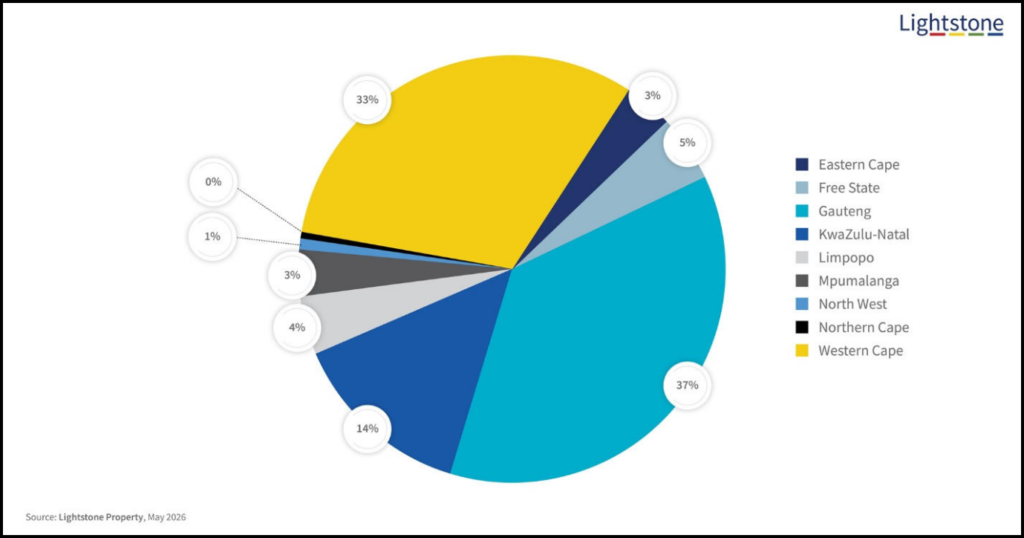
Interestingly, KwaZulu-Natal accounted for seven of the top 20 by average value, although only 14% of homes in retirement villages are in that province.
Conversely, while Gauteng is home to most retirement villages, only Midstream in Centurion makes the top 20 for average value.
The table below shows South Africa’s top 20 towns by the average value of a property in retirement estates, according to Lightstone.
| Rank | Province | Town | Average value | Number of units |
|---|---|---|---|---|
| 1 | Western Cape | Drakenstein | R4.9 million | 600 |
| 2 | Western Cape | Stellenbosch | R4.55 million | 250 |
| 3 | KwaZulu-Natal | Salt Rock | R3.9 million | 200 |
| 4 | Western Cape | Knysna | R3.85 million | 400 |
| 5 | Western Cape | Keurboomstrand | R3.6 million | 150 |
| 6 | Western Cape | Paarl | R3.5 million | 350 |
| 7 | KwaZulu-Natal | Umdloti | R3.3 million | 200 |
| 8 | KwaZulu-Natal | KwaDukuza | R3.25 million | 450 |
| 9 | KwaZulu-Natal | Phoenix | R3 million | 300 |
| 10 | KwaZulu-Natal | Greytown | R2.95 million | 100 |
| 11 | Western Cape | Hermanus | R2.9 million | 700 |
| 12 | Western Cape | Mossel Bay | R2.85 million | 800 |
| 13 | Western Cape | Robertson | R2.85 million | 200 |
| 14 | Gauteng | Midstream | R2.8 million | 400 |
| 15 | Western Cape | George | R2.8 million | 1,250 |
| 16 | Western Cape | Swellendam | R2.7 million | 100 |
| 17 | KwaZulu-Natal | Howick | R2.65 million | 2,200 |
| 18 | Western Cape | Langebaan | R2.6 million | 150 |
| 19 | KwaZulu-Natal | Kloof | R2.5 million | 1,000 |
| 20 | Western Cape | Groot Brakrivier | R2.45 million | 150 |
South Africa’s over-60 property market
These findings were part of a Lighstone analysis, which also revealed that South Africans aged 60 and older own 1.35 million properties.
Lightstone’s analysis excluded 550 known old-age homes, where units are not bought and for which no data is available, as well as 675,000 properties owned by legal entities.
The group also split the market between those who either lived inside or outside retirement villages.
Lightstone revealed that older South Africans hold a disproportionate share, at 40%, of properties valued at more than R500,000, even though just 10.5% of South Africa’s population is 60 or older.
They estimated that Gauteng and the Western Cape accounted for 70% of 400 retirement establishments, which contained 45,000 units, while 14% were in KwaZulu-Natal.
Of the 45,000 units, 30,000 (66%) were located in Sectional Schemes, and 15,000 (34%) were in Estates.
Lightstone revealed that Gauteng had the most retirement units of all South Africa’s provinces, leading in both units priced under R1 million and those priced between R1 million and R2 million.
However, it is the Western Cape where the high value sits. The province came out on top in the R2 million to R3 million, R3 million to R4 million, R4 million to R5 million, and above R5 million categories.
Lightstone also looked at the major cities in the popular retirement provinces. The City of Cape Town had the greatest number of units and the highest-value properties.
This was followed by the City of Tshwane, which had the most properties valued under R2 million, and then the City of Johannesburg.
Where South Africans are choosing to retire
Retirement villages are increasingly popular because they offer enhanced security, low-maintenance living, and comprehensive healthcare in a community-oriented environment.
With the over-60 population increasing and living longer, these villages provide tailored care and lifestyle amenities that address safety concerns and the need for medical support.
Many are even operating on popular “life rights” models for financial stability. In fact, many retirement villages, or lifestyle estates which include a retirement component, now allow residents over 50 years of age.
Even with this growing popularity, Lightstone Property’s Managing Executive Hayley Ivins-Downes said most older homeowners are still choosing to remain in traditional residential properties.
“For every one unit in a retirement establishment, there are around 30 properties owned by over-60s outside these communities,” she said.
“This tells us that ageing in place remains a major feature of South Africa’s housing market, particularly in coastal, lifestyle, and inland towns where security, healthcare access, and quality of life are strong drawcards.”
Of these over-60-year-olds living outside retirement facilities, 20% are in sectional title schemes or estates, and 80% in freehold houses.
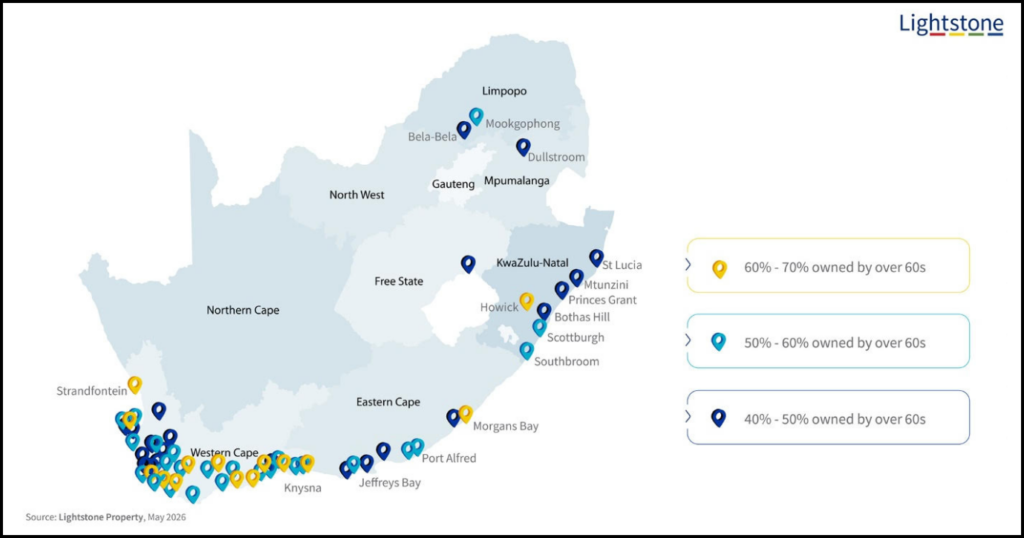
“Lightstone’s analysis also shows, most markedly, that those over 60 have settled in several coastal, lifestyle and inland towns as opposed to major metropolitan areas like Johannesburg and Pretoria,” Ivins-Downes said.
“In some towns, up to 60% of properties are owned by over-60s, particularly along the Western Cape coastline, KwaZulu-Natal’s North and South Coast, and inland retirement hubs such as Mookgophong in Limpopo.”
The trend reflects a combination of retirement migration, long-term ownership patterns and ageing local populations.
Many older homeowners are also drawn to areas offering lifestyle amenities, security, healthcare access, and lower-density living environments.
The generational divide
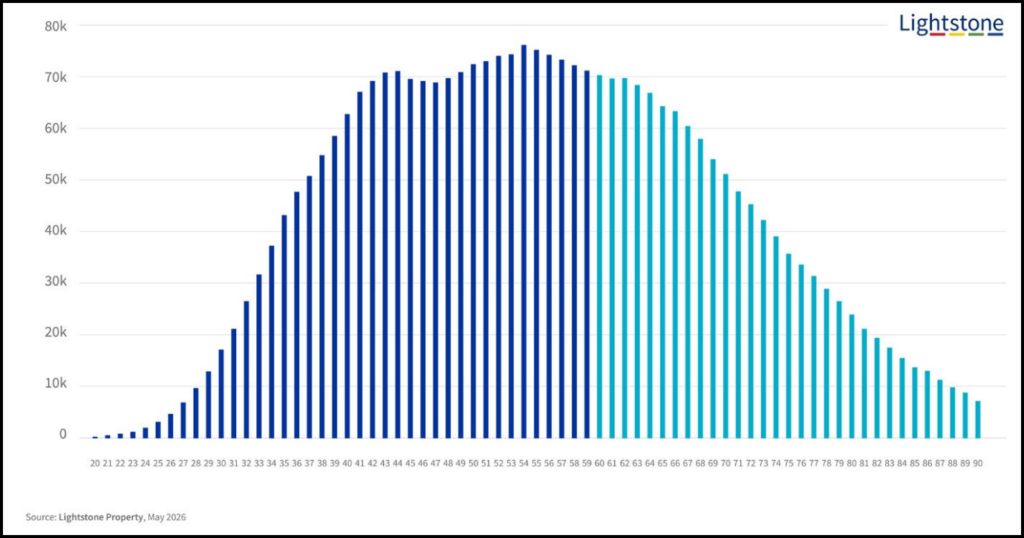
Homeowners over 60 not only own a disproportionate number of homes relative to their share of the population, but also own proportionately more homes valued above R2 million than below.
There are many reasons for what has been described as property wealth concentration or housing equity accumulation.
This includes the fact that those over 60 often bought homes when they were cheaper relative to income and then held those assets through decades of price growth.
Since many of them are now mortgage-free, the equity has had time to compound into substantial housing wealth.
Three forces matter most. Firstly, they entered the market earlier, when deposit hurdles and debt burdens were lower.
Secondly, property prices in stronger suburbs and metros rose faster than wages, so owners captured capital gains simply by holding out or trading up.
Thirdly, older owners are downsizing later, meaning they keep prime homes longer and concentrate ownership in the most valuable stock.
In broader economic language, it reflects an intergenerational asset gap. Boomers own more of the country’s high-value homes.
Meanwhile, younger people face higher entry prices and weaker affordability. As these assets are passed on, the shift is often referred to as the ‘Great Wealth Transfer’.






Comments