South African landlords are set to rake in the cash


South Africa’s listed real estate sector is set to boom in the coming months, with the potential to return more than 15% over the next 18 months.
This comes as the sector has several tailwinds boosting its prospects, including improving fundamentals and renewed access to capital markets.
This is feedback from Investec Corporate and Investment Banking’s Kyle Rollinson and Karl Priessnitz, who outlined the forces driving South Africa’s Real Estate Investment Trust (REIT) market.
The local listed real estate market was the top-performing sector on the JSE in 2025, and therefore entered 2026 with strong momentum.
This comes after a challenging decade for South African REITs, marked by structural economic challenges and earnings headwinds exacerbated by the Covid-19 pandemic.
However, after spending around three years deleveraging, reorganising, rebasing and consolidating, the sector emerged in a stronger position, with 2025 a pivotal inflexion point.
“The sector has transitioned into a cleaner earnings cycle, largely due to disciplined capital allocation and more focused growth strategies from management teams,” Rollinson and Priessnitz said.
“This distinct shift to specialisation has begun to lure back non-traditional real estate fund investors as they increasingly recognise this refreshed value proposition and renewed confidence.”
They explained that the result of this positive momentum was the unwind of most of the pronounced and persistent discount to net asset value (NAV).
Thus, listed real estate became the top-performing sector on the JSE in 2025, delivering a total return of roughly 31%.
“The question is no longer simply whether the sector has recovered. The more relevant question is how that recovery now translates into deal activity, capital formation and potential new listings,” they said.
So far, the sector is off to a strong start in this regard, with R6.4 billion in new equity raised in 2026 to date.
Rollinson and Priessnitz said it is estimated that the listed real estate sector has a total return potential of more than 15% over the next 18 months.
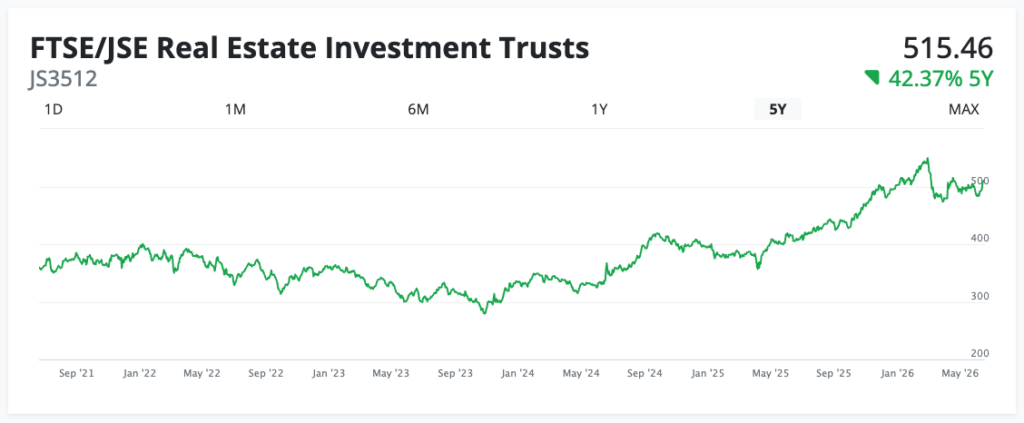
The performance of the FTSE/JSE Real Estate Investment Trusts index over the past five years can be seen in the graph below.
The REITs that will win
They explained that the listed real estate sector has seen a shift toward specialisation over the past few years, which is set to serve it well in the months to come.
This shift has resulted in management teams, even those within diversified portfolios, operating with greater focus and managing various asset classes as pockets of specialisation.
“For example, we are seeing players shifting into a nodal specialist strategy, but with broad sector exposure, combined with active portfolio management, to navigate the challenging local economic climate,” they said.
“This strategy focuses on dominating high-quality, high-demand areas in the industrial, office, and retail sectors, while expanding into alternative real estate through specialised investment partnerships.”
Rollinson and Priessnitz said that market players with deep, defensible expertise in specific asset classes, regions, and property themes tend to outperform and deliver sector-beating returns.
However, they warned that a too-narrow focus could see companies run into challenges, including limiting domestic growth and forcing players to look offshore.
“Based on the successes over the last 18 to 24 months, the winning strategy remains balancing focused sectoral expertise, with a geographic reach that is well-understood and underpinned by positive, long-term fundamentals,” they said.
Overall, based on the substantial amount of equity already raised in 2026, Rollinson and Priessnitz said the sector is entering a phase of sustainable growth.
“For listed real estate, these open, buoyant capital markets matter because the cost of capital determines the practical ability to transact,” they explained.
“Where a REIT trades at tighter yields, has a clear strategy, and can raise equity at a sensible cost of equity, acquisitions can be accretive.”
New opportunities

New sectors and opportunities are also emerging for local REITs, with Rollinson and Priessnitz using the example of data centres.
Demand for data centres is booming globally, but the space remains in its infancy in South Africa.
“This offers a massive opportunity for REITs to pivot into digital infrastructure,” they said.
They added that there is also growing demand for targeted exposure to specific sectors such as logistics, convenience retail, self-storage, data infrastructure, healthcare real estate, student accommodation, and residential rental.
“A more diverse listed market would enable more precise capital allocation and reduce reliance on diversified REITs as proxies for the broader sector,” they said.
For the listed real estate sector as a whole, Rollinson and Priessnitz said it is clear that the industry has moved beyond recovery.
“Balance sheets are stronger, income streams are more stable, and capital markets are functioning once again,” they said.
“However, the path forward will be defined by selectivity and execution. Success will depend on disciplined execution and the ability to deploy capital into transactions that are strategically aligned, earnings accretive, and sustainable over the long term.”
“We see potential for new, credible listings to come to market in 2026 and beyond that.”






Comments