South Africans can fire the government for not doing its job


South Africa’s democratic process gives citizens the opportunity to fire a government for failing to do its job, which stands in stark contrast to many other countries where violence is the only means of effecting regime change.
This is feedback from governance expert Professor Alex van den Heever, who recently told Newzroom Afrika that the democratic process in South Africa is a learning process.
His comments come ahead of South Africa’s local government elections, which are set to take place in November this year.
So far, there has been strong participation from citizens registering to vote in these elections, with the Democratic Alliance (DA), for example, reporting its biggest registration surge in history.
The DA said in a press statement that it had assisted 99,705 supporters to become correctly registered in just the past 30 days.
Despite this surge, Van den Heever urged more South Africans to register to vote, saying greater voter engagement will benefit the country as a whole.
He explained that there is a widespread misunderstanding about voting, where people believe that if the party they voted for did not deliver on their promises, their vote was “wasted”.
“That’s not what the democratic process is about. It’s basically about saying, ‘Well, if the party I voted for doesn’t do the job, then we fire them’,” he said.
Van den Heever said this stands in stark contrast to countries where violence has become the basis for changing governments, which is extremely destructive to societies.
While South Africa has experienced instances of political violence, he explained that they are more often aimed at capturing positions of public authority, rather than to effect total regime change.
“That’s something we have to be very wary of, and we need to have governments that are prepared to close the gaps that allow this kind of thing to happen,” he said.
Van den Heever said these gaps need to be closed both structurally and politically, with the democratic process being the only way to eliminate them.
Declining voter participation
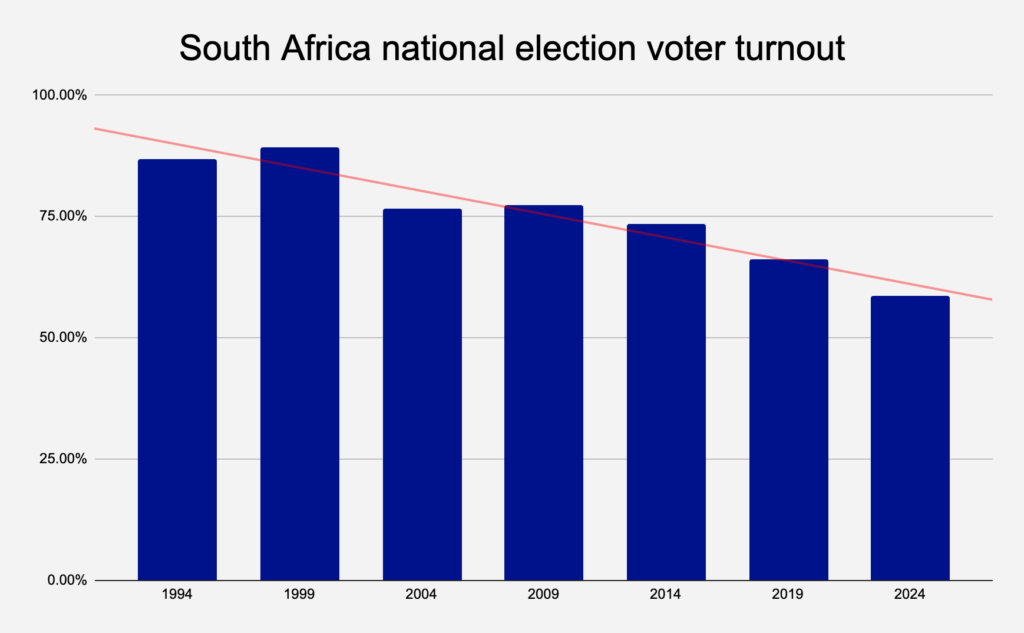
Van den Heever’s comments come as South Africa has experienced a notable decline in voter participation in national elections over the past decade, as seen in the graph above.
According to the Institute of Race Relations (IRR), South Africa has seen a steady decline in voter turnout since the 1994 national election.
This milestone election saw a voter turnout of 86.87%, which dropped to 66.05% in 2019.
In the 2024 national elections, which saw the biggest regime change since 1994 with the formation of the Government of National Unity, voter turnout was 58.64%.
However, it appears this trend is beginning to reverse, with a better turnout expected in the upcoming municipal elections in November.
Van den Heever said this is a positive development, and that the stakes for these upcoming elections are “quite high”.
“People see their communities struggling, and the question is whether they see the voting process as the way to change that,” he said.
“The question is whether people are starting to learn that the method of using the democratic process is that you will never get your perfect party, but you’re likely to at least be able to fire the people who aren’t doing their job, and that keeps people honest in the system.”
“Ultimately, it can be that you get very good people in positions of public authority if the citizenry is very active and engaged.”
Van den Heever explained that the only way for citizens to enact change, for anything from potholes to infrastructure to corruption, is by partaking in the democratic process and voting.
In other words, when voters are active, it puts pressure on political actors to keep the system honest, as continued support depends on their performance and adequately addressing their community’s needs.




Comments