Medical aid price shock for South Africans



The Reserve Bank has sounded the alarm over persistent health insurance price increases, which have outpaced inflation for much of the past decade.
The central bank attributed this to overutilisation, market inefficiencies, inadequate oversight, and weak competition in South Africa’s private healthcare industry.
It pointed out that the market remains highly concentrated, with three hospital groups accounting for about 90% of admissions and three administrators covering nearly 80% of all beneficiaries.
The Reserve Bank outlined these market dynamics in its latest Monetary Policy Review for April 2026, which outlined inflation expectations and drivers in South Africa.
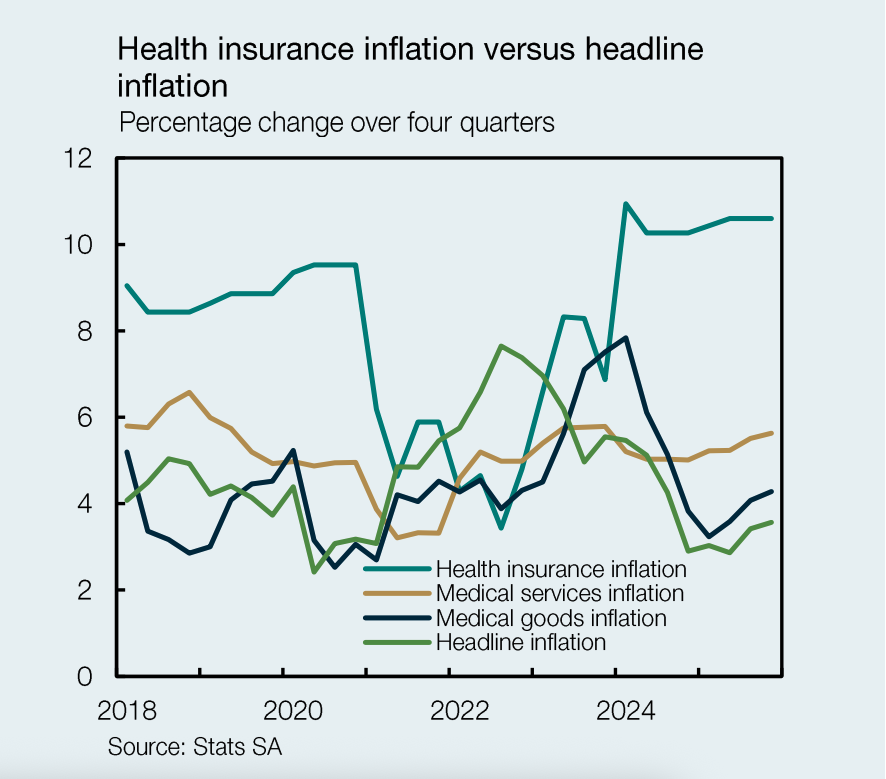
One driver outlined in the latest review was insurance inflation, with the Reserve Bank pointing out that, except for the Covid-19 period, South Africa’s health insurance inflation has consistently outpaced headline inflation.
While inflation for medicines, medical products, and services has broadly tracked headline inflation, the Reserve Bank said medical scheme premiums have escalated at a rate well above this.
The bank argued that an important driver of these above-inflation increases is overutilisation, with high admission rates and rising care intensity pushing up medical aid expenditure.
The Reserve Bank found that, from 2014 to 2024, intensive care unit admissions increased by 32.5% and high care admissions by 27.8%, while medical scheme beneficiaries grew by only 4%.
“Utilisation, as measured by hospital admission rates and lengths of stay, exceeds that of comparable Organisation for Economic Co-operation and Development countries,” the bank said.
In addition, it explained that healthcare spending in South Africa is heavily influenced by the country’s demographics and by market design failures.
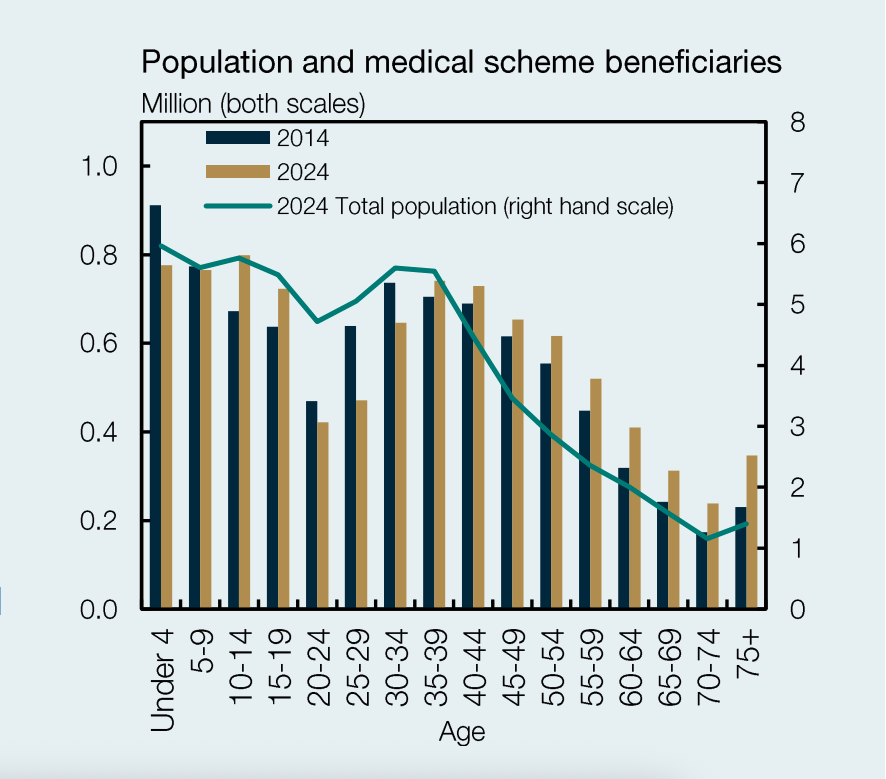
“Medical schemes have an older risk pool, while the absence of risk equalisation weakens cross-subsidisation and reinforces adverse selection,” the Reserve Bank said.
Simply put, risk equalisation in this context refers to a mechanism that redistributes funds from insurers with healthier (lower-risk) members to those with sicker (higher-risk) members.
According to the Reserve Bank, medical schemes in South Africa fail to use this mechanism efficiently and are now essentially competing on the basis of risk selection rather than ensuring equitable access.
The graph below, courtesy of the Reserve Bank’s Monetary Policy Review, shows how health insurance inflation has outpaced headline inflation for much of the past decade.
Market inefficiencies
The Reserve Bank explained that another major reason for above-inflation medical premium increases is market inefficiencies.
According to the bank, these inefficiencies compound costs, dilute cost containment, and enable fraud and abuse.
“Meanwhile, inadequate oversight of prescribed minimum benefits and practitioners, together with inefficient price-setting, limits value-based purchasing,” the central bank explained.
“Additionally, the third-party payer model entrenches moral hazard and erodes cost discipline.”
The bank added that health insurance price pressures may also reflect weak competition in South Africa’s healthcare industry.
“Both funder markets (medical schemes and administrators) and the hospital market are highly concentrated,” the Reserve Bank said.
“The three largest hospital groups account for about 90% of admissions, and the three largest administrators cover nearly 80% of all beneficiaries.”
Positively, this concentration risk is in the process of being addressed following the Competition Commission’s 2019 Health Market Inquiry.
The competition watchdog’s report concluded that South Africa’s private healthcare market is subject to distortions that adversely affect competition.
The report made several recommendations to ensure a more cost-effective, competitive, and appropriately regulated supply of private healthcare services.
“Reforms to curb unnecessary utilisation and fraud, and to strengthen competition, should reduce the relative price of health insurance and further support overall inflation control,” the Reserve Bank said.
The graph below, courtesy of the Reserve Bank’s Monetary Policy Review, shows the distribution of medical scheme beneficiaries in South Africa across various age groups.






Comments