Eskom here to stay


While many South Africans believe the creation of a free and competitive electricity market will see Eskom fall to the wayside, this is not necessarily the case.
In reality, South Africans will remain dependent on Eskom to supply the baseload power the country needs for years to come.
This was explained in a recent episode of The Allan Gray Podcast by ESG analyst Raine Adams, who outlined the role Eskom is set to play in South Africa’s electricity market.
Adams explained that, simply put, baseload electricity demand is the minimum level of electricity demand on a supply system that is sustained over a 24-hour period.
In turn, baseload supply is dispatchable generation, meaning generation that can be available on demand at any point in that 24-hour period.
South Africa’s baseload supply is currently generated by what is referred to as “baseload technologies”, meaning coal, nuclear, and hydro power.
These technologies stand in contrast to variable supply from renewables like wind and solar, which need to be supplemented.
Currently, South Africa’s demand profile is such that demand peaks in the morning and evenings, with less demand during the day.
Solar power supply, which has emerged as one of the most popular forms of renewable energy in South Africa, normally peaks midday and is lower during those morning and evening demand peaks.
This mismatch, Adams explained, is why solar power needs to be supplemented by baseload power from technologies like coal.
Adams put it simply as, “The wind doesn’t always blow, and the sun doesn’t always shine”, meaning these renewables cannot, in their current form, supply enough electricity over that 24-hour period.
She said that, over time, batteries will be able to fill that gap, as the midday excess capacity generated by solar panels can be shifted into peak-demand periods.
However, batteries are expensive and will take time to introduce into the system. Therefore, in the meantime, South Africa will remain reliant on technologies like coal and, consequently, Eskom.
“People say independent power producers can take over and Eskom can be allowed to fail, but, in practice, it can’t work that way, because they’re still supporting the whole system,” Adams said.
Eskom slowly losing market share
While South Africa will still rely on Eskom to supply baseload electricity for years to come, this does not mean the utility will not face stiff competition in those years.
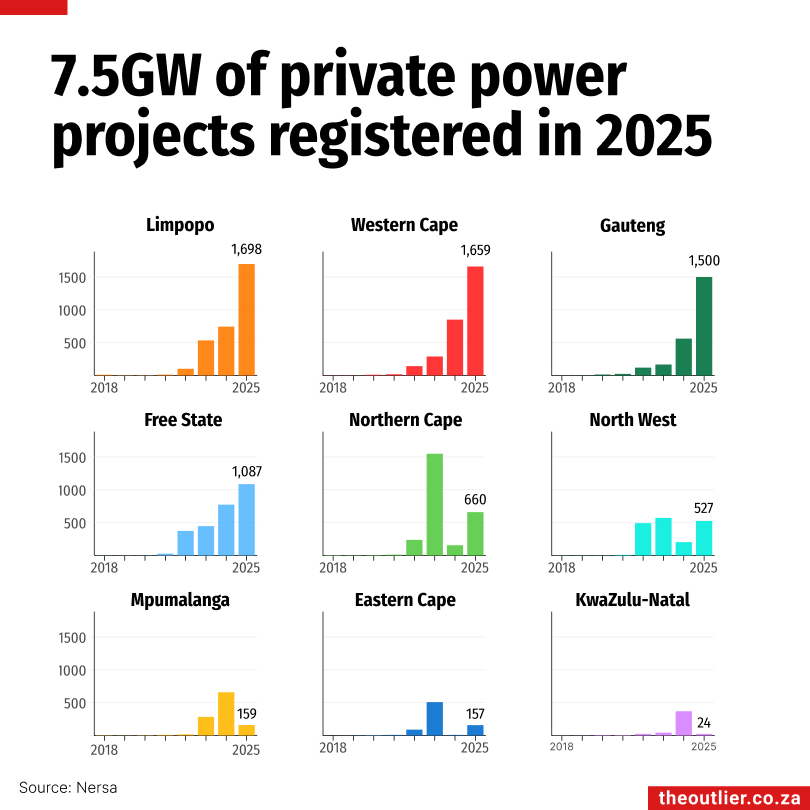
South Africa’s Integrated Resource Plan shows that new private generation capacity will outpace power procured by the government from independent producers and from Eskom-planned stations over the next few years.
Under this plan, these private projects will help to replace a “significant reduction” of 8 GW of coal capacity between 2029 and 2030.
Bloomberg reported that a pipeline of 13 GW of private generation capacity is expected to come online through 2029.
Adams said this will be positive for competition in time, creating more pricing transparency and forcing all players to compete on equal footing.
She said there is still work to be done, but the local electricity sector is on the right path, “now, it’s just about execution”.
Adams pointed out that the increase in renewable energy users over the past few years has actually been positive for Eskom.
Following years of load-shedding and operational struggles at the state-owned utility, Eskom has made meaningful progress in improving its operations and increasing supply.
Adams said the return of six units from Medupi and Kusile has been a big contributing factor and, to a large extent, “fixing what was broken”.
She also gave credit to the progress Eskom has made in stabilising its management, which has also helped to “right the ship”.
However, she said an overlooked factor that contributed immensely to improvements in the electricity sector has been lower demand.
Driven by the widespread adoption of rooftop solar PV and embedded generation from mining companies, this move away from Eskom, though not entirely, has served to lower demand from the state-owned utility.
Adams said rooftop solar went from supplying just under 2.5 GW four years ago to 7.5 GW today.
This, she said, has seen demand between 2.5 and 3 GW lower in 2025 than in prior years of load-shedding.
This lower demand has taken pressure off of Eskom, freeing up the utility’s capacity during the day and creating more “breathing room” in the system.




Comments