The man who was ‘fired’ as Capitec CEO within a week but stayed at the bank and became a billionaire


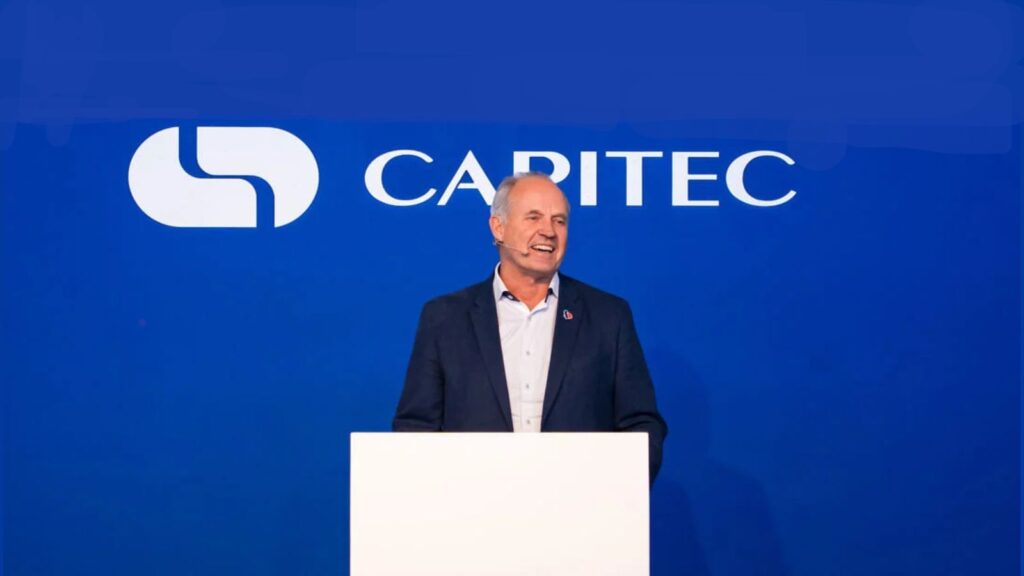
Former Capitec CEO Gerrie Fourie’s first stint as CEO of the bank was one of the shortest in South African corporate history, ending a week after he was appointed.
Fourie stayed on at Capitec as chief operating officer and helped the new CEO, Riaan Stassen, build the bank into the R550 billion giant it is today.
Later, with much more experience, Fourie would take over from Stassen as CEO for the second time and lead Capitec for a decade.
Fourie revealed this part of his journey in a webinar with the Efficient Group, where the banker outlined how Capitec was built and what he is doing with his time today.
Capitec is one of the most successful business success stories in South African history, with it being the only successful challenger to the Big Four banks.
The Big Four – Standard Bank, Absa, FNB, and Nedbank – had dominated banking in South Africa for over 100 years by the time Capitec launched in 2001.
Fourie had joined the bank in 2000, before it was called Capitec, with it being a collection of hundreds of microlenders, which Michiel Le Roux was planning to use as a launchpad for a bank.
Backed by the PSG Group, Michiel Le Roux was set to turn the microlenders into a licensed banking operation with hundreds of branches across South Africa.
At this time, Fourie was effectively the CEO, as he was in charge of the microlending enterprise and was fully expected to be the head of the new bank.
However, Le Roux realised that to appease regulators in South Africa and make a success of the bank, he would need an experienced hand at the helm.
An opportunity to pick up experienced bankers cheaply came in the midst of challenges at Boland Bank. Its key leaders, including Riaan Stassen, Andre de Plessis, and Carl Fischer, wanted out.
Le Roux convinced them to join Capitec, luring Stassen with the title of CEO. This would mean that Fourie would have to step aside.
“I probably had the shortest CEO stint of anybody. I had joined on 1 April, and Riaan and his team joined in the middle of that month,” Fourie explained.
“They went to Botswana for two or three months to have a sabbatical, and they joined us in July that year. It was in their first week that Michiel told me, ‘Listen, you are not CEO anymore. Riaan is going to take over’.”
Building Capitec and becoming a billionaire

Instead of taking the decision personally, Fourie was excited at the opportunity to learn from an experienced banking executive and build Capitec.
“I said to Michiel, ‘I don’t care. Riaan has much more experience than I.’ For me, the only thing that mattered was building the bank,” Fourie said.
“That was the way we operated. We did not worry about who did what. You had a function, and you just did it. We did not worry about titles.”
It was a tight-knit group that built Capitec, with it having an executive committee of nine people at the time it launched. These people built the bank, and they trusted each other completely.
“We knew each other very well. I knew Andre was the best person for finance. I knew Chris was the best person at risk. We trusted each other, and we fought like hell,” Fourie said.
“Monday afternoons were hectic, particularly those first few years where we were building the bank and things were not working.”
Here, Fourie said Stassen’s leadership and experience shone through, ensuring that, despite the conflict, the nine leaders remained a team moving in the same direction.
The Capitec brand subsumed the microlenders and became the bank it is today, thanks to the efforts of those nine people.
Capitec struggled to shake this branding for the first few years, and it was only really under Fourie that it shed its reputation as just a low-income bank.
Taking over from Stassen in 2013, Fourie turbocharged the bank’s success, transforming it into a dominant force across personal and business banking, with a growing presence in insurance.
Much of Fourie’s tenure focused on building out Capitec’s digital systems, leading the push to create a fully online onboarding process.
Fourie also oversaw the launch of Capitec Connect, the bank’s mobile network offering, which has over 1.5 million users and contributes over R400 million in net income for the bank.
Arguably, the most successful venture under Fourie was Capite’s push into business banking, with it replicating its model in the small business and commercial space.
Under Fourie, the bank’s client base skyrocketed from 5 million in 2013 to over 25 million when he retired in 2025.
Fourie passed the baton to another experienced Capitec executive, Graham Lee, who has been at the bank since 2003.
After a one-year transition period, Fourie was appointed as a non-executive director on Capitec’s board. He also took up a position on STADIO’s board.
Fourie was well-rewarded for his work in making Capitec one of the most valuable companies in South Africa, receiving R877 million in salaries and bonuses during his time as CEO.
He still owns 1,027,673 Capitec shares, which form the basis of his wealth. This represents nearly 1% of the company’s entire share capital.
This makes his stake in the company worth R4.7 billion, ensuring that Fourie is comfortably one of the wealthiest people in South Africa.
 Loading ...





Comments