One day saved the JSE from its worst month in 20 years


A rally on the last day of March saw the JSE avoid one of its worst months on record, though the bourse still took significant pain last month.
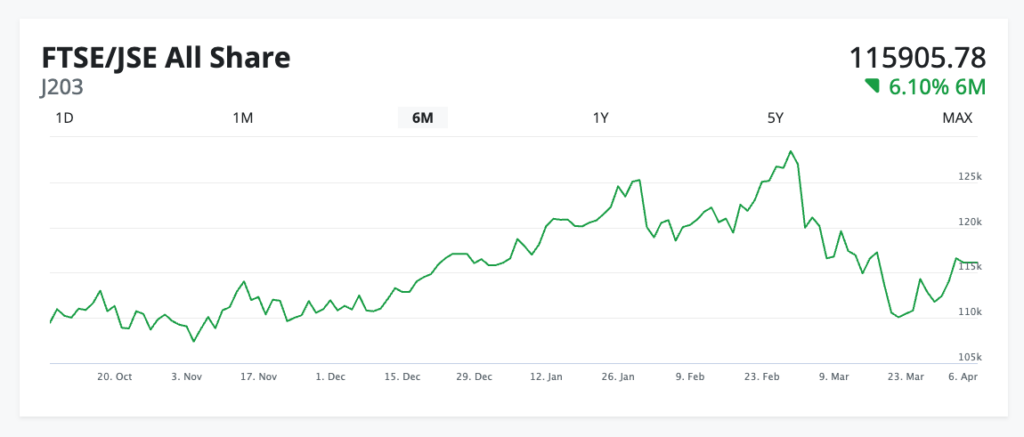
Following a record performance in 2025 and a strong start to 2026, the JSE’s outperformance ended abruptly in March due to the Middle East war.
The US/Israel-Iran conflict not only affected the performance of South African stocks but also negatively impacted bonds and the rand.
Anchor Capital’s Peter Little explained that the South African equity market’s recent streak as a top-performing global bourse ended abruptly in March, with the JSE Capped All Share down 10.5% month-on-month.
He noted that it was only a 1.6% rally by domestic equities on the last day of March that saved the JSE from delivering its worst monthly drawdown since the global financial crisis almost 20 years ago.
Little pointed out that the script was completely flipped for the JSE in March, as precious metal miners, the driving force of the bourse’s outperformance over the past year, were the biggest detractors last month.
In 2025 and the start of 2026, a commodity boom, driven by a rally in precious metals prices, boosted local mining stocks and, consequently, the JSE. Gold and platinum miners, in particular, were beneficiaries of this boom.
However, in March, gold miners were down 18% and platinum miners down 25%, contributing more than 6% to the JSE’s March drawdown.
Little attributed this to a sharp drop in precious metals prices. Gold dropped 12% month on month, while platinum fared even worse, falling 18% month on month.
He said there were some positives near the end of the month, with gold rallying late in the month and platinum only dropping back to late-December levels.
However, this did not serve to fully save the JSE, as pain on the bourse was not limited to precious metal miners, with most sectors seeing drawdowns.
Little said banking stocks, which are considered domestic economy bellwethers, dropped 10% month-on-month, erasing their year-to-date gains in only one month.
The graph below, captured on 7 April, shows the JSE All Share’s performance over the past six months, with a clear drop seen in March.
Bonds and the rand feel the pain
Little explained that the pain of the March sell-off was not limited to local equities, with bonds and the rand also experiencing one of their worst months on record.
He pointed out that the JSE All Bond Index of South African government bonds had the second-worst month in its 25-year history in March, dropping by 7% month-on-month.
At the same time, the South African government’s 10-year borrowing rate spiked 1.2% to 9.3% per annum during March.
Bloomberg reported in mid-March that the Iran war sparked the largest outflow from South Africa’s bond market in at least six years.
The publication attributed this to foreign investors having lost their appetite for one of the most popular emerging-market trades of recent months.
The rand was also a victim of this, with South Africa’s currency being the worst-performing major currency in March.
The local currency fell 5.9% month-on-month against the US dollar in March, as investors flocked to the greenback’s relative safety.
“The March losses erased early-2026 gains to leave the local currency 2.2% weaker against the US dollar for the first quarter of 2026,” Little said.
However, he noted that the rand is still 8.2% stronger than the US currency over the past year.
Investec chief economist Annabel Bishop explained that several factors have softened the blow of the Iran war on the rand.
She explained that South Africa’s low inflation, combined with positive investor sentiment from mid-2024 onwards, has allowed the rand to experience a less severe impact from the Middle East war than it would have otherwise.
Bishop said the Reserve Bank’s conservative approach to monetary policy has also allowed the rand and South Africa’s bond market to avoid the worst-case scenario from this conflict.
“For South Africa, monetary policy conservatism has allowed for a more robust environment better able to withstand shocks,” she said.




Comments