Government owes Johannesburg R1.4 billion


The City of Johannesburg has drastically ramped up its efforts to recover the R1.4 billion owed to it by government departments.
The city announced on 26 March 2026 that it would take full advantage of the financial year-end to enforce settlement of outstanding municipal debts owed by these departments.
This enforcement involves a mass disconnection of services such as water and electricity to buildings in which these departments operate.
The disconnection drive began in Johannesburg’s Central Business District on 27 March, just one day after the city’s initial announcement.
Entities that participated in the operation include the Johannesburg Metropolitan Police Department (JMPD), City Power, Johannesburg Water, and officials from the city’s Group Finance Department.
Acting Group Head of the Revenue Shared Services Centre, Lufuno Mashau, explained that the city had exhausted all other avenues to resolve the debt and had now lost its patience.
“As the financial year-end looms, the city is aware that some departments may be set to return unspent funds back into the fiscus, but this should only be a consideration after settlement of municipal debt owed to the city,” Mashau said.
He said services will not be returned to these departments until they enter into a payment agreement with the city and settle a portion of their debt.
Johannesburg Executive Mayor Dada Morero, who was on the scene of the disconnection operation, said Gauteng Premier Panyaza Lesufi had given his express permission for the service suspension.
The City of Johannesburg has vowed to keep its doors open to encourage coordination, but said it would not tolerate further delays over unpaid accounts.
“Government departments, like any other customer in the city, must prioritise settlement of their municipal accounts,” Mashau said.
“They must pay their bills in full and on time. Failure to meet their obligations leaves the city with no option but to disconnect services.”
An extensive operation
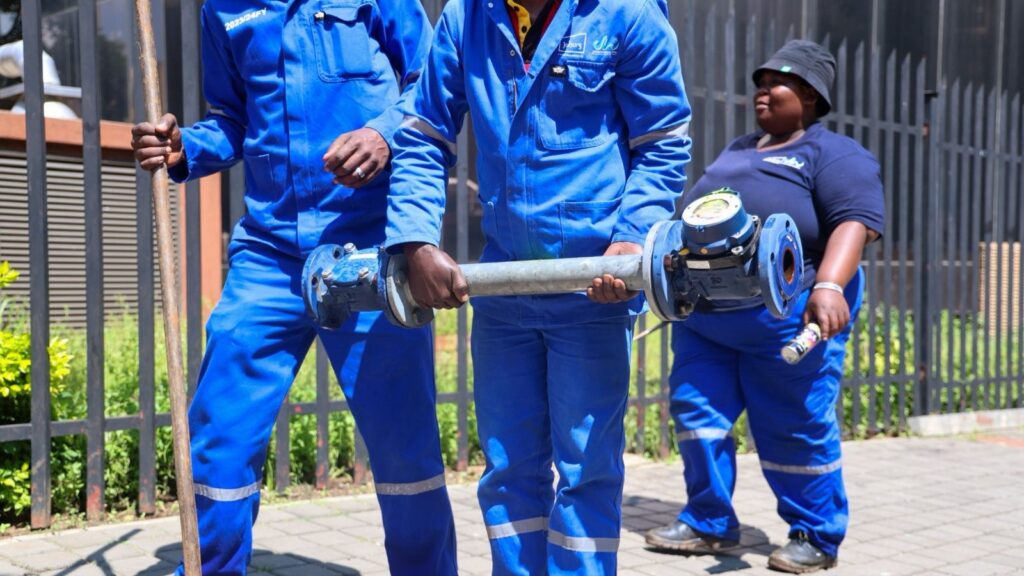
The City of Johannesburg’s large-scale disconnection drive on 27 March resulted in multiple departments having their basic services suspended.
The operation began at a multi-storey building on Simmonds Street in the CBD, where water services were suspended, and a water meter was removed.
The building is owned by the Gauteng Provincial Government’s branch of the Department of Cooperative Governance and Traditional Affairs, which owes the city over R677,000.
The disconnection team faced resistance from private security personnel at the site, prompting the JMPD to step in and assist.
A building on Commissioner Street housing the Gauteng Department of Health, among other provincial departments, was also targeted in the drive.
The building’s electricity supply was disconnected due to outstanding debts, with the Department of Health alone owing the city over R200 million.
The City of Johannesburg has warned that it will continue to aggressively disconnect even more government buildings if they do not settle their accounts, with the exception of hospitals.
“These disconnections should serve as a clear warning to all government stakeholders,” Mashau said. “The city is serious about recovering long-standing debt.”
“We will not hesitate to extend this action to other departments — including education, public works, and even court facilities — should non-payment persist.”
During the disconnection drive, the city attempted to cut services at the Johannesburg High Court but was not able to access the supply nodes.
City officials said they would return soon unless the Department of Justice agrees to settle its over R55 million debt.
Both Mashau and Morero said recovering the money owed was integral to the continued delivery of services to the city’s residents.
“The city cannot continue to supply services to government departments and entities without receiving payment,” Mashau said. “We have obligations to Eskom and Rand Water.”
“It is incumbent upon all customers – including government – to honour their accounts. Sustainable service delivery depends on consistent revenue collection.”



Comments