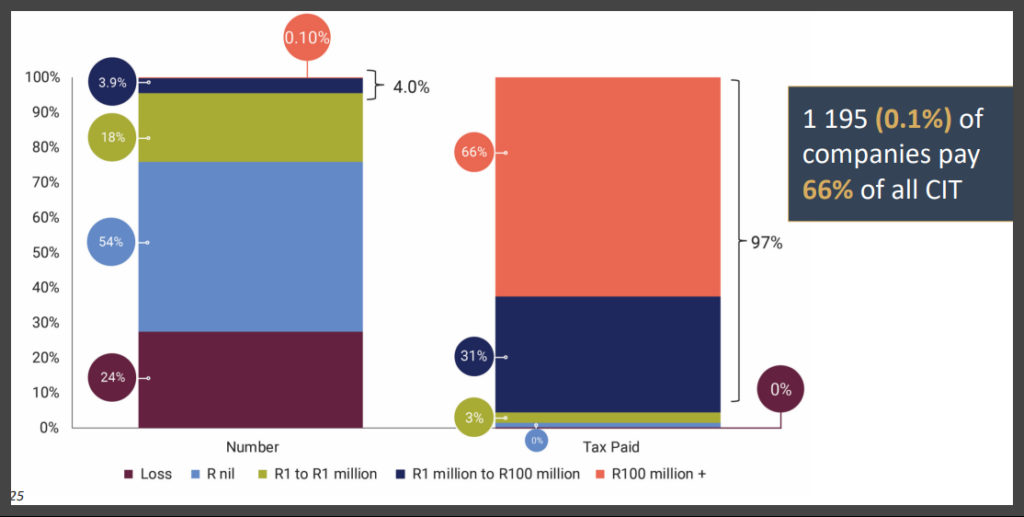
0.1% of South African companies pay 66% of all corporate tax


1,195 companies in South Africa pay 66% of all corporate income tax, which makes them the lifeblood of the economy.
This was revealed by Dawie Roodt, the Chief Economist at the Efficient Group, during his 2026 Budget presentation.
Corporate income tax accounts for R364.3 billion in revenue for the state, making it the third largest tax in South Africa.
South Africa has a corporate tax rate of 27%, which is high when compared to global and regional averages.
The tax rate was reduced from 28% to 27% in 2023 to make South Africa more competitive and encourage investment.
However, many economists, including Roodt, argue that the corporate income tax rate is still too high and deters investment.
He argued that companies shift the corporate tax burden to employees. “Essentially, companies do not pay tax,” he said.
“We need to reduce corporate taxes, and we need to reduce them aggressively. Hopefully, this will get more attention in future budgets.”
Roodt previously explained that South Africa has strayed over the edge of the Laffer Curve, where the rate is so high it deters investment.
He added that the 27% corporate income tax rate pushes companies to minimize their tax liabilities or close down.
Busisiwe Mavuso, the CEO of Business Leadership South Africa, has also said corporate taxes should be reduced in the long term.
She said the National Treasury has previously floated the idea of reducing the corporate tax rate from 27%.
“While fiscal constraints make that premature right now, it is the right long-term direction,” Mavuso said.
She said getting South Africa’s tax competitiveness right is as important to the investment climate as reliable power and efficient logistics.
Finance Minister Enoch Godongwana kept corporate taxes unchanged

Although Finance Minister Enoch Godongwana did not announce a reduction in this tax, he did offer a lower rate for qualifying companies in special economic zones.
These companies are taxed at a 15% corporate tax rate instead of 27%, which makes it attractive to operate in these zones.
There are strict conditions to prevent companies from shifting profits to connected firms in a special economic zone.
Companies are disqualified if more than one-fifth of expenditure or gross income arises from transactions with connected firms outside the zone.
The Finance Minister said that these rigid rules work against businesses already operating in the zones.
They also work against potential investors wanting to use the zones to strengthen their own supply chains.
The government will now assess whether companies are buying or selling their products to connected parties outside the zone at market-related prices.
This will ensure that profits from companies operating in other areas are not shifted into the low-tax zone.
Corporate income tax overview
 Loading ...





Comments