South Africa’s unemployment crisis worse than it looks


South Africa’s persistently high unemployment is limiting wage progression in the country, and is worsened by the economy’s perennial slow growth.
This makes South Africa’s labour market highly fragile, as the economy is simply not growing fast enough to absorb the number of people entering the workforce every year.
Despite this, South African households remain highly resilient, with their spending providing the economy with a much-needed boost as fixed investment struggles.
Investec chief economist Annabel Bishop recently explained that real take-home pay in South Africa rose by 0.3% quarter-on-quarter in the third quarter of 2025. In contrast, real incomes fell by 1.1% year-on-year.
Part of the reason for this year-on-year decline is the country’s persistently high unemployment, which constrains incomes.
The most recent Quarterly Labour Force Survey released by Stats SA showed that unemployment reached 33.2% in the second quarter of 2025. The expanded unemployment, which includes discouraged workseekers, reached 42.9%.
“In such an environment, wage progression and labour absorption are limited,” Bishop said.
In its latest Monetary Policy Review, the Reserve Bank attributed this persistent high unemployment to a prolonged period of low economic growth, skills mismatches and other entrenched structural factors.
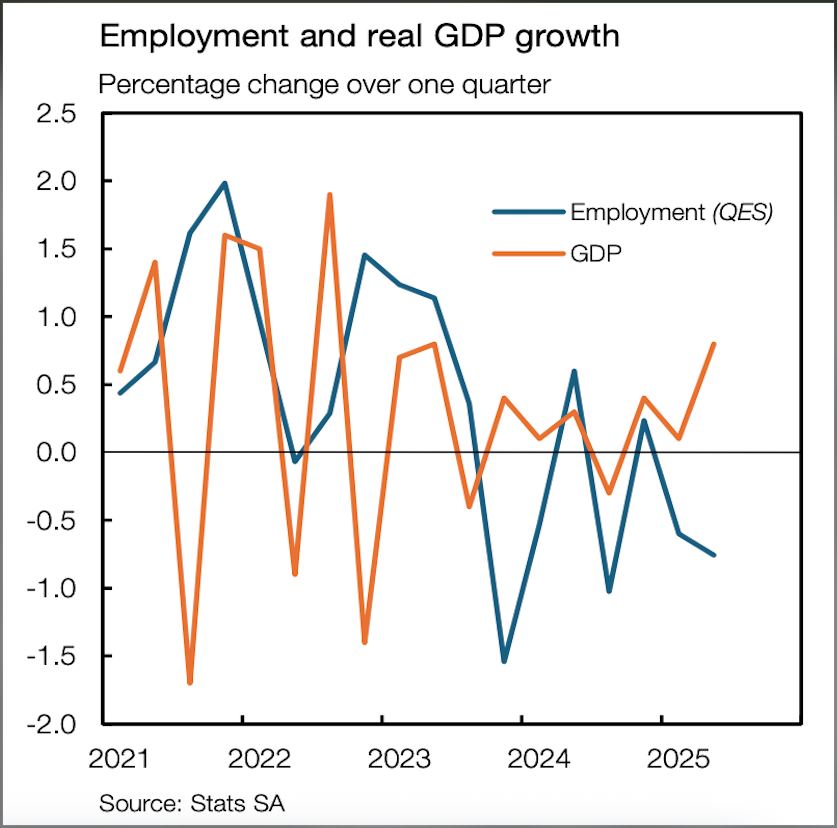
The central bank pointed out that, over the past decade, employment grew by 0.7% per year while the labour force increased at an average rate of 2.1%.
This, it explained, has resulted in rising long-term unemployment and elevated youth unemployment, which reached 46.1% in the second quarter of this year.
“The labour market remains fragile, as reflected in persistent job-shedding since mid-2023,” the Reserve Bank said.
“Labour market outcomes map directly into employee earnings and feed through into real disposable income growth and ultimately household spending.”
However, the bank said that, despite weak employment outcomes, the real total compensation of employees increased by 1% in the first half of this year, benefitting from wage growth of 3.2% and subdued inflation.
South Africa’s GDP growth and employment trends since 2021 can be seen in the graph below, courtesy of the Reserve Bank’s Monetary Policy Review.
South African households staying strong
Despite these disappointing income growth and unemployment figures, South African households have remained remarkably resilient.
The Reserve Bank revealed that household spending registered a solid 3% increase in the first six months of 2025 on a year-on-year basis and underpinned the country’s output growth.
It explained that spending benefited from growth in employee earnings, low inflation and interest rates, and two-pot retirement withdrawals.
In addition, declining debt-service costs, along with a rebound in consumer confidence, supported households’ real consumption spending.
The Reserve Bank said this spending by households, referred to as household consumption expenditure, was the primary driver of South Africa’s economic growth in the second quarter of 2025.
The local economy expanded at a relatively fast pace of 0.8% in the second quarter of 2025, which is a marked improvement on the 0.1% growth recorded in the first quarter.
While household spending gave the economy a welcome boost, fixed investment proved to be a drag in the second quarter, having registered contractions in seven of the past eight quarters.
The Reserve Bank warned that this sustained decline in investment reflects enduring structural constraints that depress confidence and undermine long-term potential economic growth.
While household spending has been positive for economic growth, it is too narrow and fragile to drive sustained growth.
This is because much of households’ spending is on imported goods and based on short-term cyclical factors, such as lower inflation, eased interest rates, and two-pot withdrawals.
Therefore, while this growth gives South Africa a good boost in the short term, it is unreliable in the long run, as the economy needs fixed investment in productive assets to improve its economic fortunes and address the growing unemployment crisis.
Stanlib chief economist Kevin Lings previously explained that over 600,000 South Africans enter the workforce every year, yet the country’s economy grows by, on average, less than 1% a year.
“We have 600,000 people entering the labour force every year who have to be accommodated with employment and opportunities,” Lings said.
“If we do not accommodate these people, it translates directly into unemployment, particularly youth unemployment.”
He explained that, even at the peak of South Africa’s economic growth in the mid-2000s, when output grew by over 4% a year, the economy added only around 500,000 jobs a year.
Therefore, even if South Africa managed this faster growth, the unemployment rate would still increase year-on-year, just at a slower rate.





Comments