One thing South Africa gets wrong about its hidden R750 billion economy


While South Africa’s informal economy plays a significant role in ensuring incomes for many households, it should not be seen as the silver bullet to solve the country’s unemployment crisis.
The formal sector continues to be the most powerful catalyst for informal sector growth and employment in South Africa, providing households with increased and more stable disposable income.
This is feedback from the Centre for Development and Enterprise (CDE), which outlined the role of South Africa’s informal economy in its recent report, “South Africa’s Unemployment Catastrophe: A call for urgent action”.
Interest in South Africa’s informal economy has boomed in recent years, as an increasing number of sources point to the sector’s significant size and economic contribution.
Informal economy expert GG Alcock has estimated the value of the informal sector at between R750 billion and R1 trillion.
This sector employs about 3.5 million South Africans, or around 20% of the country’s workforce.
The sector’s scale and potential have also drawn the interest of several formal sector companies, including JSE-listed giants like Shoprite, Capitec, and Pepkor.
Interest in the informal sector further increased in June 2025, when former Capitec CEO Gerrie Fourie claimed that, when including this sector, South Africa’s unemployment rate is closer to 10% than the official figure of 33%.
Fourie based his argument on Capitec’s vast amount of data collected from the bank’s close to 25 million clients.
He argued that Statistics South Africa, when collecting unemployment data, ignores self-employed people in the informal economy, urging the statistics agency to rethink its definitions of employment.
Fourie later clarified that these claims were not meant to focus on the exact unemployment figures but rather urge South Africans to learn more about the informal sector and its important role in the economy.
In its report, the CDE explained that while the informal sector should not be ignored, it should also not be romanticised.
In addition, the informal sector should not be seen as the primary answer to South Africa’s unemployment crisis, as the formal sector remains the most powerful method of increasing job growth.
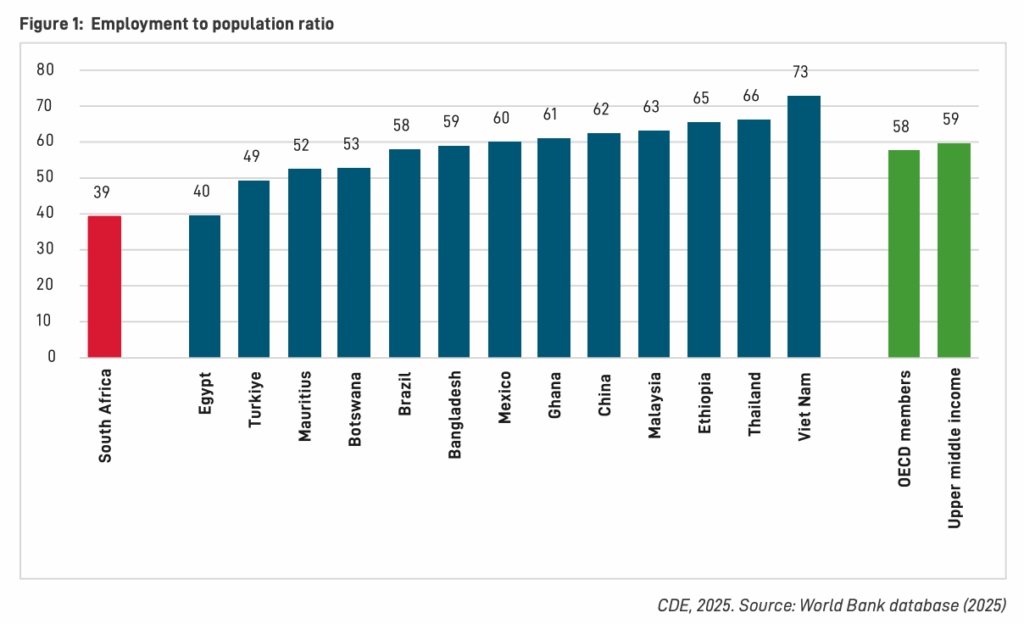
The debth of South Africa’s unemployment crisis can be seen in the graph below, which compares the country’s employment-to-population ratio with other emerging markets.
No silver bullet
The CDE explained that a thriving formal sector is the “engine of a modern economy” and crucial to providing stable incomes for local households.
“Formal jobs offer more stability, better wages, benefits and safety conditions. They also provide a pathway for skills development and career progression,” the organisation said.
“Formal jobs expand the tax base, helping to fund the public services that underpin a functioning society and an expanding economy.”
It further explained that the formal sector also plays an important role in advancing the informal sector.
This is because South Africa’s informal economy is not constrained by a lack of entrepreneurs but rather a lack of disposable income in informal communities.
“If more people had stable jobs, there would be more disposable income circulating in communities, creating a virtuous cycle of demand that supports spaza shops, hairdressers, car repair businesses and providers of household services,” it said.
“Accelerating growth and formal sector employment is, therefore, the most effective lever we have for increasing employment across the entire economy, including the informal sector.”
Therefore, the CDE said creating a less rigid and hostile environment for formal sector businesses, including small businesses, must be part of the solution to South Africa’s unemployment crisis.
“This must be accompanied by strong measures to address the rigidities in our labour market, to fix our dysfunctional skills pipeline, and to reduce the harmful effects of our highly inefficient spatial patterns,” it said.
“By making it easier for businesses to invest, expand and hire, we create sustainable jobs and lay the foundation for a more prosperous and inclusive society for all.”