South Africa can triple its economic growth in a year


South Africa’s economic growth could triple within a year if the government made a few small changes that created an environment for businesses to invest in the country.
This includes creating a stable political environment with certainty regarding property rights, which is paramount for any investment in the country.
Coupled with new electricity generation capacity being added to the grid and increased private sector investment in the logistics sector, economic growth could skyrocket.
Albeit off a low base, faster economic growth would completely shift the equation for South Africa, creating a virtuous cycle and changing how it is viewed globally.
This is feedback from Efficient Group chief economist Dawie Roodt, who explained that a few decisions could unlock tremendous potential in South Africa’s economy.
Roodt told the State of the Nation podcast that the root of South Africa’s economic and financial problems comes from political decisions made over the past decade.
The decision to rapidly increase government spending for consumption through salaries and grants has not translated into faster economic growth, saddling the state with an unsustainable debt burden.
This, coupled with widespread corruption within the public service and political class, has hamstrung South Africa’s economic growth.
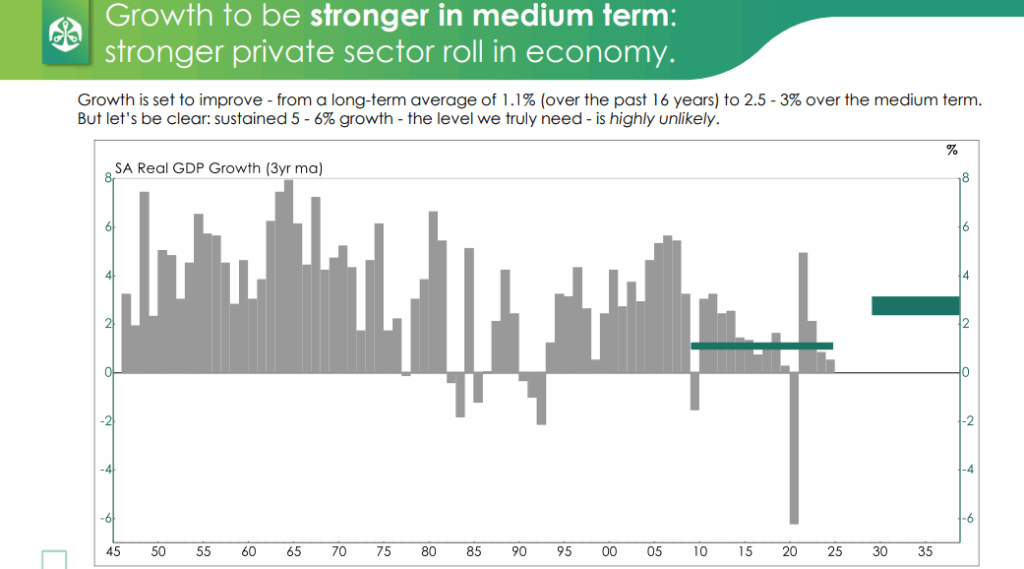
The country has averaged an annual growth rate of 1.1% since 2010 and only 0.8% over the past decade, resulting in the average South African being poorer than they were just ten years ago.
“I don’t understand why our politicians make the decisions they do. Are they trying to survive politically or line their own pockets all the time?” Roodt asked.
“Do they realise that we are heading for a disaster? That we are already experiencing a slow-motion economic and financial crisis in South Africa?”
Roodt explained that what is most concerning is politicians’ unwillingness to make drastic changes to boost economic growth.
Instead, the country’s political leaders appear content to double down on destructive policies that prevent investment and economic growth.
“If we get the right government in charge in South Africa and take a few small, important steps, then we can get economic growth up to 3% or even higher within a year,” Roodt said.
“Now we are sitting with economic growth well below population growth and below 1%. What is really concerning is that we will see an increase in unemployment and absolute poverty in South Africa.”
South Africa on the right path

South Africa appears to be on the right path in achieving 3% economic growth, with reforms in the electricity and logistics sectors well underway.
These reforms appear to be gaining momentum and are set to result in the private sector playing a much larger role in the local economy.
Private companies have invested hundreds of billions of rands in alternative energy sources to state-owned Eskom and are set to invest heavily in the country’s ailing logistics network.
Combined with cyclical factors such as low inflation and interest rate reductions, the country’s GDP growth is forecast to rise above 2.5% in the next few years.
Old Mutual’s chief economist, Johann Els, explained that in the immediate term, economic growth is going to be driven by cyclical factors that will push consumer spending higher.
Increasing investment in the country and reducing structural constraints will be necessary for longer-term economic growth.
In this regard, South Africa has made some good progress, with substantial improvements in the supply of electricity and the efficiency of the country’s logistics network.
Els said these improvements will drive economic growth higher for the next decade towards an average of 2.5% to 3%.
Crucially, these reforms increase private sector participation in the economy, which will result in improved investment and economic outcomes.
This increased participation alone will have a material positive impact on sentiment and investment, translating into increased employment and economic growth.
However, Els warned that without significant reform in the country’s labour market, growth will not reach the 5% and above level on a sustained basis.
The graph below, courtesy of Els and Old Mutual, shows South Africa’s economic growth since the end of WWII, with a noticeable slowdown in the past decade. The thick green bar shows where Els expects growth to average in the next decade.



Comments