Reserve Bank raises the alarm for South Africa’s economy amid US tariffs


The Reserve Bank has cut its forecast for South Africa’s economic growth once again, taking it down to 1% from 1.2% just two months ago.
This is largely due to the expected impact of tariffs on South African exports to the United States, which will impact several key industries.
Coupled with continued supply-side challenges from logistical inefficiencies and limited electricity generation, South Africa’s economic growth prospects have deteriorated significantly as 2025 has gone on.
Initial projections for the year put the consensus forecast for growth between 1.5% and 2.5%, with a pickup in investment and consumer spending expected.
However, so far, only consumer spending has grown strongly, with renewed uncertainty from potential tariffs to local politics limiting business and consumer confidence.
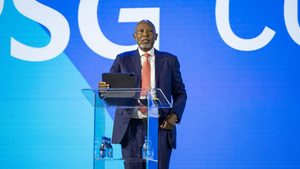
“Turning to South Africa, in May, we warned that economic activity for the first quarter of 2025 was looking weak,” Reserve Bank Governor Lesetja Kganyago said.
“Statistics South Africa has since reported that growth was just 0.1%, in line with our expectations. However, there was also a downward revision to earlier GDP data.”
“Along with an assumption of higher US tariffs on South Africa, this has caused us to mark down our 2025 growth forecast.”
The Reserve Bank’s forecast has been revised downwards to 1% from 1.2% two months ago.
Standard Bank’s economics unit has calculated that for every 10 percentage point increase in the tariff rate, South Africa will lose 0.1 percentage point of GDP growth.
Kganyago did explain that it is not all bad news, with the recent data flow has being positive, suggesting that the economy picked up in the second quarter of the year.
“The economy’s underlying growth trend remains low, mainly due to persistent supply-side problems, for instance, in logistics,” he said.
Higher levels of uncertainty also seem to have affected output, with business and consumer confidence deteriorating in the first half of the year.
“However, we still expect modestly higher growth in the coming years, supported by ongoing structural reforms.”
These reforms, particularly in the electricity and logistics sectors, are set to significantly increase private sector participation in the South African economy.
Crisis of confidence

South Africa’s economy looks set to bounce back in the second half of the year following negative growth in the first quarter.
Economic data from the manufacturing and mining sectors point to a recovery, and the whole economic Purchasing Managers’ Index (PMI) has broken into positive territory.
This suggests that economic growth will pick up in the second half of the year, with improved consumer spending helping to accelerate activity.
However, business and consumer confidence remain poor, indicating that the growth prospects may be short-lived and unsustainable in the long run.
The increased optimism in South Africa’s economy following the formation of the Government of National Unity (GNU) and improvements in electricity supply have not translated into economic data.
South Africa’s economic growth remains flat, with ratings agencies, banks, and asset managers revising their outlooks for the country’s economy downwards.
This has largely been due to disappointing output from the country’s mining and manufacturing sectors, with construction continuing its years-long decline.
These sectors are vital for employment and foreign exchange earnings through exports, with their declining output having a significant impact on economic activity.
Old Mutual chief economist Johann Els expects the output of these sectors to pick up in the second half of the year, with the data for April and May looking strong for the mining and manufacturing sectors.
The manufacturing PMI has also shown a significant uptick in new sales orders and, crucially, expected business conditions.
This suggests that the sector is beginning to expand and anticipates a future that will surpass the past.
The expected improvement in performance from the manufacturing and mining sectors has also pushed the three-month average for the whole economy PMI into positive territory, indicating a pickup in activity and growth.
A major fly in the ointment of South Africa’s economic recovery is the country’s ongoing confidence crisis, which inhibits investment.
Els explained that confidence in a country’s economic and political climate is vital for investment to occur and drive economic growth.
In South Africa, confidence has been poor since 2010, when Jacob Zuma ascended to the Presidency and the government began ratcheting up its spending without much improvement in economic growth.
The lack of confidence is primarily a function of policy uncertainty, inadequate implementation, and a failure to adjust policies that have not improved economic outcomes.
Els explained that South Africa’s economy could have grown at well above 2% per annum over the past decade if confidence levels had matched those in the 2000s.
Instead, the country’s economy has averaged an annual growth rate of less than 1% for the past decade and only 1.1% for the past 15 years.
While consumer confidence has held up more robustly over the past decade, it too has come under immense pressure in the past few years.
With rising inflation and interest rates after the pandemic, the cost of living skyrocketed, limiting consumer spending and saving.
Although this picture has improved due to lower inflation and interest rates, consumer confidence remains in negative territory.
This can be seen in the graphs below.






Comments