Dawie Roodt warns South Africa is being left behind


South Africa is falling further behind developed markets and is increasingly being overtaken by countries it was once far ahead of.
This is largely due to the country’s economic stagnation over the past 15 years, which has been caused by widespread corruption, policy instability, and the collapse of state-owned enterprises (SOEs).
The South African economy has only managed an average annual growth rate of 1.1% over the past 15 years, with a rate of 0.8% for the past decade.
This is far below developed economies and the country’s peers, with those once far behind now catching up and leaving it behind.
Efficient Group chief economist Dawie Roodt explained that this is largely due to the country’s government’s policy choices, which have severely constrained growth.
“South Africa seems to have two speeds of economic growth, and those are very slow and terrible,” Roodt told the State of the Nation podcast.
Roodt explained that it is important to compare South Africa’s economic performance to that of other countries and to itself in the past.
This enables individuals to understand whether South Africa’s challenges are unique to its situation and what has worked or not in the past to generate economic growth.
“If you compare us to ourselves, we are roughly where we were 15 years ago in terms of wealth and purchasing power,” Roodt said.
This should not be the case in any well-functioning economy, with an economy’s natural state being growth, as businesses expand and historic investment compounds.
“An economy always wants to grow. If you do the right things and put good policies in place, economies grow. That is what economies do,” Roodt said.
However, South Africa’s government has repeatedly doubled down on failed economic policies, leading to stagnation and declining wealth for citizens.
It is estimated that South Africa lost out on R5 trillion of economic activity from not merely growing at the average rate of other emerging markets.
This would have generated sufficient tax revenue to plug the country’s deficits for the past few years and put the government in a much better financial position.
South Africa versus the rest

The picture is even worse when compared to other economies, with South Africa falling further behind developed markets and being overtaken by its peers.
In the early 2000s, South Africa was on track to steadily grow into a high-income country, with economic growth averaging 4% towards the end of the decade.
The government’s financial health was improving, with it posting a full budget surplus in the 2007/08 financial year and stabilising the rand.
However, South Africa’s economy has stagnated since then, and government spending has skyrocketed, saddling the state with a debt burden of over R5 trillion.
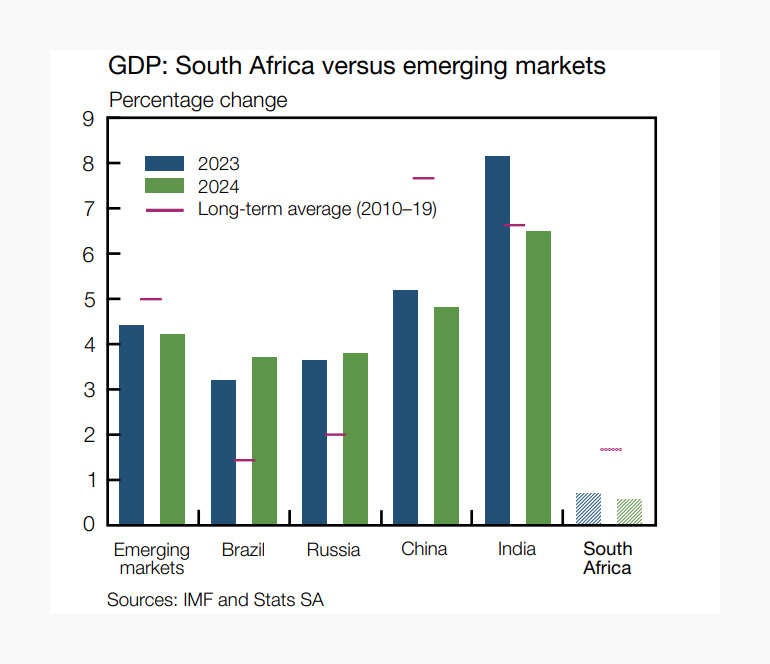
Since 2015, its economy has averaged an annual growth rate of 1.1%, while its other emerging market peers have grown at 4.5% per annum. As a result, they have effectively caught up with and overtaken South Africa.
Some of South Africa’s continental peers have also surpassed it in terms of GDP per capita, with it ranking among the worst African countries in terms of growth prospects.
“If you compare South Africa to other countries – I am not even talking about rich countries, even looking at poor countries – it is much worse off than in the past,” Roodt said.
Roodt pointed to Mauritius as an example, which had a significantly lower GDP per capita than South Africa in the 2000s.
Now, the average Mauritian is richer than the average South African. On a GDP per capita basis, Mauritius is wealthier than South Africa.
“So, we are falling behind the rich guys, and the poor guys are catching up with us, and they are overtaking us,” he said.
Roodt estimated that if South Africa had grown at the same rate as its emerging market peers over the last decade, the country’s GDP per capita would have been 40% higher than it is now.
South Africa’s low economic growth primarily reflects a decline in the performance of the country’s key SOEs, which resulted in severe load-shedding and logistical challenges.
High production costs and a loss of competitiveness have also dragged down output growth, making local exports less attractive in the global marketplace.
This starkly contrasts South Africa’s emerging market peers and even its fellow African states, which have grown strongly in the last few years.
The graph below, courtesy of the Reserve Bank, compares South Africa’s economic growth to that of its emerging market peers.
 Loading ...




Comments