Collapse of iconic South African construction company


After over a century of operation, South African construction company Murray & Roberts is unlikely to exist in its current form for much longer.
This is because its business rescue plan will see its core mining business sold to a consortium of investors and effectively render the company commercially insolvent.
Its board of directors revealed in presenting the company’s interim results that it will recommend to shareholders that a creditors’ voluntary windup of the company be pursued following the sale and completion of the business rescue plan.
This will effectively bring the 133-year-old company to an end as South Africans know it, with it being the latest victim of the rapid decline of the country’s construction industry.
The overall construction sector has seen its contribution to the country’s economy decline by 33.7% over the past eight years.
This has been driven partly by the emergence of the construction mafia in the key provinces of Gauteng and KwaZulu-Natal, as well as limited government spending on infrastructure.
The decline in mining output in the country is also a contributing factor, with the construction sector’s fortunes being closely tied to those of the mining industry.
Within this environment, Murray & Roberts has struggled to overcome multiple headwinds since the relatively prosperous economy of the 2000s created a construction boom preceding the 2010 FIFA World Cup.
The company has become a sprawling industry heavyweight with various operations in South Africa, most crucial of which is its mining business.
These operations came under increasing pressure from an economic slowdown in the country, with marginal revenue growth and profit margins coming under strain.
This jewel in the crown began to lose its shine when De Beers, hit hard by declining diamond prices, sharply reduced its contract with Murray & Roberts Cementation.
The De Beers contract made up a significnat amount of the division’s revenue, creating severe liquidity challenges across Murray & Roberts’ South African operations.
As a result, Murray & Roberts Limited was placed into business rescue in November 2024 and classified as discontinued operations.
In April this year, the Business Rescue Practitioners (BRPs) presented a plan to try to save the company, which included the sale of Murray & Roberts’ mining assets in South Africa.
This plan is currently being implemented, after which the board plans to recommend to shareholders that the company be wound up.
The company that once was
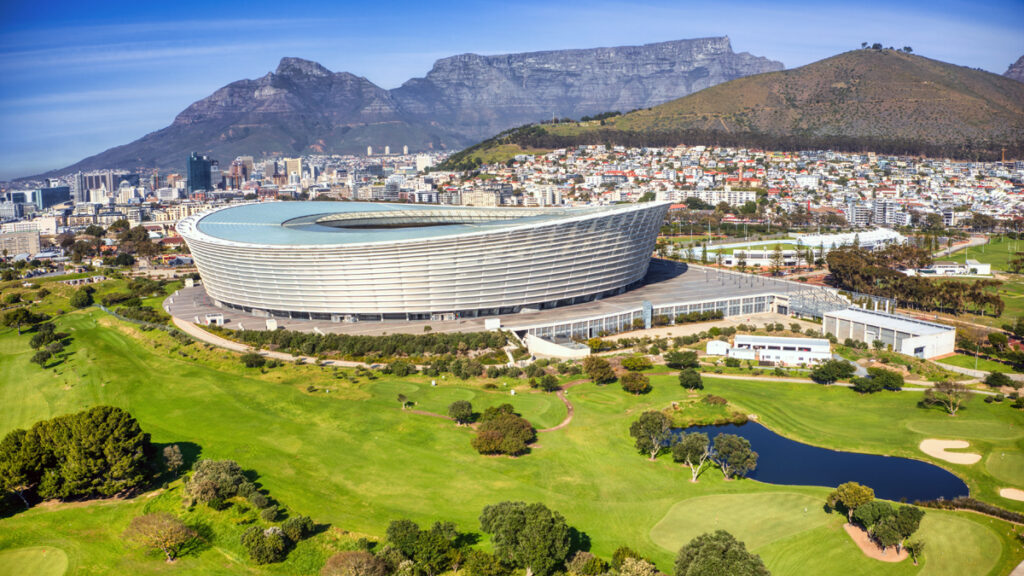
Murray & Roberts has an illustrious history in South Africa, with it being involved in iconic construction projects, such as Sanlam’s head office, the Reserve Bank’s building in Pretoria, Melrose Arch, and Cape Town Stadium.
It has also played a key role in building infrastructure across the country, such as the iconic Bloukrans Bridge and parts of the Gautrain railway system, including the viaduct through Centurion.
Perhaps its most famous building was the Carlton Centre, which was constructed in the late 1960s at the behest of the Oppenheimers and Anglo American.
This building alone represented over a million square feet of construction and could fit over 6,000 employees inside its main office tower.
The project also belied the company’s close ties to the mining industry, with Murray & Roberts being deeply involved in developing the country’s world-renowned mining infrastructure.
These projects were immense in comparison to the company’s humble beginnings as a house-building company in the old Cape Colony by the Murray and Stewart families.
After taking over at the helm of the family business, Douglas Murray co-founded The Roberts Construction Company in 1934 with his friend Douglas Roberts.
Murray and Roberts would soon butt heads over the companies strategy, with a fierce debate over diversifying into construction materials and industry versus expanding into Africa.
Despite this difference in strategy, The Roberts Construction Company flourished and was listed on the JSE in 1951.
Following Murray’s death, Murray & Stewart merged with The Roberts Construction Company to form Murray & Roberts in 1967.
The companies continued to operate as effectively separate businesses owing to their different strategies until 1979.
By this time, the company had become much more industrial in nature and focused heavily on specialised engineering.
After a rapid expansion through a lucrative deal with Sanlam, Murray & Roberts was well-positioned to benefit from the infrastructure expansion planned by South Africa’s new ANC government in the late 1990s and early 2000s.
Over the decade from 2000 to 2010, Murray & Roberts experienced significant growth, with its project order book increasing exponentially to R42 billion and revenues quadrupling to R32 billion.
This period in the company’s history was strongly characterised by the lead-up to the 2010 FIFA World Cup and the infrastructure investment programme launched by the government to prepare South Africa for the event.
It was also a time of global expansion as demand for mining, energy and transport infrastructure increased.
However, this momentum would not be sustained forever, as in the decade following the 2010 World Cup, the South African economy slowed, and infrastructure spending declined.
This put immense pressure on construction companies that were heavily reliant on government tenders for their revenue, with many looking offshore for growth opportunities.
 Loading ...


Comments