South African municipalities spend R1.6 billion on consultants to do their taxes and financial statements


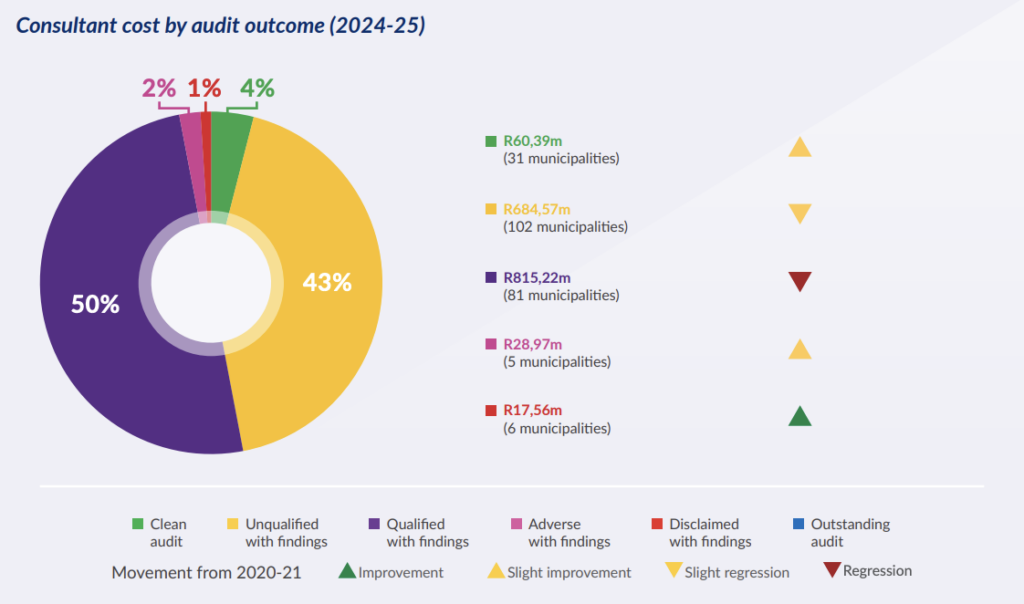
R1.61 billion was spent across 225 of South Africa’s municipalities on external financial reporting consultants during the 2024/25 financial year.
This was revealed in the Auditor-General of South Africa’s (AGSA) most recent Local Government Audit Outcome report.
According to the AGSA, just R590 million was spent on consultants at 179 municipalities only a decade prior, representing an increase of almost 173% in just ten years.
Despite this massive increase, the AGSA reported that 61% of municipalities which made use of outside consultants submitted financial statements with material misstatements.
“Reliance on consultants was most pronounced in the areas of financial statement preparation, asset management and tax-related matters,” the AGSA said.
“Consultant appointments were often recurring and increasingly concentrated among a limited number of service providers across multiple service areas and over successive years.”
53% of municipalities used consultants due to a lack of skills at the municipal level, while 6% used them to fill vacancies. The remaining 41% was due to a combination of both.
Additionally, the AGSA found that 68% of these municipalities had reappointed consultants used in the previous year, indicating a severe lack of skills transfer to municipal staff.
The province which reportedly spent the most on consultants during the 2024/25 financial year was North-West, with almost R417 million spent this way across 22 of its municipalities.
All of the top five municipalities which spent the most on consulting were found in this province, contributing R211 million to the total consultancy spend just by themselves.
Despite this, all five municipalities had material misstatements in the areas for which consultants were hired, with three receiving qualified audit opinions from the AGSA.
“Despite widespread and considerable municipal spending on consultants, there has been little improvement in financial statement quality and consultant effectiveness over the past decade,” the AGSA said.
“The same governance gaps continued over the administration, especially weak skills transfer, showing that the use of consultants is still not being managed strategically.”
Skills shortages a growing problem at municipalities
The growing over-reliance on financial consultants at South Africa’s municipalities has raised significant concerns about municipal skills shortages and municipal financial mismanagement.
The subsequent inability of many of these municipalities to report substantial improvements, even after hiring outside consultants, further exacerbates these anxieties.
Governance expert Hlumelo Xaba told SABC News that non-compliance by municipal financial officers was likely to be a major factor in the increased reliance on consultants.
“According to the Municipal Financial Management Act, there are provisions that are made for the procurement of financial consultants,” Xaba said. “Chapter 11 does stipulate that.”
“I think it’s a matter of a lack of compliance by accounting officers in municipalities that leads to the municipalities outsourcing financial consultants.”
Appearing alongside Xaba, University of the Free State research fellow Dr Harlan Cloete pointed to the growing skills gap at many of South Africa’s municipalities.
Cloete explained that under the Skills Development Act, municipalities are required to submit skills development plans to their local Sector Education and Training Authority (SETA) every year.
Yet in the 28 years since the act was passed, Cloete said research had pointed to a severe lack of proper management and compliance with regard to this skills development.
“Managers simply do not accept this responsibility,” Cloete said. “They dump everything on HR, and that is the problem. We’ve got progressive legislation in the Skills Development Act.”
“Municipalities submit these work skills plans, but the return on investment on these plans is poor. Managers are not managing the development of people in municipalities, which leads to an over-reliance.”
The professionalisation of the public service has been consistently touted in State of the Nation addresses as one of the primary goals of Cyril Ramaphosa’s tenure as President.
Yet since Ramaphosa first took office in 2018, Xaba said little had been done in the way of practical implementation to achieve this goal and address issues such as the growing skills shortage at the local government level.






Comments