Johannesburg’s collapse can take South Africa down with it


Johannesburg’s importance as South Africa’s economic powerhouse means failures in the city are felt across the country.
Underperformance in Johannesburg transmits directly into national economic growth, South Africa’s sovereign risk perception, and the operating environment for local businesses.
This was explained by the Bureau for Economic Research’s Vuyo Gama, who outlined how important Johannesburg’s recovery is for South Africa as a whole.
“When Johannesburg underperforms, the cost is national,” Gama said, pointing out that the city is the single largest contributor to South Africa’s GDP.
Johannesburg produces 16% of the national GDP and is the country’s most populous metro, with 4.8 million residents.
These residents are spread across 1.84 million households, placing an enormous burden on service delivery in the city.
Despite being an economic heavyweight, Johannesburg has underperformed and struggled with governance and fiscal issues for years.
The city’s slow collapse has not been aided by instability at the top of its leadership, with Johannesburg having had 11 mayors since 2016.
“Since 2016, the mayoralty has turned over via elections, resignations, deaths, motions of no confidence, court reversals, and coalition realignment,” Gama said.
“Executive instability disrupts budget cycles, senior appointments, oversight and the multi-year planning horizons that capital programmes depend on – a direct input into governance credibility and counterparty risk.”
This instability at the top can clearly be seen in Johannesburg’s fiscal health, with the city having come under severe financial pressure in recent years.
Johannesburg’s current leadership faces an infrastructure backlog of R220 billion, and is owed R57 billion from consumers.
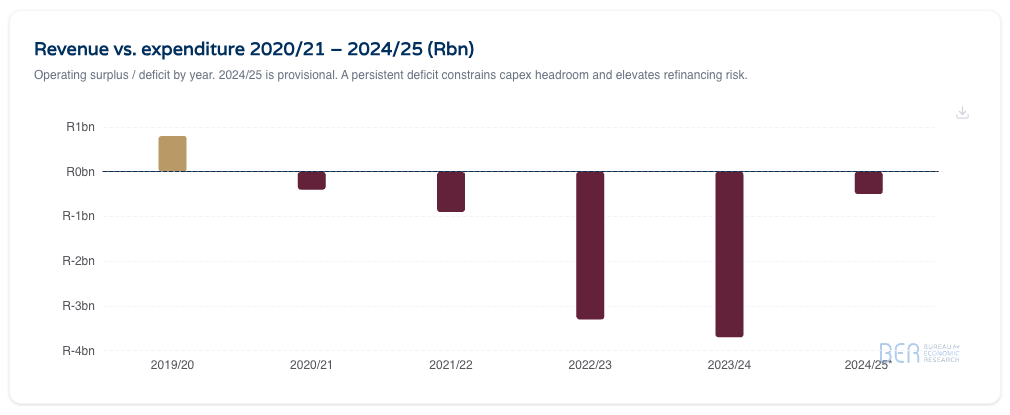
It has an operating deficit of R3.7 billion, and has posted deficits every year since 2020/21, excluding a provisional 2024/25 estimate.
Gama attributed this to Johannesburg’s revenue having been structurally undermined by declining electricity income, as an increasing number of households have opted to install solar.
On top of this, the city faces a billing system crisis, non-payment culture, and an ageing metering infrastructure.
These issues recently came to a head when the National Treasury formally warned that the city tabled an “unfunded budget” for 2025/26, overestimating revenues and underestimating expenditure.
Johannesburg collapsing for all to see
According to Gama, one issue Johannesburg faces is that most of every rand in the city’s budget is committed before service is even delivered.
This is because salaries, bulk electricity, bulk water, and debt service costs consume the majority of Johannesburg’s operating revenue.
“The residual available for maintenance, capex and discretionary service improvement is structurally thin – and shrinking as collection rates deteriorate,” she said.
Gama illustrated this problem by explaining that, if Johannesburg had R100, it would be divided as follows:
- R29 would go towards bulk suppliers like Eskom and Rand Water
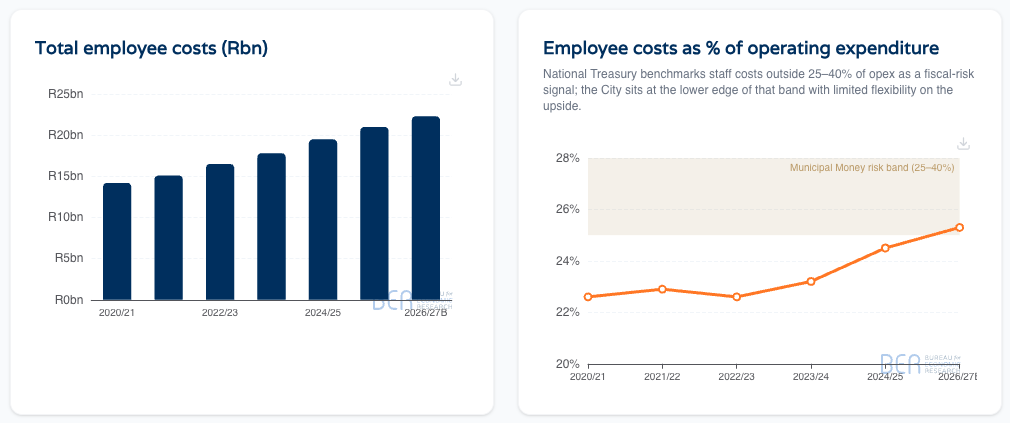
- R25 would cover employee costs
- R20 is consumed by debt, depreciation, and finance charges
- R9 goes towards capital investment
- R7 is committed to other operating costs
- R7 is for contracted services
In other words, R97 of that R100 is already committed, before Johannesburg has even delivered services.
Gama explained that this rigid cost base limits the city’s operating budget’s capacity to absorb shocks. In Johannesburg, one particularly rigid cost is employee compensation.
“Employee costs are the single largest line in the operating budget – roughly 25 cents of every rand spent in 2025/26,” she said.
“When collection rates weaken, and bulk-purchase inflation rises, that rigidity translates directly into deferred maintenance, capex underspend and audit-visible overruns.”
This essentially means the city’s capex budget is being squeezed, resulting in deteriorating infrastructure and service delivery.
Gama said Johannesburg’s consistent capex underspend is the most reliable forward indicator of service collapse.
“Approved capital budgets are systematically under-executed. When operating cash tightens, capex is informally repurposed as a liquidity buffer,” she said.
While this allows Johannesburg to preserve short-term payments, it compounds asset-condition risk on water, electricity, and road networks.
“Despite facing a R220+ billion infrastructure backlog, the city consistently fails to spend the money it does allocate for capital works – the very expenditure that could begin to arrest deterioration,” she said.





Comments