The tiny Western Cape town with a special zone cut off from the government


The Atlantis Special Economic Zone (ASEZ) is the only green-focused manufacturing hub in Africa, with it providing a template for economic development without reliance on government services.
This hub aims to be completely self-sufficient, with it generating its own renewable energy, being a net-zero water consumer, and producing little to no landfill waste.
Located in the small town of Atlantis, north of Cape Town, the ASEZ has been singled out for praise from the African Development Bank (AfDB).
In its latest Africa Industrialisation Index, the AfDB highlighted the role special economic zones can play in developing local economies.
South Africa is one of the few African countries with a long-standing, well-structured special economic zone programme.
A special economic zone is a designated area that is set aside for specific economic activities and operates under a set of economic, regulatory, and fiscal rules that are more business-friendly than the rest of the country.
Governments tend to use these zones as policy tools to overcome national infrastructure gaps or bureaucratic hurdles and drive faster economic growth.
The typical incentives applied to South African zones include tax relief in the form of reduced corporate income taxes, duty-free imports of raw materials, employment subsidies, and purpose-built infrastructure.
South Africa has special economic zones around the country, with the largest being located in Coega in the Eastern Cape. This zone focuses on automotive manufacturing and agro-processing.
This is one of twelve such areas, with all provinces apart from the North-West Province having a special economic zone. Gauteng leads the way with three across its major hubs.
However, only one looks to be completely cut off from the state, with the ASEZ being Africa’s first green-focused SEZ.
The AfDB said the ASEZ particularly focuses on attracting low-carbon, resource-efficient, and socially inclusive investments.
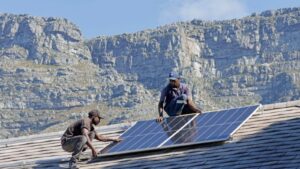
Targeted sectors include renewable energy production (e.g., wind turbines and solar panels), biofuels, e-mobility, green building materials, recycling, and waste management, among others.
In addition to its sectoral focus on the green economy, ASEZ also aims to be environmentally and socially sustainable in its development and operations.
This includes generating its own renewable energy, being a net-zero water consumer, producing little to no landfill waste, and operating in harmony with nature and the environment.
Atlantis revival

The ASEZ is part of plans to revive Atlantis, which has suffered a prolonged economic decline since the 1980s, as manufacturing shifted out of the town.
Formed in the 1970s for the Coloured population of Cape Town under the apartheid-era of the Group Areas Act, the area was to become a “model industrial node”.
To make the town viable and serve as an example of what could be done elsewhere, the government of the day pumped money into Atlantis to make it attractive to manufacturers.
This included the construction of bulk infrastructure, offers of significant tax breaks, cheap land, and relocation grants to businesses.
The plan initially worked, with over 100 manufacturing companies moving to Atlantis in the 1980s. These companies employed thousands of people across engine manufacturing and electronics.
This saw Atlantis become a destination for South Africans moving to find work. Only, the town was never sustainable as it was built on subsidies from the state.
Once these subsidies and incentives were halted by the government in the 1990s, the town collapsed into a severe economic depression.
Lacking trade protections and financial cushions, factories closed throughout Atlantis. Without the incentives and subsidies, the town was uncompetitive with other hubs in South Africa and, more importantly, with Asian exporters.
This ended up with Atlantis becoming a ghost town, with thousands of people becoming unemployed and those who did have jobs spent much of their salaries on commuting to Cape Town.
The government began making plans to try to revive Atlantis. However, it was clear that heavy industry was not going to work again.
Instead, given its abundant renewable energy sources, the government focused on making Atlantis a hub for manufacturing components used to in wind turbines and solar panels.
Atlantis was designated a Greentech Hub in 2011 and attracted significant investment from private companies.
Today, most of the companies operate within the ASEZ, which is managed by its own state-owned provincial entity.
Images of ASEZ




Comments