One of South Africa’s oldest towns getting a huge new private school


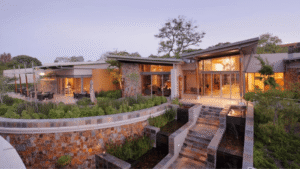
Lydenburg, now known as Mashishing, is set to get a new private school in the coming years, with dhk Architects having designed a school for the town.
This marks the latest addition to dhk’s education portfolio, which includes the University of Cape Town’s chemical engineering department, Bishops’ learning centre, Parklands College, and Battery Park.
The project could also mark a significant step in the revival of the town of 37,000 people, with its historic industries of gold mining and trade fading.
“Our education portfolio continues to grow steadily, from university campus buildings to schools,” dhk Architects said in a social media post.
“These projects incorporate spaces that facilitate progressive teaching techniques and philosophies.”
While short on detail, the firm said that it has designed a new private school in Mashishing, Mpumalanga, as part of the expansion of its education portfolio.
“The school, designed for Thanbeng Developers, accommodates learners from pre-primary to Grade 12,” dhk said.
“The masterplan for the new campus comprises a series of classroom buildings around courtyards linked with a series of shared cultural and technology hubs which are anchored back to an admin building and grand hall.”
The masterplan also features sports facilities, accommodates future phases, and identifies opportunities for expansion, and is set to play a prominent role in the town.
Mashishing’s new school will mark only the second full-school development for dhk Architects after Parklands College in 2019.
The school is likely to feature prominently as a sign of the town’s renewal, with Seeff’s Anna-Marie de Jager explaining that demand for property in the town has grown in recent years.
De Jager said most of the town’s houses sell for between R800,000 and R1.6 million. Homes in estates or near schools can sell for over R2.3 million.
The town is looking to repair its image after years of maladministration, police corruption, and allegations of authorities being involved in criminal activity.
Mashishing

Mashishing is one of the oldest consistently inhabited towns in the north of South Africa, being founded in 1849 by a group of Voortrekkers under Andries Potgieter.
The character of the town has changed greatly over the years, with it experiencing periods of significant growth followed by sustained declines.
Lydenburg, as it was named then, gets its name from the Dutch Lijdenburg, meaning “Town of Suffering”, and is reflective of the experiences of the settlers who moved to the area following a malaria outbreak at their earlier settlement.
The town’s importance grew rapidly in the late 1800s, with it being vital for the Afrikaners’ access to the sea at Delagoa Bay, now Maputo.
This route was critical to the Boer republics, as it enabled them to trade with the rest of the world without British involvement.
However, as with many towns in the northern part of South Africa, its real growth came with the discovery of gold in 1873.
The town surged in population and scale, with thousands of people coming to try their luck on the gold fields. However, the industry’s growth was stifled by conflict between the Afrikaners and the British towards the end of the 1800s.
Lydenburg’s importance steadily dwindled as South Africa became a unified state, with its important link to the sea losing prominence as the route to Durban was far more economical.
It gradually became known for its fly-fishing industry and an agricultural hub, with tourism also growing strongly throughout the 20th century.
The town’s fortunes would see some revival with the rapid growth of chrome mining in the area, with it being located close to ferrochrome smelters.
Driven by South Africa’s abundant and cheap electricity in the 1990s and 2000s, mining giants set up smelters in Mpumalanga to process some of the country’s minerals locally.
These smelters have become incredibly important for employment and economic activity in the region, as they provide high-paying jobs and bring skilled workers into towns nearby.
This significant change in the town’s economic character was coupled with a name change in 2006 to Mashishing, meaning “long green grass”.
However, these smelters have come under immense financial pressure in recent years as Eskom’s electricity prices surge.
This undermines the initial benefit of having smelters in South Africa, with it becoming cheaper to export raw materials to Asia and import finished goods.
More than a dozen smelters have shut down in South Africa in recent years, leading to thousands of job losses, largely due to high electricity costs, which have surged by more than 900% since 2008.
Eskom has received Nersa’s approval for a tariff reduction for Samancor Chrome as well as a joint venture between Glencore and Merafe Resources in a bid to avert smelter closures and save jobs.
Samancor Chrome and the Glencore-Merafe joint venture started processes late last year to shut down their smelters and lay off workers, citing viability problems mainly related to high electricity costs.
This provides some hope for small towns like Mashishing, which rely heavily on the mining industry and smelters for economic activity.
dhk’s renders of the school






Comments