One South African company too big to fail


Transnet’s collapse is simply not an option for South Africa, with the company essentially too big to fail.
While government efforts to save the utility are gaining speed, progress is slow, and Transnet’s continued reliance on taxpayer-funded bailouts presents a notable fiscal risk.
This is why the government is tapping private sector capital and expertise as a critical part of Transnet’s turnaround, which some consider a form of “back-door privatisation”.
In a recent research note, Bank of America analyst Tatonga Rusike explained that Transnet is key to South Africa’s logistics sector reforms, adding that the company is “too big to fail”.
This explains the government’s intensive efforts in recent years to turn the utility around, as failure to do so could present a major risk to the economy.
Transnet has been implementing an approved recovery plan since October 2023, which is seeking to undo years of mismanagement, corruption, collapsing infrastructure, and financial strife. It was previously estimated that Transnet’s failures cost the economy around R1 billion a day.
The utility’s collapse culminated at the end of 2023 when Transnet’s board underwent a massive overhaul.
CEO Portia Derby and CFO Nonkululeko Dlamini resigned in September 2023 following pressure from business lobby groups, mining companies, and unions.
Current CEO Michelle Phillips was brought in shortly after, tasked with turning the struggling utility around.
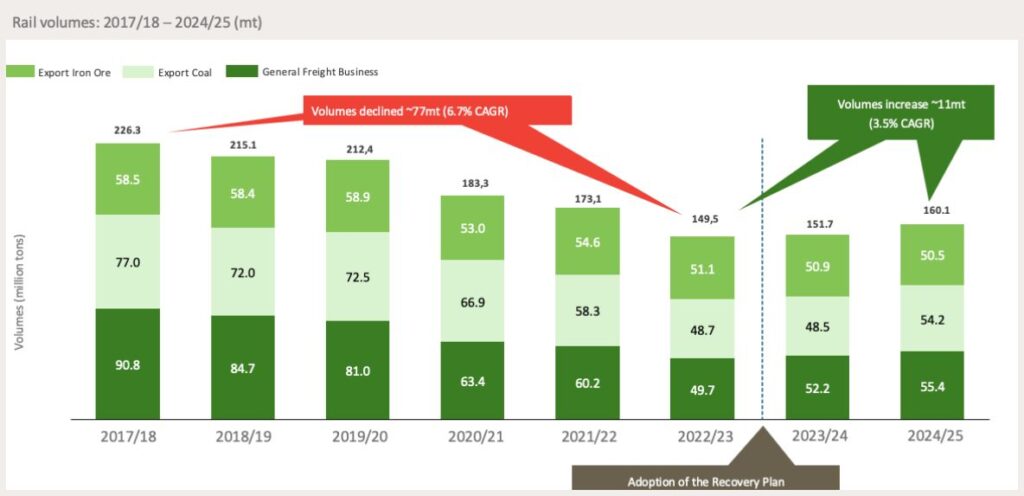
So far, Phillips and her team’s efforts have borne fruit, with Transnet’s performance having improved significantly over the past year.
The utility has managed to reduce the handling time of cargo at its ports and increase its rail tonnage.
The most significant reform progress so far was opening the door for private players to use and operate some of its infrastructure.
Transnet released a Network Statement in December 2024, which, for the first time, will enable private rail operators to access the freight rail system, with the goal of enhancing efficiency and increasing investment in new equipment and machinery.
Privatised through the back door
President Cyril Ramaphosa praised this move in his State of the Nation Address, delivered on 12 February 2026.
“Open access to the rail network will allow train operating companies to increase the volume of goods transported by rail, while our network infrastructure remains state-owned,” he said.
“This will ensure that South African minerals, vehicles and agricultural produce reach international markets, securing jobs and earning much-needed revenue for our fiscus.”
Efficient Group chief economist Dawie Roodt has described this as “backdoor privatisation”, saying the government is effectively privatising many state assets, including electricity generation and parts of the logistics sector.
This results in private companies providing services once performed solely by the state-owned enterprise, with the public company relegated to being a competitor like any other.
However, some experts have voiced their concerns regarding the current “hybrid privatisation” approach.
For example, the Centre for Risk Analysis (CRA) has warned that Transnet’s approach, where private companies can compete with Transnet, while the infrastructure remains under the state’s control and not in a free market, could cause problems.
In practice, this approach could mean that Transnet – and in turn, the state – remains the entity that makes the ultimate decisions about capital allocation and who receives which rail slots.
This keeps the door open for inefficiency, political patronage and corruption – the same problems that landed Transnet in this situation in the first place.
In addition, it could discourage private players from investing, as they know the playing field will not be equal.
Bailouts and tough love

Transnet’s “too big to fail” status is a double-edged sword – South Africa’s government cannot afford to let the utility collapse, but it also cannot afford to support it in perpetuity.
While this incentivises urgent reform to ensure the utility’s survival, it also means Transnet is likely to continue receiving state support if it cannot successfully implement a rapid turnaround, presenting a notable fiscal risk.
Rusike pointed out that the state-owned company has already used up a government guarantee of R47 billion granted in December 2023, and received R51 billion of new guarantees in May 2025.
On top of this, it has also requested a R30 billion cash injection in the 2025/26 fiscal year.
Finance Minister Enoch Godongwana has taken a ‘tough love’ stance towards state-owned enterprises, saying there will be no new fiscal transfers to Transnet in the current year.
However, if Transnet cannot improve its operations and finances, allowing it to stand on its own two feet, the government will likely step in to prevent a total collapse.
This has far-reaching consequences for South Africa, with rating agency S&P Global highlighting Transnet’s dependence on state support as a risk to any future positive rating actions.
“In our view, the cash flow deficit leaves Transnet with limited capacity to service its debt (principal and interest) on a stand-alone basis and materially constrains any deleveraging prospects over the next two years,” the firm said in November 2025.
“Consequently, we expect the company to remain dependent on government support, primarily through guarantees, to address its refinancing requirements.”
Despite the fiscal risk this poses, S&P also acknowledged that Transnet is “too big to fail”, with an essential monopoly over all of South Africa’s major logistics infrastructure.
“Notwithstanding the challenges facing Transnet, we think the company plays an instrumental role in South Africa’s transport industry and, by extension, its economic growth, thanks to its control of all major logistics infrastructure,” it said.
“Transnet also has a dominant position in rail freight, and monopoly positions in regulated port and pipeline activities.”





Comments