The small African island whose citizens are nearly twice as rich as South Africans


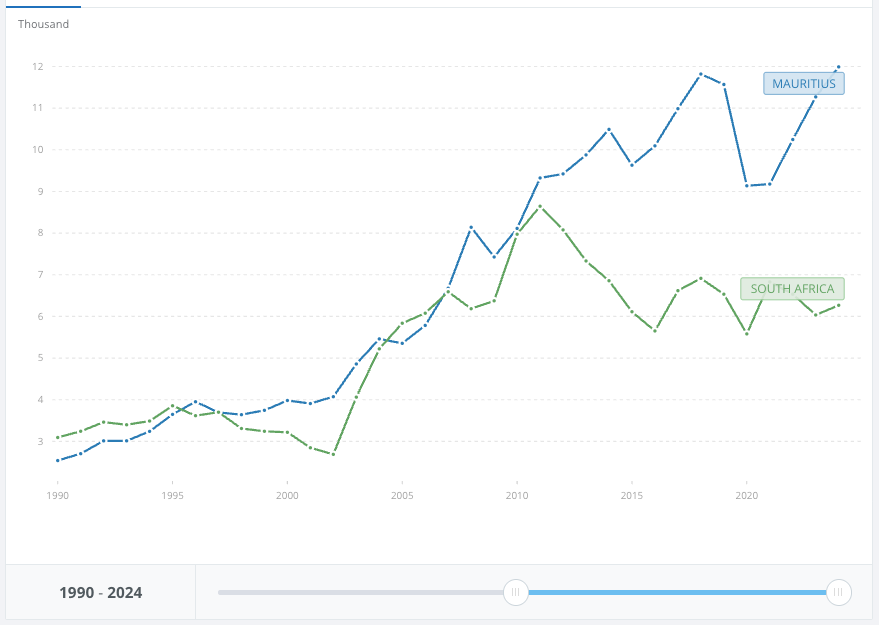
Since 2010, Mauritius’ GDP per capita has far outpaced South Africa’s, with the average Mauritian now almost twice as rich as the average South African.
While the two nations had comparable GDP per capita figures in the 1990s and 2000s, Mauritius has now completely overtaken South Africa on this metric.
This is despite South Africa having a far larger economy than Mauritius, yet the island nation continues to attract increasing investment and businesses, while South Africa has remained largely stagnant.
Based on World Bank data, Mauritius’ GDP per capita surged from $2,539.90 in 1990 to $11,990.80 in 2024, a 372.1% increase.
Over the same period, South Africa went from $3,093.50 to $6,267.20, a 102.6% increase – significantly slower growth than Mauritius.
This is despite the two countries’ having had comparable GDP per capita figures throughout the 1990s and 2000s.
At the start of the 2010s, South Africa and Mauritius’ GDP per capita figures started to diverge, with the island nation now far above South Africa.
Mauritius’ prosperity over the past few decades has been attributed to its status as an appealing investment and business hub.
The country’s business-friendly tax rates and regulations have made Mauritius one of the most attractive destinations for foreign professionals, investors, self-employed individuals and retirees.
According to Henley & Partners’ Africa Wealth Report for 2025, Mauritius now boasts 4,800 dollar millionaires and 14 centi-millionaires.
This means Mauritius has seen its number of millionaires grow by 63% between 2015 and 2025, making it one of the fastest-growing countries in Africa.
According to the report, Mauritius is now the sixth wealthiest country in Africa, driven largely by its political stability, tax efficiency, and a robust residence-by-investment program.
Over the same period, South Africa’s number of millionaires has declined by 6%, with wealthy South Africans increasingly looking for more tax-friendly destinations like Mauritius.
The divergence in GDP per capita between South Africa and Mauritius between 1990 and 2024 can be seen in the graph below, courtesy of the World Bank.
South Africa fell behind
Mauritius is just one example out of many that are outpacing South Africa following decades of economic decline and policy missteps.
Many of South Africa’s emerging market peers have outpaced the country in terms of economic growth in the past decade.
Since 2015, South Africa’s economy has averaged a muted annual growth rate of 1.1%, while its other emerging market peers have grown at 4.5% per annum.
As a result, they have effectively caught up with and, in some cases, overtaken South Africa.
This is concerning, as it means South Africa is losing out on significant investment, with many investors preferring to invest in countries with stronger, more sustainable growth.
Even South African companies have taken note of this, with major corporates like Standard Bank, for example, starting offshore offerings in countries like Mauritius.
In launching this offering in 2025, Tunde Macaulay, head of Africa regions for Standard Bank business banking, explained that Mauritius’s stable macroeconomic environment stands in contrast to Africa’s present macroeconomic challenges.
“Significant currency devaluations, inflationary pressures and liquidity challenges have been experienced in several sub-Saharan countries, negatively affecting the operations of our clients in a range of sectors,” he said.
“For African businesses, Mauritius is, therefore, a place for protecting wealth and working capital against the present challenges being faced in some African markets.”
Efficient Group chief economist Dawie Roodt previously estimated that if South Africa had grown at the same rate as its emerging market peers over the last decade, the country’s GDP per capita would have been 40% higher than it is now.




Comments